
How to Sell to Target: A Vendor’s Complete Guide
Last Updated: Mar 23, 2026
Everything brands need to know about becoming a Target vendor—from the supplier intake form to Partners Online, EDI setup, compliance requirements, chargebacks, and Target Plus marketplace. Built for D2C brands and first-time retail vendors.
This guide contains AI-generated content based on publicly available information and general industry knowledge. Always verify requirements directly with Target.
In This Guide
What It’s Really Like to Sell to Target
How to sell to Target is one of the most searched questions by consumer brands ready to make the leap from direct-to-consumer into brick-and-mortar retail. And for good reason—Target operates nearly 2,000 stores across the United States, generates roughly $107 billion in annual revenue, and has earned a reputation as the retailer that genuinely embraces emerging brands.
Target’s “test and learn” approach means they actively look for differentiated products with strong brand stories, clean packaging, and proven demand. Unlike some retailers that only work with massive CPG companies, Target has a history of launching smaller brands and scaling them from a handful of test stores to nationwide distribution. That’s the exciting part.
The hard part is everything that comes after the buyer says yes. Target has a rigorous vendor compliance program, strict shipping and labeling requirements, an EDI system that trips up first-time vendors, and a chargeback program that can eat your margins if you’re not prepared. This guide covers the entire journey—from getting Target’s attention to surviving your first scorecard review.
Target at a Glance
- ●Stores: ~2,000 locations across all 50 states
- ●Revenue: ~$107 billion annually
- ●Vendor programs: In-store vendor, Target Plus (online marketplace)
- ●Vendor portal: Partners Online (POL)
- ●Known for: Design-forward merchandising, test-and-learn culture, strong owned brands
The Target-specific data in this guide is based on publicly available retailer compliance information. This content is for general educational purposes—always verify current requirements directly with your Target buyer or through Partners Online.
Target’s Vendor Programs: In-Store vs. Target Plus
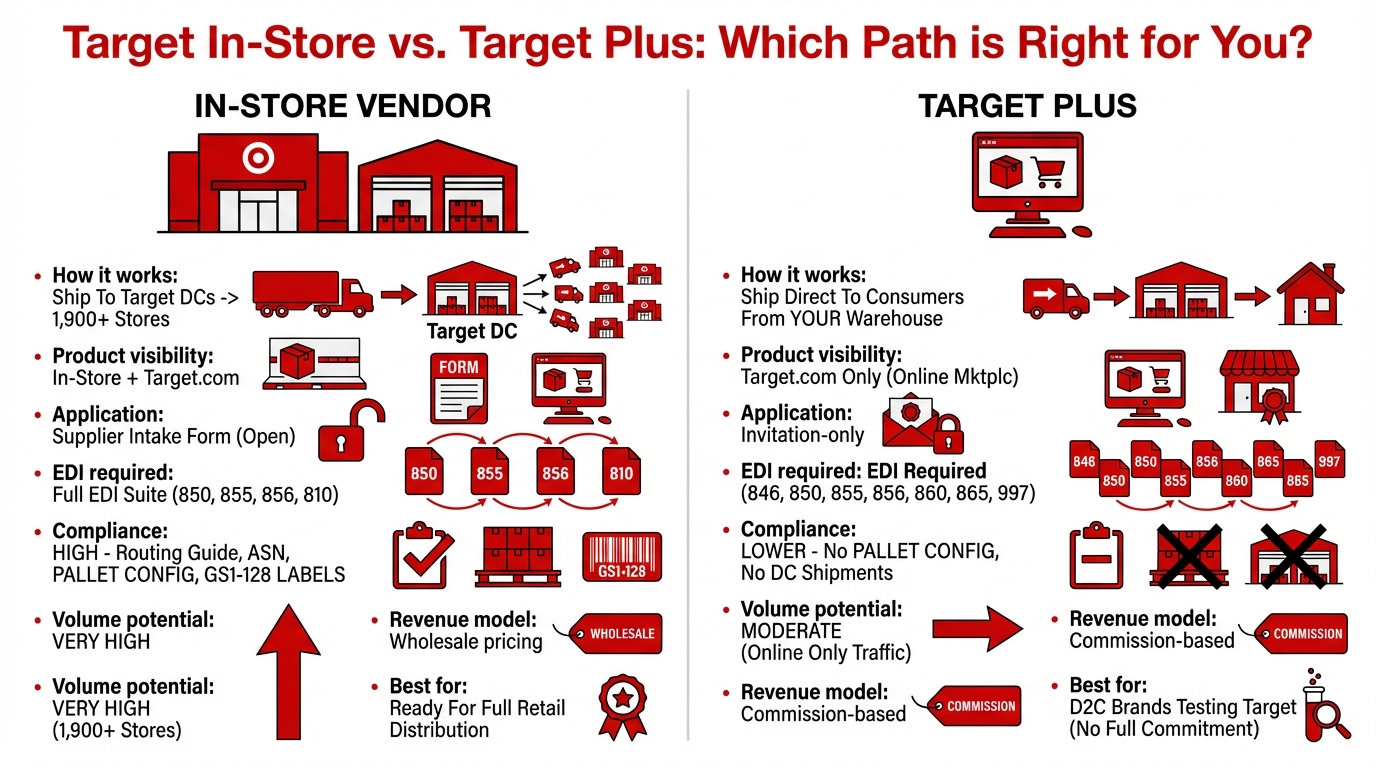
Before applying, understand which program fits your brand. Target has two distinct paths for vendors, each with different fulfillment models, compliance requirements, and margin structures.
| Criteria | In-Store Vendor | Target Plus (Marketplace) |
|---|---|---|
| How it works | You ship to Target distribution centers; Target handles store fulfillment | You ship directly to consumers from your own warehouse |
| Product visibility | In-store shelves + Target.com | Target.com only |
| Application | Supplier intake form on corporate.target.com | Invitation-only marketplace |
| EDI required | Yes — full EDI suite (850, 855, 856, 810, 846, etc.) | Yes — EDI 846, 850, 855, 856, 860, 865, 997 |
| Compliance burden | High — routing guide, ASN, pallet config, labeling | Lower — no pallet configuration or DC shipments |
| Volume potential | Very high — ~2,000 stores | Moderate — online-only traffic |
| Best for | Brands ready for full retail distribution | Brands testing Target before committing to in-store |
Target’s Owned Brands
Target operates over 45 owned brands, including Cat & Jack, Good & Gather, Threshold, and Hearth & Hand. These brands occupy significant shelf space across categories. Before pitching, research whether Target has an owned brand in your category—you’ll need to clearly articulate how your product complements (rather than competes with) their private label offering.
The good news: Target’s buyers actively seek differentiated national brands that drive incremental sales beyond what their owned brands capture. If your product serves a niche their private label doesn’t cover, that’s a strong positioning angle.
How to Apply: The Target Supplier Intake Process
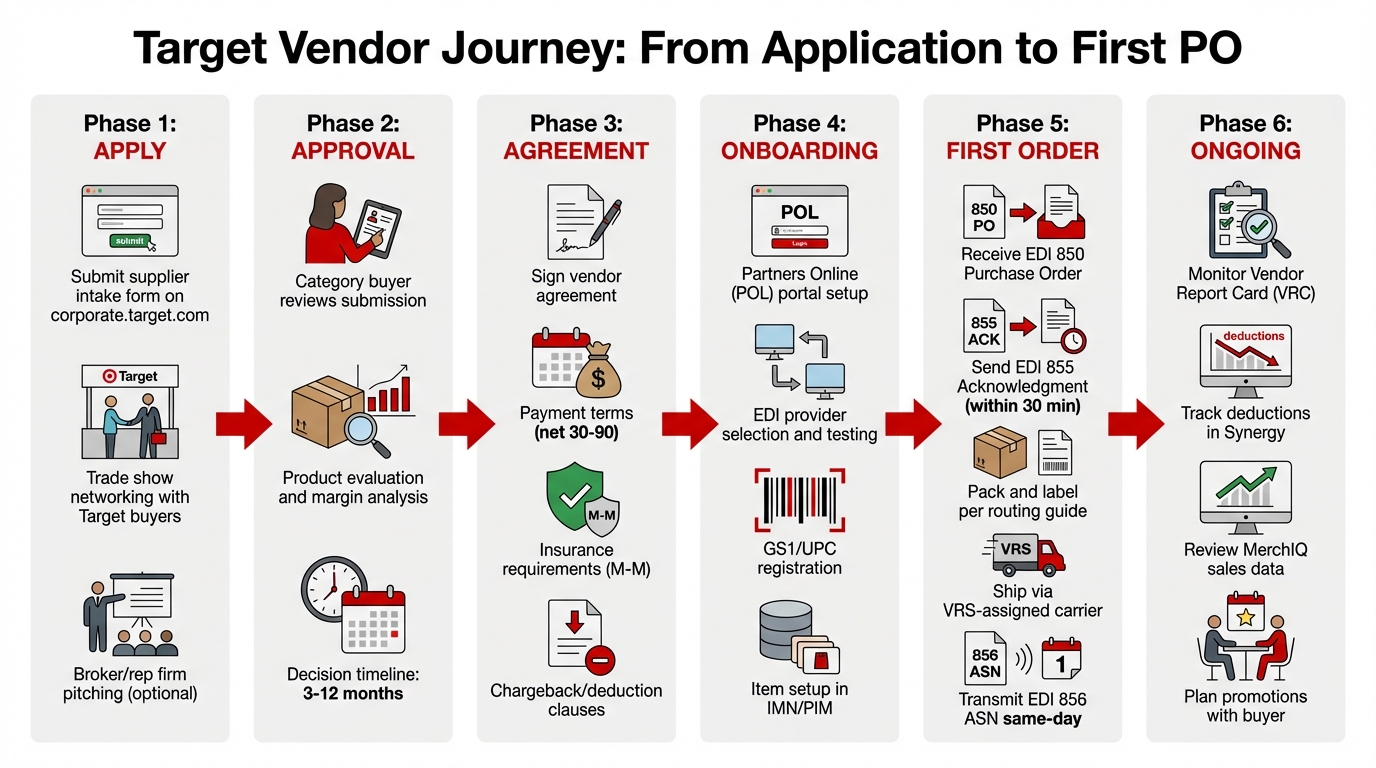
Target uses a centralized supplier intake process through their corporate website. There is no shortcut—even if you meet a buyer at a trade show, you’ll still need to complete the formal application.
Step 1: Submit the Supplier Intake Form
Visit the Suppliers section on corporate.target.com and complete the intake form. You’ll provide basic company information, product descriptions, and category details. Target’s sourcing team reviews submissions and routes qualifying ones to the appropriate category buyer.
Step 2: What Target Looks For
Target buyers evaluate vendors on four primary criteria:
- ●Brand differentiation: What makes your product unique? Strong brand identity, design-forward packaging, and a compelling origin story matter at Target more than most retailers.
- ●Market demand: Proven sell-through data from your D2C channel, Amazon, or other retailers. Buyers want evidence that consumers already want your product.
- ●Margin structure: Can you maintain healthy margins at wholesale pricing while hitting Target’s retail price point for the category? See our wholesale pricing guide for margin benchmarks.
- ●Supply chain readiness: Can you scale production, maintain consistent quality, and meet delivery schedules? First-time vendors often underestimate this requirement.
Step 3: Trade Shows & Buyer Meetings
The intake form is the formal path, but trade shows offer a way to build relationships with buyers before or after submitting. Target buyers attend ECRM sessions, Natural Products Expo West, Toy Fair, and category-specific industry shows. A face-to-face pitch that complements your intake submission can accelerate the review process.
Step 4: Broker or Rep Firms
Some brands hire a broker or sales representative to pitch Target on their behalf. Brokers who specialize in Target know the buyers, understand category dynamics, and can navigate the review process more efficiently. The tradeoff is their commission (typically 3–7% of sales). For first-time retail vendors without existing buyer relationships, a broker can be worth the cost.
The Target Vendor Agreement: Key Terms to Understand
Once Target decides to bring your product in, you’ll sign a vendor agreement. This is a legally binding contract that governs your entire relationship with Target. Here are the terms first-time vendors need to understand before signing.
| Term | What It Means | Watch Out For |
|---|---|---|
| Payment terms | When Target pays you after delivery (typically net 60–90) | Net 60–90 means you finance inventory for months before seeing cash |
| Chargeback clauses | Penalties deducted from payments for compliance violations | Target calls these “deductions”—see the chargebacks section below |
| Markdown allowances | You may be required to share the cost of markdowns or clearance pricing | Can significantly reduce your effective margin on slow-moving inventory |
| Return policy | Target’s ability to return unsold or defective product to you | RTV (Return to Vendor) deductions can appear without warning |
| Insurance requirements | Product liability and general liability coverage | Minimums vary by category (can be $2M–$5M+); Target must be named as additional insured |
| Routing guide compliance | Contractual obligation to follow Target’s shipping and labeling rules | Violations trigger chargebacks; see our routing guide explainer |
The vendor agreement is largely non-negotiable for small and mid-size brands. Target negotiates with major CPG companies, but if you’re a first-time vendor, expect to accept standard terms. The key is understanding what you’re agreeing to so you can build the costs into your pricing model upfront. Read our retail chargebacks guide to understand the financial impact of compliance failures.
Vendor Onboarding at Target
Once the agreement is signed, onboarding begins. This is where most first-time vendors feel overwhelmed—there are multiple portals, systems, and data requirements to set up before you can receive your first purchase order.
Partners Online (POL) Portal
Partners Online is Target’s central vendor portal. Think of it as your command center for everything Target-related. You’ll use it for order management, performance reporting, compliance tracking, and communication with Target’s merchant team.
| Application | What It Does |
|---|---|
| Partners Online (POL) | Central hub for all vendor content and applications |
| VMM (Vendor Management and Maintenance) | Account setup and capabilities management |
| IMN & PIM | Item setup and maintenance (product data, images, descriptions) |
| EDI Portal | EDI setup, testing, and transaction monitoring |
| EVD (Electronic Vendor Documentation) | Real-time order view and shipment validation |
| Vendor Report Card (VRC) | Fulfillment performance reporting and scorecards |
| MerchIQ | Sales analytics and merchandising performance data |
EDI Setup
Target requires Electronic Data Interchange (EDI) for all vendor transactions. This is one of the biggest surprises for D2C brands—you can’t process Target orders via email or a Shopify dashboard. EDI is a structured electronic communication system that automates purchase orders, invoices, and shipment notifications.
Target requires several EDI transaction sets including:
- ●EDI 850 — Purchase Order (incoming from Target)
- ●EDI 855 — Order Acknowledgment (you confirm receipt within 30 minutes)
- ●EDI 856 — Advance Shipment Notification (ASN) sent same-day when shipping
- ●EDI 846 — Daily inventory feed
- ●EDI 860 — Purchase Order Change Request (including cancellations)
- ●EDI 997 — Functional Acknowledgment
You’ll need an EDI provider (SPS Commerce, TrueCommerce, and DiCentral are popular for Target vendors). Expect to spend $200–$500/month for a full EDI setup with a mid-tier provider. Target requires a testing phase before you go live—your EDI mappings must match Target’s specifications exactly, and you must demonstrate proper handling of duplicate transmissions (deduplication by PO number).
Item Setup Requirements
Before your product can appear in Target’s system, you need to complete item setup in IMN/PIM with the following required attributes:
- ●Product title (150 characters max)
- ●Images: 2–5 images, minimum 1000×1000 px (2400×2400 preferred), RGB, JPG/PNG/TIF format
- ●Feature bullets: At least 2 bullets, each over 20 words
- ●Long copy: Minimum 50 words for product description
- ●UPC/EAN barcode registered with GS1
- ●Size charts (required for all items with size variations)
- ●Prop 65 compliance information (if applicable)
You’ll also need subtype and item-type approvals from your Category Manager in POL before submitting items. Items can be stand-alone (unique products) or variation items (with size, color, or size & color variants).
Overwhelmed by Target’s onboarding?
RetailerHub’s Compliance IQ answers any Target compliance question instantly. Ask about EDI setup, labeling requirements, or packaging specs—get answers in seconds instead of digging through documentation.
Target’s Compliance Requirements
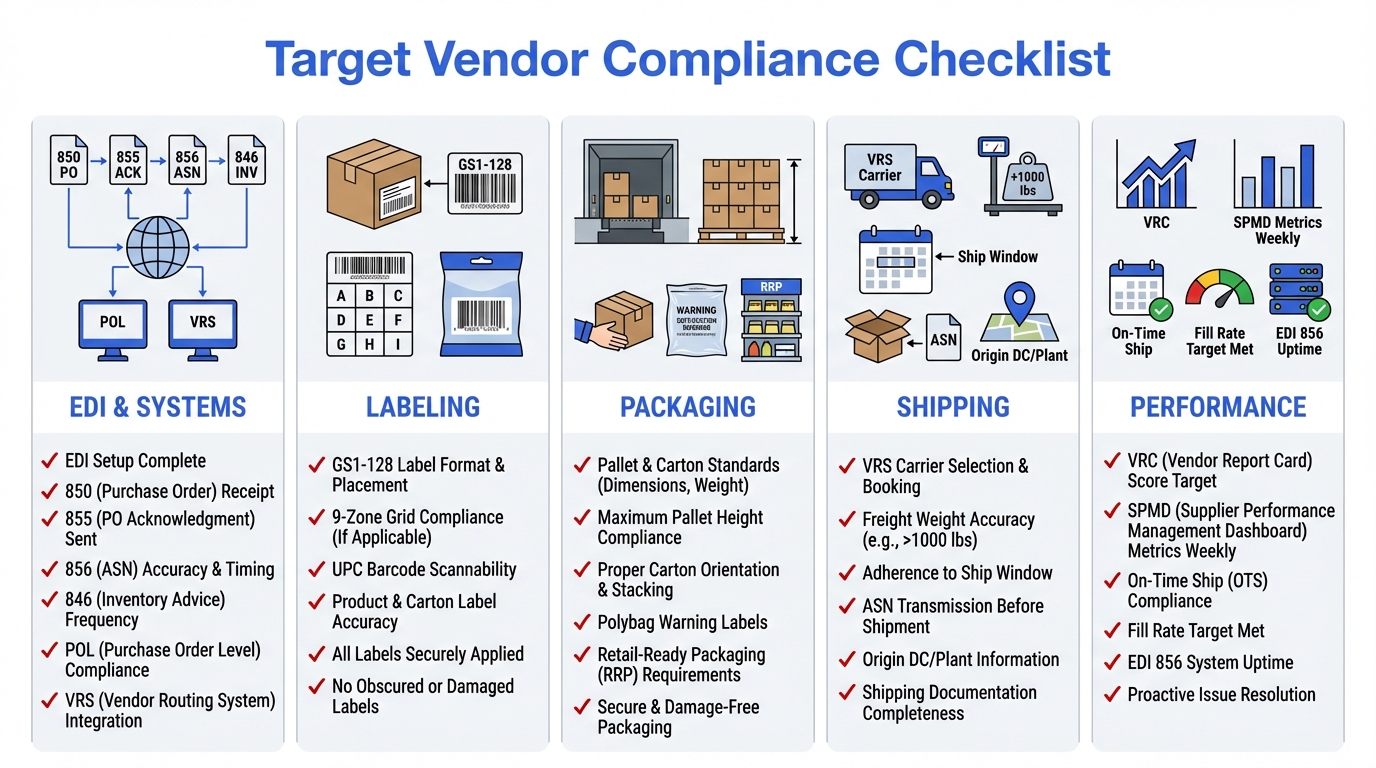
Compliance is where first-time Target vendors get hit hardest. Target has specific requirements for shipping, labeling, packaging, and delivery timing. Violations trigger deductions (chargebacks) that come straight off your payment. Here’s what you need to know.
Routing Guide & Shipping
Target’s routing guide governs how you ship to their distribution centers. The system is called VRS (Vendor Ready to Ship), and it works like this:
- ●You enter your shipment details into VRS through Partners Online
- ●Shipments route at least 48 business hours before pickup
- ●VRS assigns a Target load number and carrier/consolidator
- ●The carrier or consolidator contacts you to schedule pickup
- ●For LTL shipments, you schedule pickup with the LTL carrier using consolidator-provided contacts
Carrier contact information is posted on Partners Online. For a deeper dive into routing guide compliance, see our complete routing guide explainer.
ASN & Labeling Requirements
Target requires an EDI 856 ASN for every shipment. The ASN must be transmitted the same day the shipment leaves your dock. Late or inaccurate ASNs are one of the most common triggers for Target deductions.
Your shipping labels must follow Target’s GS1-128/SSCC-18 label format with several distinct zones:
| Zone | Content |
|---|---|
| A: Ship From | Your name, address, city, state, ZIP, country |
| B: Ship To | Target DC name, address, city, state, ZIP, country |
| C: Postal Barcode | Ship-to postal code with barcode |
| D: Carrier Info | SCAC code, Bill of Lading number, Pro number |
| E: Order Info | PO number and carton/pallet count |
| F: Shipment Details | Ship date, addresses, and PO reference |
| G: ASN Type | Shipment type indicator and location code |
| H: SSCC-18 | GS1-128 / SSCC barcode with human-readable text |
Packaging Requirements
Target has specific packaging requirements that differ from D2C fulfillment. Your beautiful branded shipping box won’t cut it for DC deliveries. Key requirements include:
- ●Standard height loading dock compatibility
- ●Pallet height maximums for stackable product
- ●Carton sorting and loading requirements per Target’s specifications
- ●Polybag suffocation warnings on all poly-wrapped items
- ●Retail-ready packaging for shelf display where applicable
OTIF & Vendor Scorecard
Target tracks vendor performance through the Vendor Report Card (VRC) and Supplier Performance Management Dashboard (SPMD). Key metrics include on-time ship/release, fill rate, and EDI 856 availability. Your scorecard directly impacts your standing with Target—consistently poor performance can lead to reduced orders or termination of the relationship. See our vendor scorecard guide for strategies to maintain strong performance metrics.
Stay ahead of Target’s compliance changes
RetailerHub’s Version Intel tracks changes to Target’s vendor guidelines and alerts you when requirements update. Never get caught by a routing guide revision again.
Target’s Chargeback (Deduction) Program
Target uses the term “deductions” rather than “chargebacks,” but the mechanics are the same—financial penalties deducted from your payments for compliance violations. Understanding Target’s deduction categories is essential to protecting your margins.
| Category | Common Codes | What Triggers It |
|---|---|---|
| Freight & Logistics | 90SF, TR01, TR02, TR08, TR11, TR12 | Wrong carrier, wrong origin, weight/measurement errors, shipping from wrong DC |
| Invoice Discrepancies | A032, A030, A036, A034 | Damage/defective, carton shortage, cost difference, unit shortage |
| Returns | RTVS8, CB####, CB501 | Return to vendor, store/FDC rejections, weekly defective roll-ups |
| Supplier Performance | VCNA | On-time ship/release failures, EDI 856 availability issues, fill rate misses |
| Vendor Income | CPN######, VIAP, VONL | Manufacturer coupon discrepancies, promotional allowance issues |
| Category & Compliance | RS&S audit | Category management dashboard fees, responsible sourcing audit denials |
How to Dispute Target Deductions
Not all deductions are final. Target provides a formal dispute process through their Synergy system:
- ●PRGX audit deductions: Email prgx.target@prgx.com and open a dispute case in Synergy
- ●Accounts payable deductions: Pull the Credit/Debit Memo Detail Report and open a Synergy dispute case
- ●Supplier performance deductions: Open a Synergy dispute case with backup documentation from the SPMD
The key to successful disputes is documentation. Keep records of every shipment—BOL copies, carrier delivery receipts, ASN transmission timestamps, and packing slips. Without supporting evidence, your dispute will be denied. For a comprehensive look at chargeback prevention strategies across all retailers, see our retail chargebacks guide.
Common First-Time Vendor Triggers
Based on publicly available compliance information, the most common deduction triggers for new Target vendors include:
Top Deduction Triggers for New Vendors
- ●Late or missing ASN: EDI 856 not transmitted same-day as shipment
- ●Wrong carrier: Using a non-contracted carrier instead of the one assigned by VRS
- ●Weight/measurement errors: Inaccurate weights in VRS for shipments over 1,000 lbs
- ●Case pack violations: Carton count mismatches between ASN and physical shipment
- ●Late shipments: PO locations not ready within the assigned ship window
Selling on Target Plus Marketplace
Target Plus is Target’s invitation-only online marketplace. Unlike the in-store vendor program, Target Plus sellers ship directly to consumers from their own warehouse, similar to Amazon’s third-party marketplace model.
How Target Plus Works
- ●Invitation-only: You cannot apply directly. Target identifies and invites brands they want on the platform.
- ●Direct-to-consumer fulfillment: You ship orders directly to Target customers from your facility.
- ●Commission-based: Target charges a commission on each sale (varies by category).
- ●EDI required: Even Target Plus vendors need EDI (846, 850, 855, 856, 860, 865, 997).
- ●Lower compliance burden: No pallet configuration, DC shipments, or routing guide compliance needed.
When Target Plus Makes Sense
Target Plus is a strong option for brands that want the Target brand association without the full operational complexity of in-store distribution. It’s particularly appealing for:
- ●D2C brands already proficient at direct-to-consumer fulfillment
- ●Brands wanting to test Target demand before investing in DC-level compliance
- ●Companies with products that sell well online but don’t need shelf presence
- ●Brands that can’t yet meet the production volume for ~2,000 stores
Keep in mind that Target Plus is curated—Target maintains quality control by only inviting brands that meet their standards. Having a strong D2C presence and positive customer reviews increases your chances of receiving an invitation.
Lessons from Real Target Vendors
Online vendor communities like Reddit’s r/ecommerce and r/smallbusiness are full of first-hand accounts from brands that have sold to Target. Here are the key themes that come up repeatedly:
“The deal is just the beginning”
Getting the yes from a Target buyer is exciting, but the operational buildout that follows is where most brands struggle. EDI setup, warehouse reconfiguration for retail packing, and compliance documentation take 60–90 days minimum.
“Cash flow nearly killed us”
With net 60–90 payment terms, you’re financing production, warehousing, and shipping for months before Target pays. Layer in markdown allowances and unexpected deductions, and your cash flow model from D2C no longer applies. Many vendors recommend having 6 months of operating capital before launching with Target.
“Chargebacks add up fast”
First-time vendors often underestimate how quickly compliance deductions accumulate. A single wrong carrier selection or late ASN on a multi-PO shipment can result in deductions across every PO on that shipment. The first quarter is a learning curve—budget for it.
“Invest in operations before saying yes”
The vendors who succeed at Target are the ones who build their operational infrastructure before accepting the deal. That means EDI provider, retail-compliant warehouse processes, labeling equipment, and ideally a 3PL with Target experience. Trying to figure this out after your first PO arrives is a recipe for chargebacks.
Target Vendor Success Checklist
Use this checklist to track your progress from application to first shipment. Each phase builds on the previous one—don’t skip ahead.
1 Pre-Application
- ☐ Confirm your product is differentiated from Target’s owned brands
- ☐ Verify you can maintain 50%+ margins at wholesale pricing
- ☐ Confirm production capacity for 5,000–50,000+ units
- ☐ Secure product liability insurance (minimums vary, typically $2M–$5M+)
- ☐ Prepare sell-through data from D2C, Amazon, or other channels
2 Application
- ☐ Complete supplier intake form on corporate.target.com
- ☐ Prepare pitch deck with brand story, market data, and margin structure
- ☐ Register for relevant trade shows where Target buyers attend
- ☐ Evaluate whether a Target-specialized broker makes sense
3 Onboarding
- ☐ Set up Partners Online (POL) account
- ☐ Complete VMM account setup
- ☐ Select and contract an EDI provider
- ☐ Complete EDI testing and move to production
- ☐ Register GS1 Company Prefix and assign UPCs
- ☐ Submit item data in IMN/PIM (images, descriptions, attributes)
- ☐ Set up labeling equipment for GS1-128/SSCC-18 labels
4 First Order
- ☐ Review Target’s routing guide and VRS procedures
- ☐ Confirm correct carrier assignment from VRS
- ☐ Send EDI 855 acknowledgment within 30 minutes of PO receipt
- ☐ Transmit EDI 856 ASN same-day as shipment
- ☐ Verify GS1-128 labels on all cartons and pallets
5 Ongoing Operations
- ☐ Monitor Vendor Report Card (VRC) weekly
- ☐ Review and dispute invalid deductions in Synergy
- ☐ Track routing guide updates on Partners Online
- ☐ Analyze MerchIQ sales data for replenishment planning
- ☐ Build promotional calendar with your category buyer
Frequently Asked Questions About Selling to Target
Sell to Target with confidence
Brands and 3PLs use RetailerHub to instantly answer Target compliance questions, generate warehouse-ready SOPs, and get alerted when vendor guidelines change. Built by a former ShipBob Lead WMS Engineer with 10+ years in fulfillment.
Related Guides
Retail Vendor Onboarding
Step-by-step guide to everything after a retail buyer says yes.
Vendor ComplianceRetail Chargebacks
Common types, retailer penalties, and proven prevention strategies.
Retail StrategyHow to Get into Retail Stores
The full playbook for D2C brands entering retail for the first time.