
Retail Chargebacks: What They Are, Why They Happen & How to Prevent Them
Last Updated: Mar 21, 2026
A complete guide to retail chargebacks for vendors and suppliers, covering common chargeback types, retailer-specific penalties from Walmart, Amazon, Target, and Kroger, and proven strategies to reduce chargebacks and protect your margins.
This guide contains AI-generated content based on publicly available information and general industry knowledge. Always verify requirements directly with your retail trading partners.
In This Guide
What Are Retail Chargebacks?
Retail chargebacks are financial penalties that retailers deduct from vendor payments when a supplier fails to meet the retailer’s compliance requirements. Unlike credit card chargebacks (which involve a consumer disputing a transaction), retail chargebacks are business-to-business penalties built into the vendor agreement between a supplier and their retail trading partner.
When a shipment arrives at a retailer’s distribution center with incorrect labeling, a missing Advance Shipment Notification (ASN), wrong packaging, or a late delivery, the retailer issues a chargeback: a deduction from the vendor’s next payment. These deductions are designed to recover the retailer’s costs for handling non-compliant shipments, but they often exceed the actual cost of the error.
For suppliers, chargebacks can be devastating. Industry estimates suggest that vendor compliance chargebacks cost suppliers billions of dollars annually across the retail industry, with some vendors losing 2–5% of their gross revenue to compliance penalties. Understanding what triggers chargebacks and how to prevent them is essential to maintaining healthy margins in retail.
The retailer-specific chargeback data in this guide is based on publicly available retailer compliance information, including requirements published by Walmart, Amazon, Target, and Kroger. This content is for general educational purposes. Always verify current requirements directly with your retail trading partners.
Chargebacks vs. Deductions vs. Fines: What’s the Difference?
Retailers use different terminology, but the mechanics are similar. Understanding the distinctions helps you navigate each retailer’s compliance program and dispute process.
| Term | Definition | Used By |
|---|---|---|
| Chargeback | A specific penalty deducted from vendor payments for non-compliance with shipping, labeling, or EDI requirements. | Amazon, Walmart, Kroger |
| Deduction | A broader term for any amount subtracted from a vendor’s payment. It may include chargebacks, shortages, allowances, or co-op advertising fees. | Target, most retailers |
| Non-compliance fee | A cost recovery charge for violating routing guide or packaging rules. Often treated as liquidated damages in the vendor agreement. | Walmart, Home Depot, Kroger |
| OTIF penalty | A specific penalty tied to On-Time In-Full delivery metrics. Charged when shipments arrive late or with incorrect quantities. | Walmart (OTIF program) |
Regardless of the label, the financial impact is the same: money deducted from your payments. Most vendor agreements define these charges as “liquidated damages” rather than penalties, which makes them harder to dispute legally. Kroger’s vendor agreement explicitly states that its non-compliance fees are “liquidated damages, not penalties.”
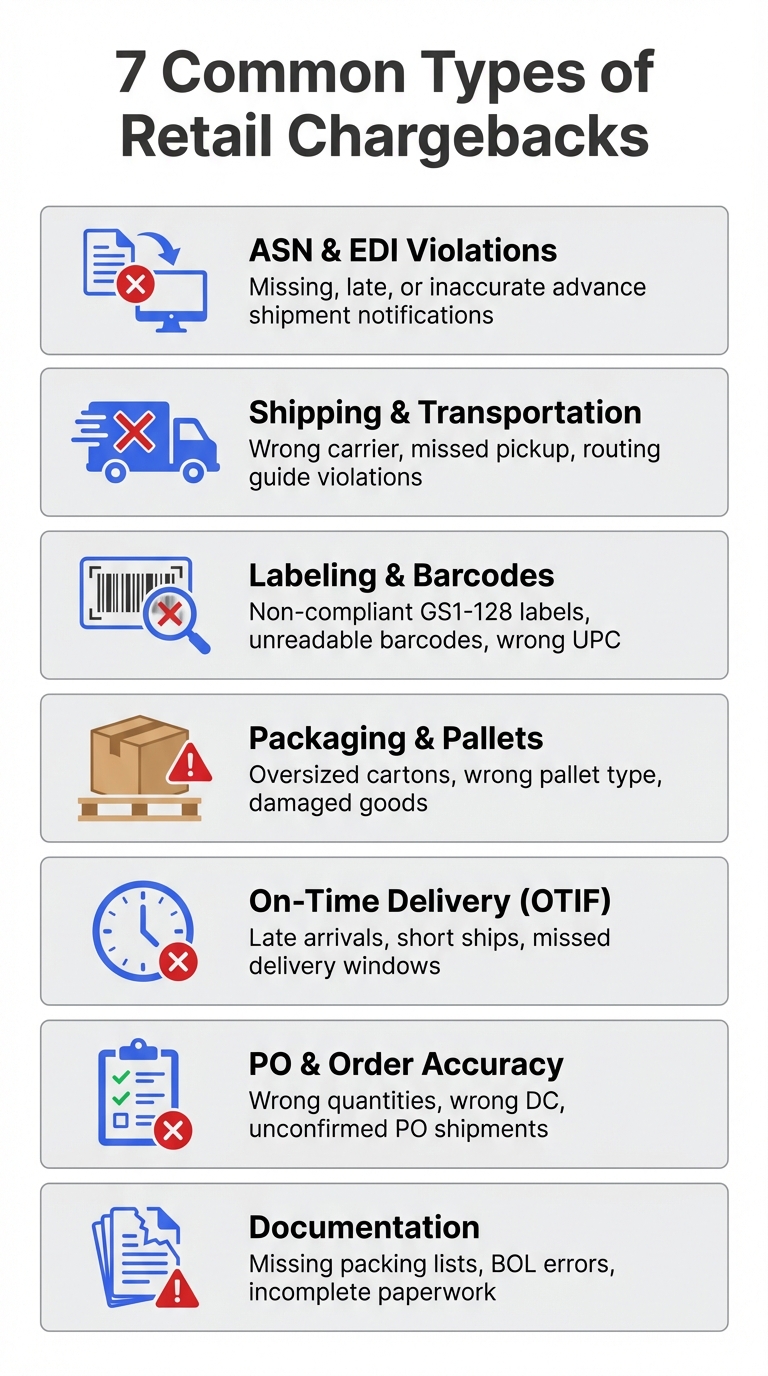
7 Common Types of Retail Chargebacks
While every retailer has its own compliance program, most chargebacks fall into these categories. Understanding them is the first step to prevention.
ASN & EDI Violations
Missing, late, or inaccurate Advance Shipment Notifications (EDI 856). The ASN must match the physical shipment exactly. Wrong quantities, missing carton details, or late transmission all trigger chargebacks.
Examples: No ASN sent, ASN sent after delivery, carton content mismatch, incorrect PO reference
Shipping & Transportation Violations
Failure to follow the retailer's routing guide for carrier selection, shipping mode, delivery appointments, or freight terms. Using the wrong carrier or shipping method is one of the most common chargebacks.
Examples: Wrong carrier, missed pickup window, unauthorized prepaid freight, no bill of lading
Labeling & Barcode Violations
Non-compliant GS1-128 labels, missing SSCC barcodes, incorrect UPC codes, or illegible labels. Barcodes must be scannable and meet ANSI grade requirements.
Examples: Missing GS1-128 label, unreadable barcode, wrong SSCC, UPC not registered, label placement error
Packaging & Pallet Violations
Incorrect case pack quantities, oversized or overweight cartons, damaged packaging, or pallets that don't meet the retailer's specifications (size, weight, stacking pattern).
Examples: Oversized carton, overweight pallet, wrong pallet type, damaged goods, incorrect case pack
On-Time Delivery (OTIF) Violations
Shipments that arrive outside the retailer's delivery window or with fewer units than ordered. OTIF penalties are typically the most expensive chargebacks because they're calculated as a percentage of COGS.
Examples: Late delivery, early delivery (some retailers), short ship, over ship
PO & Order Accuracy Violations
Shipping quantities that don't match the purchase order, shipping to the wrong DC, or shipping against an unconfirmed or cancelled PO.
Examples: Overage shipment, wrong DC, unconfirmed PO shipment, cancelled PO shipment
Documentation & Administrative Violations
Missing or incorrect paperwork including packing lists, bills of lading, certificates of compliance, or import documentation.
Examples: No packing list, missing BOL, incorrect customs documentation, no country of origin marking
Retailer Chargeback Comparison: Walmart, Amazon, Target & Kroger
Each major retailer has its own chargeback program with different categories, penalty amounts, and dispute processes. Here’s how the top four compare.
Walmart
Walmart’s chargeback program is one of the most extensive in retail. Their Non-Compliance Cost Recovery Program (Section 15 of the Supplier Packaging & Labeling Compliance Manual) covers violations across transportation, ASN, labeling, routing guide compliance, and on-time delivery. Walmart also runs the well-known OTIF (On-Time In-Full) program, which penalizes suppliers whose shipments arrive late or with incorrect quantities.
| Category | What It Covers |
|---|---|
| Transportation | DSV shipments using wrong carrier method ($5/shipment); prepaid transportation non-compliance |
| ASN / EDI | Missing or incorrect ASN, domestic PO non-compliance |
| Labeling & Packaging | Non-compliant GS1-128 labels, barcode issues, packaging violations |
| Routing Guide | Failure to follow Walmart’s routing instructions for carrier, mode, or delivery appointments |
| OTIF | Shipments arriving late or with incorrect fill rates; thresholds are 98% on-time (collect), 90% on-time (prepaid), and 95% in-full |
Walmart DSV transportation chargebacks are charged per non-compliant shipment. For inbound/DC violations, penalty amounts vary by violation type and are detailed in Section 15 of the Supplier Packaging & Labeling Compliance Manual. DSV disputes are filed through the Transportation Portal; inbound disputes go through Supplier One under Payments.
Amazon
Amazon Vendor Central issues chargebacks across a wide range of operational categories. Unlike some retailers, Amazon provides a dedicated Chargeback Support portal within Vendor Central where vendors can view fee schedules, current rates, and dispute history.
| Chargeback Type | Description |
|---|---|
| ASN Accuracy | ASN not sent, inaccurate, or not received before shipment arrives at the fulfillment center. |
| No Carton Content Label (No CCL) | Missing or incorrect carton content labels on individual boxes. |
| Carton Content Accuracy (CCA) | Physical carton contents don't match what was declared in the ASN or carton label. |
| PO On-Time Accuracy | Shipment doesn't arrive within the expected delivery window for the purchase order. |
| Overage PO Units | Shipping more units than what was ordered on the purchase order. |
| No Show | Shipment was expected based on PO confirmation but never arrived. |
| Oversized Carton / Overweight Carton | Cartons exceed Amazon's size or weight limits for the product category (tracked as separate chargebacks). |
| Prep Violations | Products not prepped according to Amazon's prep requirements (bubble wrap, poly bag, etc.). |
| Ships in Own Container (SIOC) | Items shipped in their retail packaging without proper outer carton protection when required. |
| Confirmation Rate | Failure to confirm purchase orders within Amazon's required timeframe. |
| Import Shipment Late Booking | Import shipments not booked with the carrier by the required booking deadline. |
| Import Vendor On-Time Performance | Import shipments that miss the cargo-ready date or origin delivery window. |
| Pickup Accuracy | Shipment not ready for carrier pickup at the scheduled time and location. |
| Unconfirmed PO | Shipping against a purchase order that was never confirmed in Vendor Central. |
Chargeback amounts vary by type and are defined in the Chargeback Support portal within Vendor Central. Amazon tracks vendor performance via the Operational Performance Dashboard.
Target
Target uses the term “deductions” rather than chargebacks. Their Deductions and Chargebacks Guide outlines four major categories of penalties: freight violations, responsible sourcing violations, accounts payable deductions, and supplier performance management (SPM) deductions.
| Category | Examples |
|---|---|
| Freight | Shipping from non-designated location, wrong carrier, inaccurate weights, unapproved backorders, failing to prepay freight |
| Responsible Sourcing | Denied factory audits, unauthorized subcontracting, production in non-compliant facilities |
| Accounts Payable | Defective/damaged products, carton or unit shortages, cost differences, EDI violations, coupon discrepancies, return-to-vendor (RTV) |
| Supplier Performance (SPM) | On-time ship failures, on-time release failures, fill rate discrepancies, late or erroneous ASN |
Target does not publish fixed dollar amounts for most deductions. Penalties are tied to the specific non-compliance and may reference further details in partner portal resources.
Kroger
Kroger publishes one of the most transparent chargeback fee schedules in retail. Their Standard Vendor Agreement includes a detailed non-compliance fee table with specific dollar amounts per violation type. All fees are classified as “liquidated damages, not penalties” and are deducted from outstanding invoices.
| Violation | Fee |
|---|---|
| ASN not provided or incorrect | $200 per shipment |
| Case labeling or pack errors | $500 per shipment |
| Illegible GS1-128 barcode | $500 flat fee |
| Hazardous material labeling violation | $500 per incident |
| Improper application of hangers | $1,000 per item per division |
| Discontinuing items without 60-day notice | $1,000 + extra transport costs |
| Late or incorrect ad merchandise | $200 per shipment + costs |
| Packing list errors / no packing list | $100 per pallet + extra costs |
| Poor pallet quality | $2,000 per item per division |
| Violating EDI or routing instructions | $250 per incident + costs |
| UPC violations | $500–$5,000 per item per division |
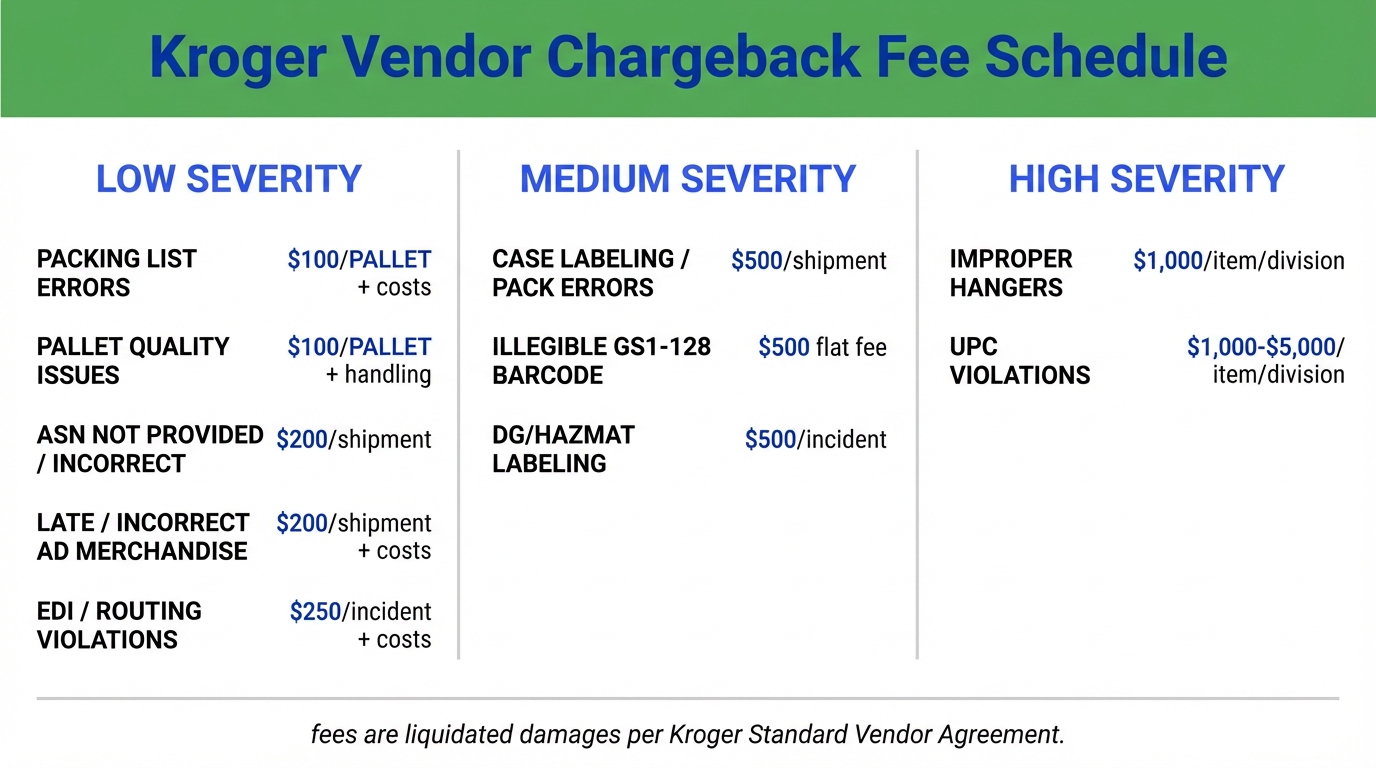
Kroger’s fees escalate significantly for UPC violations ($1,000–$5,000 per item per division). Hanger and hazardous material violations can reach $1,000 per item per division.
Stop guessing, start knowing
Not sure what your retailer’s chargeback rules are?
RetailerHub’s Compliance IQ lets you ask any compliance question and get instant, accurate answers. No more digging through 100-page PDFs to find the labeling spec that’s about to cost you $500.
OTIF Penalties: The Chargeback That Changed Everything
OTIF (On-Time In-Full) is a supply chain metric that measures whether shipments arrive at the retailer’s distribution center on time and with the correct quantity. Walmart’s OTIF program, launched in 2017, transformed how retailers hold vendors accountable for delivery performance and has become the industry standard.
Under Walmart’s OTIF program, suppliers are expected to meet a 98% on-time rate for collect shipments (90% for prepaid) and a 95% in-full delivery rate. Shipments that miss their delivery window or arrive with fewer units than ordered incur financial penalties. The program applies to both collect (Walmart-arranged) and prepaid (vendor-arranged) freight, though with different on-time thresholds.
Other retailers have adopted similar programs. Target measures On-Time Arrival (OTA) and On-Time Ship compliance, with deductions for vendors who fall below their targets. The core principle is the same: if your shipment is late or short, you pay.
Why OTIF matters more than other chargebacks
- •Volume-based penalties: OTIF fines are calculated as a percentage of COGS (cost of goods sold), not a flat fee. A single late truckload can cost thousands.
- •Scorecard impact: OTIF performance feeds directly into your vendor scorecard, affecting your standing for line reviews and shelf space.
- •Compounding effect: A single late shipment can trigger both an OTIF penalty and a routing guide chargeback if the delay was caused by carrier non-compliance.
The Financial Impact of Retail Chargebacks
Chargebacks eat directly into profit margins. For a supplier operating on typical retail margins of 5–15%, even a small chargeback rate can turn a profitable account into a losing one.
Example: How chargebacks erode margins
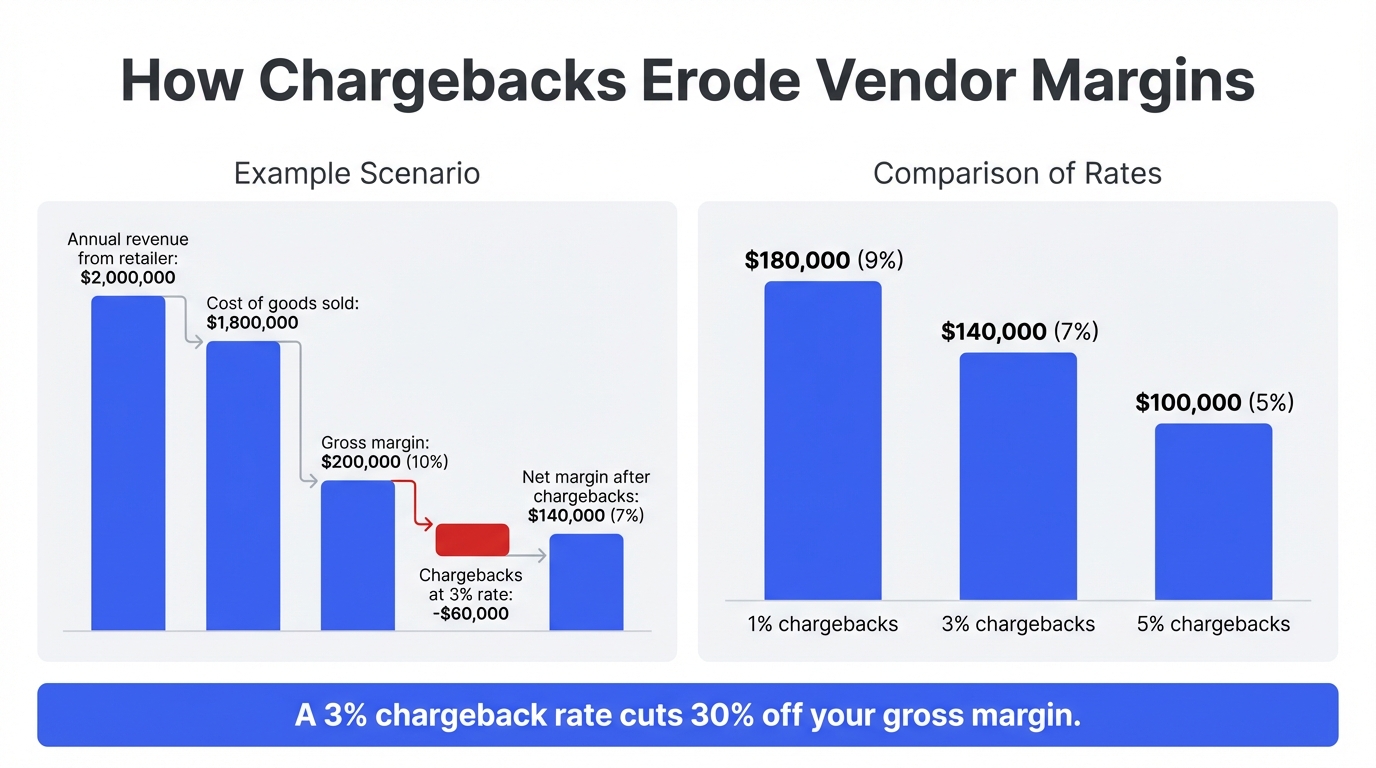
Beyond direct financial penalties, chargebacks create hidden costs:
- •Administrative burden: Each chargeback requires investigation, documentation, and potentially a dispute filing. Staff time spent managing chargebacks is time not spent growing the business.
- •Relationship damage: High chargeback rates signal to the retailer that you’re an unreliable partner, which can lead to reduced shelf space or lost accounts.
- •Cash flow disruption: Deductions are taken from payments you were expecting, creating unpredictable cash flow.
What if you could catch compliance errors before they ship? RetailerHub automatically surfaces each retailer’s labeling, routing, and packaging requirements so your warehouse team knows exactly what’s expected, before the truck leaves the dock. See plans →
How to Prevent Retail Chargebacks: 8 Proven Strategies
The most cost-effective way to deal with chargebacks is to prevent them from happening in the first place. These strategies address the root causes behind the most common chargeback types.
1. Read and internalize each retailer's routing guide
Every retailer publishes a routing guide or vendor compliance manual. These documents spell out exactly how, when, and where to ship. Read the full guide for every retailer you sell to, and don't rely on summaries or what worked for another retailer. The challenge is that retailers update these guides frequently. Tools like RetailerHub's Version Intel automatically detect when a retailer's guidelines change, so you're never caught off guard by a new requirement.
Prevents: Routing, carrier, and transportation chargebacks
2. Automate ASN generation and transmission
Manual ASN creation is the #1 source of ASN chargebacks. Integrate your WMS or ERP with your EDI provider so ASNs are generated automatically from pick/pack data and transmitted before the shipment arrives. This eliminates mismatches between the ASN and physical shipment.
Prevents: ASN violations, carton content accuracy errors
3. Invest in barcode verification (not just scanning)
A barcode scanner tells you if it can read the barcode. A barcode verifier tells you if it meets ANSI grade standards. Use a verifier to check GS1-128 labels before shipping. A scannable barcode that grades below the retailer's threshold still triggers a chargeback.
Prevents: Labeling and barcode chargebacks
4. Build delivery buffers into your shipping schedule
Ship early enough to account for transit delays, carrier issues, and appointment scheduling. Most OTIF penalties come from shipments that were "almost on time." Build 1–2 days of buffer into your ship dates.
Prevents: OTIF and on-time delivery penalties
5. Implement a pre-shipment compliance audit
Before a shipment leaves your dock, verify: correct carrier, correct labels, ASN transmitted, PO quantities match, packing list included, pallet specs met. A 5-minute audit at the dock door costs far less than a chargeback. RetailerHub's Instant SOPs generate warehouse-ready standard operating procedures for each retailer, so your dock team has a printed checklist for every account.
Prevents: All chargeback types
6. Track chargebacks by type and root cause
Maintain a chargeback log that categorizes every penalty by retailer, type, and root cause. Review it monthly to identify patterns. If 60% of your chargebacks are ASN-related, that's where to focus your process improvement.
Prevents: Recurring chargebacks (systematic root cause elimination)
7. Confirm POs before shipping
Never ship against an unconfirmed or cancelled PO. Verify PO status in the retailer's portal before picking and packing. Shipping against a cancelled PO guarantees a chargeback with no dispute path.
Prevents: PO accuracy violations, unconfirmed PO chargebacks
8. Use compliance management software
Vendor compliance platforms like RetailerHub let your team ask any retailer compliance question, such as "What pallets does Kroger accept?" or "What's Walmart's OTIF threshold?", and get instant, accurate answers. Combined with AI-generated SOPs and automatic requirement change alerts, compliance software pays for itself many times over in chargeback avoidance.
Prevents: All chargeback types (proactive compliance monitoring)
See how RetailerHub prevents chargebacks
Book a 15-min setup call and see Compliance IQ, Instant SOPs, and Version Intel in action for your retail accounts.
How to Dispute Retail Chargebacks
Not every chargeback is legitimate. Retailers’ automated compliance systems can make errors, and you have the right to dispute charges you believe are incorrect. A structured dispute process can recover significant revenue.
Review the chargeback details
Log into the retailer's vendor portal and review the specific chargeback: what was the violation, what shipment was affected, what date, and what amount. Make sure you understand exactly what you're disputing.
Gather supporting documentation
Collect proof that you were compliant: carrier BOL with delivery timestamp, ASN transmission confirmation, barcode verification report, photos of labels and pallets, PO confirmation screenshot. The stronger your documentation, the better your odds.
File within the dispute window
Every retailer has a deadline for disputes (typically 30–90 days). File as soon as possible, and don't batch disputes. Late disputes are automatically rejected regardless of merit.
Be specific and factual
State exactly why the chargeback is incorrect, reference specific documents, and include tracking numbers, ASN IDs, and timestamps. Avoid vague objections like "we believe we were compliant."
Track the outcome and follow up
Log every dispute with its outcome. If a dispute is denied, review the reason and decide whether to escalate to your buyer contact. If you're seeing a pattern of denied disputes for a specific type, escalate to your retail partner contact.
Dispute filing by retailer
- Walmart: DSV disputes go through the Transportation Portal. Inbound/DC disputes are filed through Supplier One → Payments category. Include chargeback month and supporting documentation.
- Amazon: Use the Chargeback Support portal in Vendor Central. Review your Operational Performance Dashboard for context.
- Target: Contact your Target buyer or use the Partners Online portal to submit deduction disputes.
- Kroger: Disputes are handled through your Kroger vendor representative. Fees are deducted from outstanding invoices.
Pro tip: Track your dispute win rate by retailer and chargeback type. If you’re consistently winning disputes for a specific category, it may indicate a systemic issue on the retailer’s side that you can raise with your buyer.
Retail Chargeback Prevention Checklist
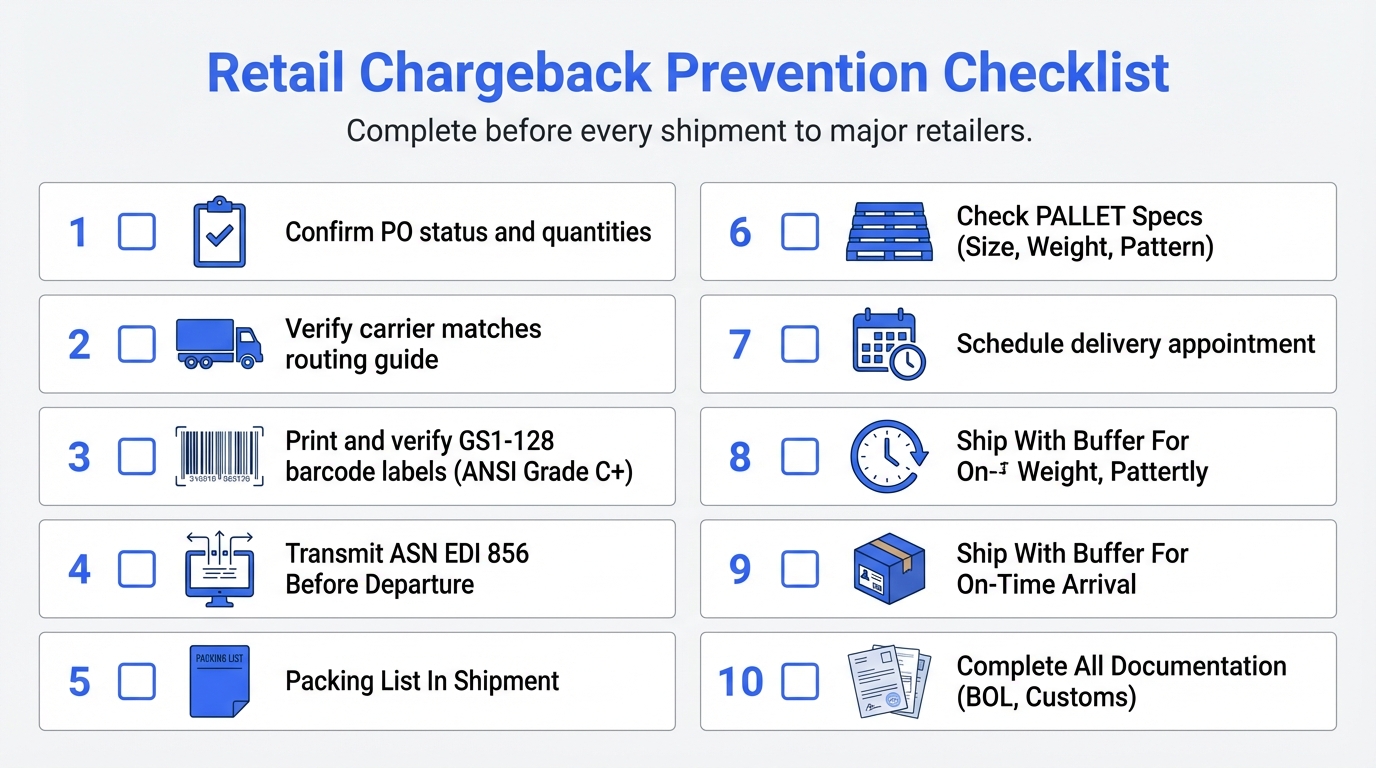
Use this checklist before every shipment to minimize chargeback risk. Each item addresses a common compliance failure that triggers chargebacks across major retailers.
PO confirmed and quantities verified
Match pick quantities to PO line items. Don't ship over or under.
Carrier and shipping method match routing guide
Use the retailer-assigned carrier and service level. No substitutions.
GS1-128 labels printed and verified
Barcode verifier confirms ANSI Grade C or better. SSCC matches ASN.
ASN transmitted before shipment departs
EDI 856 sent with correct carton contents, quantities, and SSCC references.
Packing list included in shipment
Matches PO, lists all carton contents and quantities.
Pallet specs meet retailer requirements
Correct pallet size, weight under limit, proper stacking pattern.
Delivery appointment scheduled (if required)
Appointment confirmed within the retailer's delivery window.
Ship date allows buffer for on-time arrival
Account for transit time plus 1–2 days buffer for delays.
All cartons sealed and labeled correctly
Labels on correct face, away from edges and tape. One label per carton.
Documentation complete (BOL, customs, certificates)
All required paperwork ready before carrier pickup.
Frequently Asked Questions
Stop losing revenue to chargebacks
Brands and 3PLs use RetailerHub to instantly answer any retailer compliance question, generate warehouse-ready SOPs, and get alerted when requirements change. Built by a former ShipBob Lead WMS Engineer with 10+ years in fulfillment.
Related Guides
What is an ASN?
Complete guide to advance shipment notifications, EDI 856, and SSCC labels.
Labeling & BarcodesGS1-128 Shipping Labels
Everything about GS1-128 barcodes, SSCC-18, and retailer label requirements.
Vendor PerformanceVendor Scorecard Guide
Metrics, templates, and how major retailers grade supplier performance.