
Shelf Ready Packaging (SRP): The Complete Guide to Retail Ready Packaging
Last Updated: Mar 21, 2026
Everything you need to know about shelf ready packaging: types, design principles, retailer-specific requirements from Walmart, Amazon, Costco, Target, and Kroger, plus how to avoid common mistakes that trigger compliance chargebacks.
This guide contains AI-generated content based on publicly available information and general industry knowledge. Always verify requirements directly with your retail trading partners.
In This Guide
What Is Shelf Ready Packaging?
Shelf ready packaging (SRP), also called retail ready packaging (RRP), is secondary packaging designed so that products can move directly from the shipping case to the retail shelf with minimal handling. Instead of a store associate opening a master carton, unpacking individual units, and stocking them one by one, SRP lets them place the entire tray or display-ready case on the shelf in a single motion.
The concept originated in European grocery retail in the early 2000s, driven by retailers like Tesco and Aldi who needed to cut store labor costs. Today it is standard across North American retail. Walmart, Costco, Target, Amazon, and Kroger all have specific SRP requirements that vendors must meet to avoid compliance chargebacks and delivery refusals.
SRP serves a dual purpose: it reduces in-store labor (the biggest cost in retail operations) and it turns the packaging itself into a point-of-sale display. A well-designed shelf ready case protects the product during transit, opens quickly on the sales floor, and presents the brand attractively to shoppers.
The retailer-specific data in this guide is based on publicly available retailer compliance information, including packaging specifications published by Walmart, Amazon, Costco, Target, and Kroger. This content is for general educational purposes. Always verify current requirements directly with your retail trading partners.
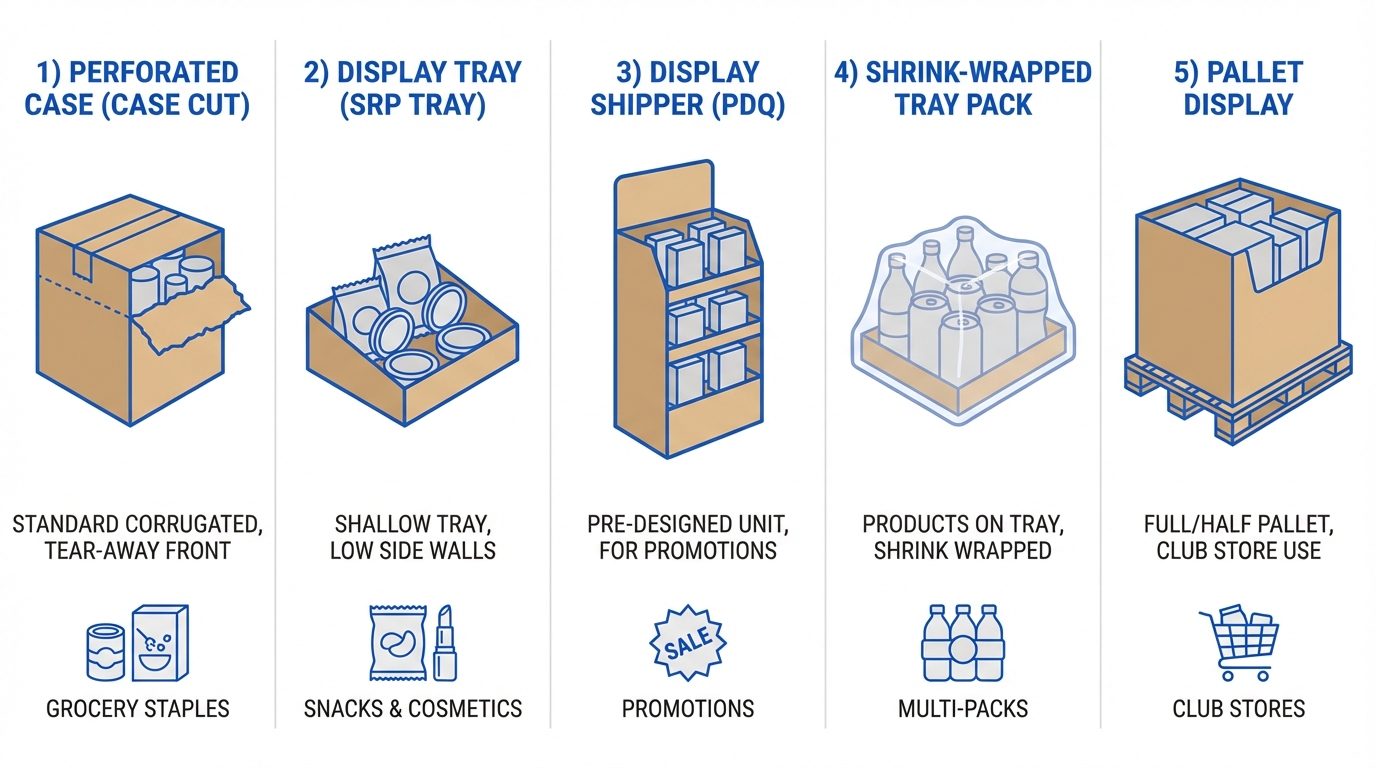
Types of Shelf Ready Packaging
Not all shelf ready packaging is the same. The type you use depends on your product category, retailer requirements, and where the product will be merchandised: aisle shelf, endcap display, pallet drop, or club store floor stack. Here are the five main types.
Perforated case (case cut)
A standard corrugated shipping case with a perforated tear-away front panel. The store associate tears along the perforation to expose the products inside, then places the open case directly on the shelf. The remaining tray holds products upright and acts as a shelf divider.
Best for: Grocery staples, canned goods, beverages, health and beauty. These are high-volume items with regular shelf replenishment.
Display tray (SRP tray)
A shallow corrugated tray with low side walls (typically 2–4 inches) that holds products in a single layer. Products are visible from the front and top. The tray slides onto the shelf and can be removed and replaced as a unit when empty.
Best for: Snacks, confectionery, cosmetics, small electronics. These are products that benefit from front-facing presentation.
Display shipper (PDQ)
A pre-designed display unit that functions as both the shipping container and the in-store merchandising display. PDQ shippers are typically used for promotional or seasonal items. They arrive fully assembled and go directly from the pallet to the endcap or floor.
Best for: Seasonal promotions, new product launches, endcap displays, cross-merchandising programs.
Shrink-wrapped tray pack
Products arranged on a corrugated tray and secured with shrink wrap film. The shrink wrap is removed at the store, and the tray is placed on the shelf. This format provides strong transit protection while remaining easy to open.
Best for: Multi-packs, beverages, club store bulk items. These are products that need tight bundling for transit stability.
Pallet display (club store format)
A full or half pallet designed for direct floor placement in club stores like Costco and Sam's Club. The display is engineered for double-stacking and includes branded shrouds or headers. The pallet is wheeled directly from the truck to the sales floor.
Best for: Club store retail (Costco, Sam's Club, BJ's), warehouse-format stores, high-volume seasonal displays.
SRP vs. RRP vs. PDQ: are they the same?
You’ll hear different terms depending on the retailer and region. SRP (Shelf Ready Packaging) and RRP (Retail Ready Packaging) are interchangeable terms for the same concept. PDQ (Pretty Darn Quick) refers specifically to display-ready trays or shippers: a subset of SRP designed for promotional or endcap placement. In practice, most retailers use “retail ready packaging” or “display ready packaging” in their compliance guides.
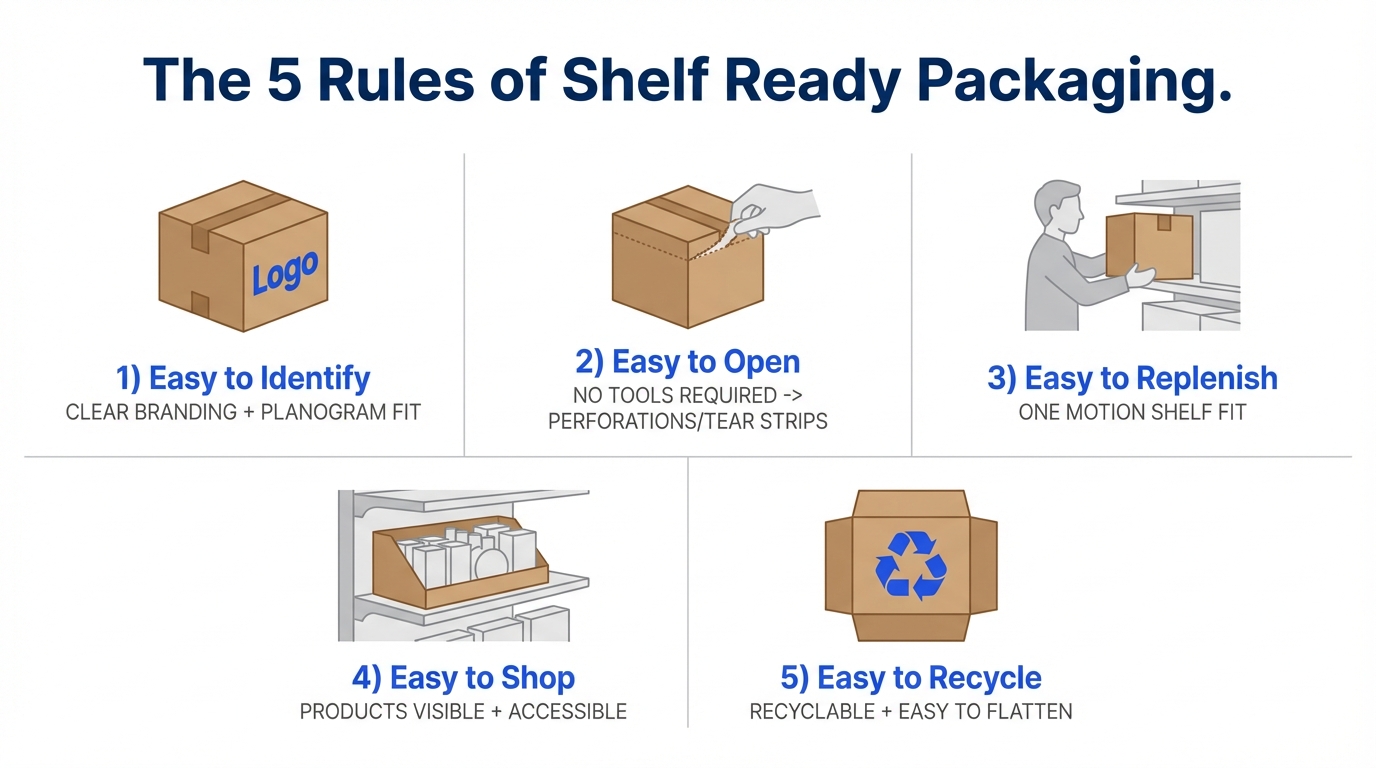
The Five Rules of Shelf Ready Packaging Design
The ECR (Efficient Consumer Response) framework established five criteria that all shelf ready packaging must meet. These rules are widely adopted by retailers globally and form the foundation of most retailer SRP scorecards.
Easy to identify
Store associates must be able to identify the product and shelf location at a glance. Clear branding, product name, and planogram-compatible sizing are essential. The case should match what is in the retailer's planogram system.
Easy to open
The case must open quickly without tools: no box cutters, no scissors, no prying. Perforations, tear strips, and thumb holes must work reliably. If a store associate needs a knife to open it, your SRP has failed.
Easy to replenish
The opened case or tray must fit the planogram shelf space and slide into position in a single motion. Dimensions must align with standard shelf depths and heights. Overhang, wobble, or instability means the SRP needs redesign.
Easy to shop
Products must be visible and accessible to shoppers. The front panel height must be low enough for customers to see and reach the products. Brand messaging and product information should face the shopper.
Easy to recycle
The packaging must be easy to break down, compact for disposal, and made from recyclable materials. Store backrooms have limited space, and packaging that doesn't flatten easily creates waste management problems.
A package that fails any one of these five criteria creates friction in the store: slower stocking, damaged product, poor shelf appearance, or confused associates. Retailers evaluate SRP against all five when approving new packaging designs.
Retailer-Specific Shelf Ready Packaging Requirements
Each major retailer has its own SRP specifications. What passes at Walmart may fail at Costco. Here’s what each retailer requires for shelf ready and display ready packaging, based on publicly available compliance information.
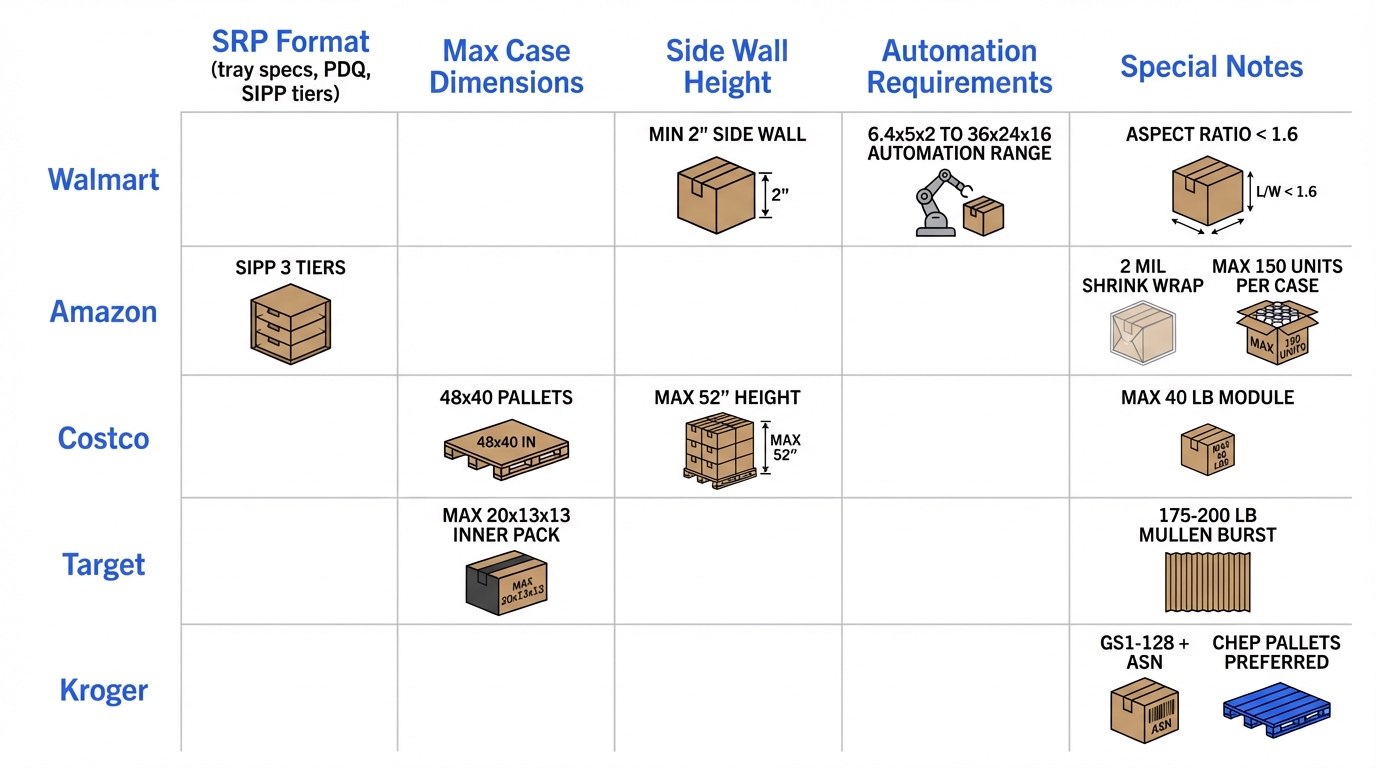
Walmart
Walmart’s Supply Chain Standards include detailed SRP and display ready packaging (PDQ) requirements. Cases must be designed for automation compatibility in Walmart’s distribution centers.
| Requirement | Specification |
|---|---|
| Tray side wall height | Minimum 2" (3" for glass products). Product info on at least two sides, including the longest side. |
| Automation dimensions | Eligible cases: 6.4"×5.0"×2.0" to 36"×24"×16", max 50 lbs. Flat, smooth surfaces required. |
| Aspect ratio | Height/width ratio above 1.6 is automation-ineligible and must ship in a full corrugated case. |
| Shrink wrap trays | Must follow same marking rules as all other cases. No large flap gaps or loose film allowed. |
| PDQ displays | Four corner boards + stretch wrap required. Displays may require individual labeling and special shrouds. |
| Barcode placement | GTIN barcodes must not be covered by plastic seams on shrink-wrapped trays. |
Amazon
Amazon’s approach to retail ready packaging focuses on its SIPP (Ships in Product Packaging) program, which has three tiers that determine how products are packaged for fulfillment.
| Requirement | Specification |
|---|---|
| Frustration-Free (SIPP Tier 1) | Easily opened within 120 seconds, curbside recyclable materials, no EPS foam. Reduces prep chargebacks. |
| Ship in Own Container (SIPP Tier 2) | Product ships in manufacturer packaging with no additional Amazon overbox. Must survive transit undamaged. |
| Prep-Free Packaging (SIPP Tier 3) | Arrives at FC ready to ship: pre-bagged, pre-labeled, sealed. Avoids Amazon prep fees. |
| Tray pack side walls | Minimum 3" for glass (to neck), 2" for other products. Continuous flat surfaces on all sides. |
| Shrink wrap on trays | At least 2 mils thick or 130g+ tear strength. Use nontransparent film if unit barcodes are visible to prevent mis-scanning. |
| Case pack limit | Maximum 150 units per case. All units must be identical SKU and condition. |
Costco
Costco’s club store format means every product is displayed on the sales floor in its shipping packaging. This makes Costco’s SRP requirements among the most demanding in retail.
| Requirement | Specification |
|---|---|
| Display pallet size | 48"×40" max, no overhang. Height max 52" for dry loads (48" refrigerated), including pallet. Max load 2,500 lbs. |
| Display module weight | Max 40 lbs (25 lbs recommended). Front panel minimum 3" high (4" recommended). |
| Module dimensions | Max 24" front length × 20" width. Must face the 48" side of the pallet. |
| Stacking and stability | Engineered for double-stacking. Layer sheets or caps required for open-top modules unless locking stack tabs are used. |
| Stretch wrap | Minimum .79 gauge film, three times around. Plastic strapping allowed, no metal strapping. |
| Corner posts | Rigid paper-based required. Plastic corner posts are not allowed. Required for structural stability during display. |
Target
Target’s packaging guidelines focus on case-pack configuration and carton quality for efficient DC handling and rapid store replenishment.
| Requirement | Specification |
|---|---|
| Inner pack dimensions | Must fit within 20"×13"×13" and weigh under 60 lbs. |
| Carton quality | 175–200 lb Mullen Burst or 29–32 ECT corrugated. Taped or glued, with no staples. |
| Conveyable dimensions | 6"–42" L, 6"–24" W, 2"–30" H, weight 2–60 lbs for DC handling. |
| PDQ / display ready | Requires coordination with Target buying team. Clear marking and secure, protected packing. |
| Inner pack materials | Acceptable: cardboard cartons, polyethylene bags, or bands. |
Kroger
Kroger’s SRP requirements emphasize case labeling, code date visibility, and automated handling compatibility across their distribution network.
| Requirement | Specification |
|---|---|
| Case labeling | Product GTIN, product name, pack count, size, and code date required on every case. GS1-128 barcode required when using ASN; standard case label format accepted otherwise. |
| Code date on SRP | Must appear on both the front of the display packaging and on the product itself. |
| Multi-use item dating | Avoid code dates on removable packaging. Print on inner packs and consumer units instead. |
| Automation compatibility | Cartons must withstand Kroger's automated case handling systems without causing jams or interruptions. |
| Palletization | 48×40 four-way entry pallets required. CHEP block pallets preferred. |
Need to check a retailer’s packaging requirements?
RetailerHub’s Compliance IQ lets your team ask questions like “What are Costco’s display module dimensions?” or “Does Walmart require shrink wrap on tray packs?” and get instant, accurate answers: no digging through 100-page PDFs required.
Shelf Ready Packaging Design: Key Principles
Designing effective SRP is a balancing act between supply chain durability, retail shelf performance, and brand presentation. Here are the design principles that separate packaging that works from packaging that gets rejected.
Design for the worst-case transit scenario
Your SRP must survive the supply chain before it performs on the shelf. That means surviving pallet stacking, vibration during trucking, and multiple handling points at the DC. Test with ISTA 3A or 3B transit simulation protocols. A case that looks great in the design studio but collapses under a pallet stack is worthless.
Match the planogram exactly
Retailers assign shelf space by the millimeter. Your SRP tray or case must fit the allocated shelf slot in the planogram: not close, not approximately, but exactly. Get the shelf dimensions from your buyer or category manager before finalizing the structural design. A tray that's 2mm too wide won't fit the shelf, and one that's 2mm too narrow will slide around.
Perforate with precision
Perforations are the single most common failure point in SRP. Too shallow and the associate can't tear the panel cleanly. Too deep and the case tears open in transit. The optimal cut-to-tie ratio depends on board grade, flute direction, and humidity conditions, so work with your corrugate supplier to dial in the right balance. Test with actual store associates, not designers.
Keep the front panel low
The front panel of a display tray must be low enough for shoppers to see and reach the products, but high enough to prevent products from falling off the shelf. A common guideline is keeping the front panel at one-third to one-half of the product height. For heavy items, go higher to prevent tipping.
Print brand messaging on the tray itself
Once the lid or front panel is removed, the tray is your shelf display. Print your brand name, product visuals, and key messaging on the tray sides and back panel. Retailers prefer branded trays because they look cleaner on the shelf than plain brown corrugated.
Design for restocking, not just first fill
The first case looks great. But what about the second case stacked on top, or the half-empty tray that's been on the shelf for three days? Design trays that nest cleanly when stacked, maintain their shape when partially depleted, and don't develop a sloppy appearance as inventory decreases.
SRP material comparison
| Material | Strength | Best for | Drawback |
|---|---|---|---|
| B-flute corrugated | Good | Standard SRP trays, light to medium products | Not strong enough for heavy items or pallet displays |
| E-flute corrugated | Moderate | High-quality print SRP, cosmetics, premium brands | Lower stacking strength, higher cost per unit |
| BC-flute (double wall) | Excellent | Club store displays, heavy products, pallet shippers | Thicker walls reduce interior volume |
| Solid board (SBS) | Moderate | Premium PDQ displays, counter displays | Not suitable for heavy products or transit without overwrap |
Common Shelf Ready Packaging Mistakes (and How to Avoid Them)
Even experienced CPG brands make packaging mistakes that result in retailer chargebacks, delivery refusals, or poor shelf performance. Here are the most common SRP failures and how to prevent them.
Perforations that don't tear cleanly
Associates revert to box cutters, damaging products and slowing stocking. Inconsistent perforation depth across production runs is the usual cause.
Fix: Specify perforation ratio in your packaging spec and test each production run with a tear test before shipping. Run pilot cases through actual store stocking to validate.
Tray dimensions that don't match the planogram
The SRP was designed to the product dimensions without checking the retailer's planogram slot. A tray that's even slightly too wide gets rejected at the buyer review stage, or worse, gets to the store and won't fit.
Fix: Get planogram slot dimensions from your buyer before finalizing the structural design. Include a 2–3mm tolerance buffer on each side.
Cases that collapse under pallet stacking
SRP trays have less structural material than full master cartons. The corrugated flute direction, board grade, and tray height all affect stacking strength. Transit damage is the #1 reason for retail chargebacks on SRP shipments.
Fix: Specify minimum ECT (Edge Crush Test) for the board grade. Run ISTA transit simulation. Align the flute direction vertically for maximum compression strength.
No brand messaging on the tray
Once the lid or front panel is removed, shoppers see a plain brown tray. This looks cheap and hurts brand perception. Some retailers will reject unbranded trays.
Fix: Print brand graphics on all visible tray surfaces: front, sides, and back panel. Use E-flute or litho-laminated board for high-quality print.
Ignoring retailer-specific automation requirements
Cases that jam automated conveyors at the retailer DC get flagged as non-compliant. Walmart's aspect ratio rules and minimum dimension requirements exist specifically to prevent conveyor jams.
Fix: Check each retailer's automation specs before finalizing case dimensions. Cases must have flat, smooth surfaces with no loose film, protruding flaps, or irregular shapes.
Using the same SRP design for every retailer
Costco needs pallet displays with double-stack engineering. Walmart needs automation-compatible cases. Amazon needs SIPP-certified packaging. A one-size-fits-all SRP design will fail compliance at most retailers.
Fix: Maintain retailer-specific packaging specs. Use a compliance platform to track each retailer's current requirements and generate packaging specifications automatically.
How Shelf Ready Packaging Affects Your Supply Chain
SRP isn’t just a packaging decision. It impacts everything from warehouse operations to transportation costs. Understanding these trade-offs helps you make better packaging choices.
Benefits
- ✓Reduces shelf replenishment time by 30–50% compared to unpacking individual units from master cartons
- ✓Fewer damaged products, because SRP is engineered for product protection during both transit and shelf display
- ✓Lower chargeback risk when packaging meets retailer specifications
- ✓Better brand visibility, because the tray itself becomes a branded shelf display
- ✓Reduced packaging waste, because SRP typically uses 15–30% less corrugated than master carton plus inner packaging
- ✓Faster planogram resets, because shelf-ready trays can be swapped in and out quickly during resets
Trade-offs
- •Higher per-unit packaging cost compared to standard master cartons due to design complexity, perforation tooling, and branded printing
- •More complex packaging design process, which must balance transit durability with easy opening
- •Reduced case cube efficiency, because trays and displays use more shipping volume per unit than packed master cartons
- •Requires retailer-specific designs, because one SRP format rarely works across all retailers
- •Longer lead times for initial packaging design, testing, and retailer approval
The net effect for most vendors is positive. Industry studies show that switching to SRP reduces shelf replenishment time by 30–50% and cuts in-store labor costs significantly. For vendors, the higher packaging cost is offset by fewer chargebacks, fewer delivery rejections, and better retailer relationships.
Your warehouse SOPs must account for SRP requirements at the packing station. Associates need to know which retailers require tray packs, which require perforated cases, and which accept standard master cartons. RetailerHub’s Instant SOPs auto-generates packing instructions based on each retailer’s current packaging requirements, so your team always builds the right case configuration.
Stay ahead of packaging requirement changes
Retailers update their packaging guidelines regularly. RetailerHub’s Version Intel alerts you when retailer packaging requirements change, so your packaging team knows about updates before they ship non-compliant cases.
Shelf Ready Packaging Compliance Checklist
Use this checklist before submitting new SRP designs to your retail partners or before shipping shelf ready cases for the first time. Every item should pass before production.
Retailer packaging spec confirmed
Verified current SRP/RRP requirements for each target retailer: dimensions, materials, labeling.
Planogram slot dimensions matched
Tray fits the allocated shelf space with 2–3mm tolerance on each side.
Perforation tear test passed
Front panel tears cleanly in one motion without tools. Tested on 10+ production samples.
Transit simulation completed
ISTA 3A or 3B test passed, so cases survive stacking, vibration, and handling without collapse or product damage.
Stacking strength verified
ECT (Edge Crush Test) meets minimum for planned pallet stack height.
Barcodes scannable and unobstructed
GTIN barcodes on individual products are not covered by shrink wrap seams or tray walls.
Brand messaging printed on tray
Brand name, product visuals, and key messaging on all visible tray surfaces after opening.
Automation compatibility confirmed
Case dimensions and surface finish meet retailer DC automation specs (Walmart aspect ratio, smooth surfaces).
GS1-128 labels applied correctly
Case-level labels include SSCC, GTIN, lot, and date. Positioned per retailer spec.
Sustainability requirements met
Recyclable materials, no EPS foam, compliant with retailer sustainability guidelines.
Shelf Ready Packaging: E-commerce vs. Brick-and-Mortar
The rise of omnichannel retail means the same product may ship to a Walmart store, an Amazon fulfillment center, and a DTC customer, each with different packaging expectations. Here’s how SRP requirements differ across channels.
| Factor | Brick-and-Mortar SRP | E-commerce / Fulfillment |
|---|---|---|
| Primary goal | Reduce shelf stocking labor | Survive individual parcel shipping |
| Opening method | Perforated tear or lid removal by store associate | Easy open by consumer (Frustration-Free) |
| Display function | Tray becomes shelf display | No shelf display needed, so focus on unboxing experience |
| Protection level | Pallet-level transit + shelf stability | Individual parcel drop test (ISTA 6-SAMSCLUB or Amazon SIOC) |
| Barcode requirements | GS1-128 case-level + unit GTIN | FNSKU or manufacturer barcode, SIPP certification |
| Sustainability focus | Recyclable corrugated, minimal packaging | Eliminate overbox, curbside recyclable, no EPS |
For Amazon specifically, the SIPP program (Ships in Product Packaging) is effectively Amazon’s version of shelf ready packaging for e-commerce. Products certified as Frustration-Free (Tier 1) or Ship in Own Container (Tier 2) skip the Amazon overbox entirely, reducing packaging waste and avoiding prep fees. The polybag and suffocation warning requirements still apply to individual units within e-commerce SRP.
Sustainability and Shelf Ready Packaging
Sustainability is increasingly driving SRP decisions. Retailers are pushing vendors toward packaging that uses less material, is easier to recycle, and eliminates plastic where possible.
The good news for vendors is that SRP inherently reduces packaging waste. By eliminating the outer master carton (or making it the display), you use less total corrugated material. A well-designed SRP tray can significantly reduce board usage compared to a traditional master carton plus separate inner packs.
How to Get Started with Shelf Ready Packaging
Whether you’re transitioning from standard master cartons or designing SRP for a new product launch, here’s a practical roadmap.
Audit your current packaging against retailer specs
Pull the current packaging guidelines from every retailer you ship to. Compare your existing case designs against their SRP requirements. Identify gaps: cases that don't meet automation dimensions, trays that lack perforation, displays without required labeling.
Prioritize by chargeback volume and retailer revenue
Start your SRP transition with the retailers that generate the most chargebacks related to packaging non-compliance or that represent your largest revenue. Don't try to redesign all SKUs for all retailers at once.
Engage your corrugate supplier early
Your corrugated packaging supplier should be involved from the concept stage. They can advise on board grades, flute direction, perforation specs, and print capabilities. Many suppliers offer SRP design services and ISTA testing in-house.
Request retailer packaging approval before production
Most retailers have a packaging approval process. Submit samples through your buyer or category manager. Don't run a full production order until you have written approval. Some retailers (like Costco) have structural packaging teams that review every design.
Test with actual store associates
Send pilot cases to a store and watch associates stock them. Can they open the case in under 10 seconds? Does the tray fit the shelf? Do products stay upright? Real-world testing catches problems that lab testing misses.
Update your warehouse SOPs
Your packing station team needs clear instructions for building SRP cases. Which retailers require tray packs? Which need perforated cases? What labeling goes where? Document the retailer-specific requirements so your team builds the right configuration every time.
Shelf Ready Packaging FAQs
Never miss a packaging requirement change
Brands and 3PLs use RetailerHub to answer any retailer compliance question instantly, auto-generate warehouse-ready SOPs, and get alerted when packaging requirements change. Built by a former ShipBob Lead WMS Engineer with 10+ years in fulfillment.
Related Guides
GS1-128 Shipping Labels
Everything about GS1-128 barcodes, SSCC-18, and retailer label requirements.
ComplianceRetail Chargebacks Guide
Common chargeback types, retailer penalties, and prevention strategies.
OperationsWarehouse SOPs
SOP templates for receiving, picking, packing, and shipping with retailer-specific requirements.