
Polybag Suffocation Warning Requirements: Retailer Rules, State Laws & Label Specs
Last Updated: Mar 21, 2026
A complete guide to polybag suffocation warning labels, covering required warning text, font sizes, bag thickness rules, U.S. state laws, and Amazon, Walmart, and Target packaging compliance standards.
This guide contains AI-generated content based on publicly available information and general industry knowledge. Always verify requirements directly with your retail trading partners.
In This Guide
What Is a Polybag Suffocation Warning?
A polybag suffocation warning is a printed or labeled notice on plastic bags alerting consumers, especially parents and caregivers, that the bag poses a suffocation hazard to infants and young children. These warnings are legally required in several U.S. states and mandated by major retailers like Amazon, Walmart, and Target for any product shipped in a poly bag.
The standard warning text reads: “To avoid danger of suffocation, keep this plastic bag away from babies and children. Do not use this bag in cribs, beds, carriages, or playpens. This bag is not a toy.” Some jurisdictions and retailers require additional language about the bag blocking the nose and mouth and preventing breathing.
Whether you sell on Amazon FBA, ship to Walmart distribution centers, or fulfill Target.com orders, understanding the exact requirements for suffocation warning labels (including text, font size, placement, and bag thickness thresholds) is critical to avoiding chargebacks, shipment rejections, and legal liability.
The retailer-specific requirements in this guide are sourced from our analysis of publicly available retailer compliance information, including requirements published by Amazon, Walmart, and Target. This content is for general educational purposes. Always verify current requirements directly with your retail trading partners.
Why Are Suffocation Warnings Required?
Plastic bags are one of the leading causes of suffocation-related deaths in children under three years old. The U.S. Consumer Product Safety Commission (CPSC) has issued guidelines recommending that all plastic bags thin enough to conform to a child’s face carry a suffocation warning. While there is no single federal law mandating suffocation warnings on all plastic bags, several states have enacted their own legislation, and major retailers enforce strict packaging standards that go beyond state minimums.
For brands and suppliers, the practical reality is simple: if you ship products in polybags to any major U.S. retailer or sell through Amazon FBA, you must include a suffocation warning that meets the retailer’s specific requirements. Non-compliance results in chargebacks, re-work fees, and potential shipment refusal.
Federal vs. State Requirements
There is no federal statute that specifically requires suffocation warnings on plastic bags. The CPSC provides voluntary guidelines that form the basis of most state laws and retailer standards. However, several states have made these warnings mandatory through legislation, and selling into those states without proper warnings can result in fines and legal liability.
Because retailers distribute to all 50 states, most require suppliers to comply with the strictest applicable standard, effectively making state-level requirements the de facto national standard for any brand selling through retail channels.
Standard Suffocation Warning Text
The CPSC-recommended warning text has become the industry standard. Most retailers and state laws accept variations of this text, but the core message must convey the suffocation hazard and keep-away instructions.
Standard Warning Text
WARNING: To avoid danger of suffocation, keep this plastic bag away from babies and children. Do not use this bag in cribs, beds, carriages, or playpens. The plastic bag could block nose and mouth and prevent breathing. This bag is not a toy.
Short-Form vs. Long-Form Warnings
Some suppliers use a shorter version that omits the “block nose and mouth” sentence. While accepted by some retailers, the long-form version is recommended because it satisfies the broadest set of requirements. Amazon, Walmart, and Target all accept the full CPSC-recommended text.
| Version | Text | Accepted By |
|---|---|---|
| Long-form (recommended) | “WARNING: To avoid danger of suffocation, keep this plastic bag away from babies and children. Do not use this bag in cribs, beds, carriages, or playpens. The plastic bag could block nose and mouth and prevent breathing. This bag is not a toy.” | Amazon, Walmart, Target, all state laws |
| Short-form | “WARNING: To avoid danger of suffocation, keep this plastic bag away from babies and children. Do not use this bag in cribs, beds, carriages, or playpens. This bag is not a toy.” | Most retailers (check specific requirements) |
Multilingual Warnings
Walmart specifies that a bilingual warning is only required if other text on the bag is bilingual. For products sold in Canada, French and English warnings are typically required. If you sell cross-border or into markets with multilingual requirements, include warnings in all applicable languages.
Font Size Requirements by Bag Dimensions
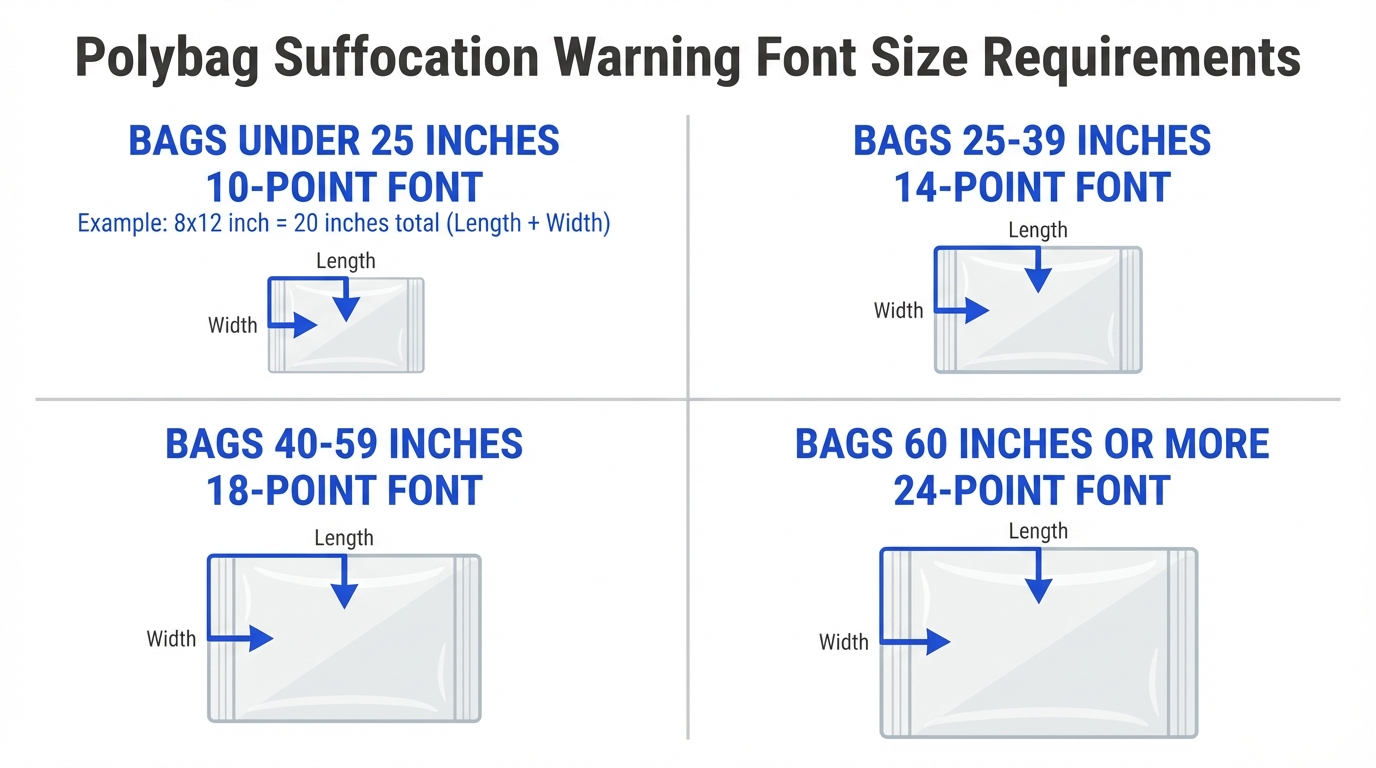
The minimum font size for suffocation warnings is determined by the bag’s dimensions, specifically the sum of the bag’s length and width when laid flat. Larger bags require larger type to ensure the warning is visible and readable. While the general brackets are similar, each retailer defines slightly different breakpoints.
| Bag Size (Length + Width) | Amazon | Walmart | Target | Strictest |
|---|---|---|---|---|
| 60 inches or more | 24 pt | 24 pt | 24 pt | 24 pt |
| 40–59 inches | 18 pt | 18 pt | 18 pt | 18 pt |
| 25–39 inches | 10 pt (14 pt for 30–39”) | 14 pt | 10 pt (14 pt for 30–39”) | 14 pt |
| Under 25 inches | 10 pt | 10 pt | – | 10 pt |
Pro tip: If you sell through multiple retailers, use the strictest column for each size bracket. This avoids maintaining multiple bag SKUs. The key difference is the 25–39” range: Walmart requires 14 pt starting at 25”, while Amazon and Target only require 14 pt from 30”. Defaulting to 14 pt for all bags 25” and above covers everyone.
How to Measure Your Bag
Lay the bag flat and measure the length (top to bottom) and width (side to side). Add these two measurements together. For example, a 12” × 18” bag has a combined dimension of 30 inches, requiring at least 14-point font for the warning text. Note that Amazon measures the opening width when flat, while Walmart and Target measure the overall bag dimensions.
Bag Thickness Requirements
The minimum polybag thickness and the threshold at which a suffocation warning becomes required vary by retailer. Understanding these differences is important because a bag that is compliant for one retailer may need additional labeling for another.
| Retailer | Min. Bag Thickness | Warning Required When | Opening Size Trigger |
|---|---|---|---|
| Amazon FBA | 1.5 mil (standard) | Opening ≥ 5 inches (flat) | 5 inches |
| Walmart | No specific minimum stated | Bags < 1 mil thick with opening ≥ 5” | 5 inches |
| Target | Not specified (must fit product snugly) | All polybags | Not specified |
Amazon’s 5-Inch Rule
Amazon FBA requires suffocation warnings on any polybag with an opening of 5 inches or more when measured flat. This is one of the most specific thresholds among major retailers. Bags that do not meet this requirement may be re-bagged at the fulfillment center at the seller’s expense. Amazon also requires that polybags be at least 1.5 mil thick. Thinner bags (1 mil or less) require extra caution and must always carry the suffocation warning.
Walmart’s Thickness-Based Trigger
Walmart takes a different approach: the warning is required specifically for bags less than 1 mil thick (0.001 inch) with an opening of 5 inches or more. Bags thicker than 1 mil do not require the suffocation warning under Walmart’s standards, though they may still need it for state law compliance. Walmart also prohibits polypropylene (PP) import polybags and dry cleaner bags entirely.
Target’s Universal Requirement
Target requires suffocation warnings on all polybags regardless of thickness or opening size. This is the most conservative policy among the three retailers and the safest standard to default to if you sell through multiple channels. Target also requires that polybags be clear, free of BHT (butylated hydroxytoluene), sized to fit the product snugly, and securely sealed.
Warning Placement & Visibility Rules
Where and how you place the suffocation warning is just as important as the text itself. Placement rules vary by retailer and are a common cause of compliance failures, even when the warning text is correct.
General Placement Best Practices
- Print the warning directly on the bag rather than using a separate sticker when possible. Stickers can peel off during transit
- Use high-contrast colors (black text on clear or white bag) for maximum readability
- Place the warning where it will be visible without opening the package
- Ensure the warning is not obscured by product labels, barcodes, or seams
- For clear bags, ensure the warning does not overlap with the product inside, making it unreadable
Retailer-Specific Placement Rules
| Retailer | Placement Rules |
|---|---|
| Amazon FBA | Warning must be prominently placed and legible. Polybag must be transparent with barcode visible or affixed externally. Non-compliant bags may be re-bagged at seller’s expense. |
| Walmart | Warning must be visible from both sides of the bag. For clear bags, printing on one side is sufficient if legible from both. Solid color bags require printing on both sides in a contrasting color. Bags over 40” (L+W) must repeat the warning at 20-inch intervals. |
| Target | Warning must be visible and legible on the bag. On bags where L+W exceeds 40”, repeat the warning at 20-inch intervals. UPC/barcodes must remain visible through the polybag. |
Key difference: Walmart’s 20-inch repeat interval rule is one of the most commonly missed requirements. If your bag is 42 inches (L+W), you need two copies of the warning text: one every 20 inches.
Retailer Polybag Requirements Comparison
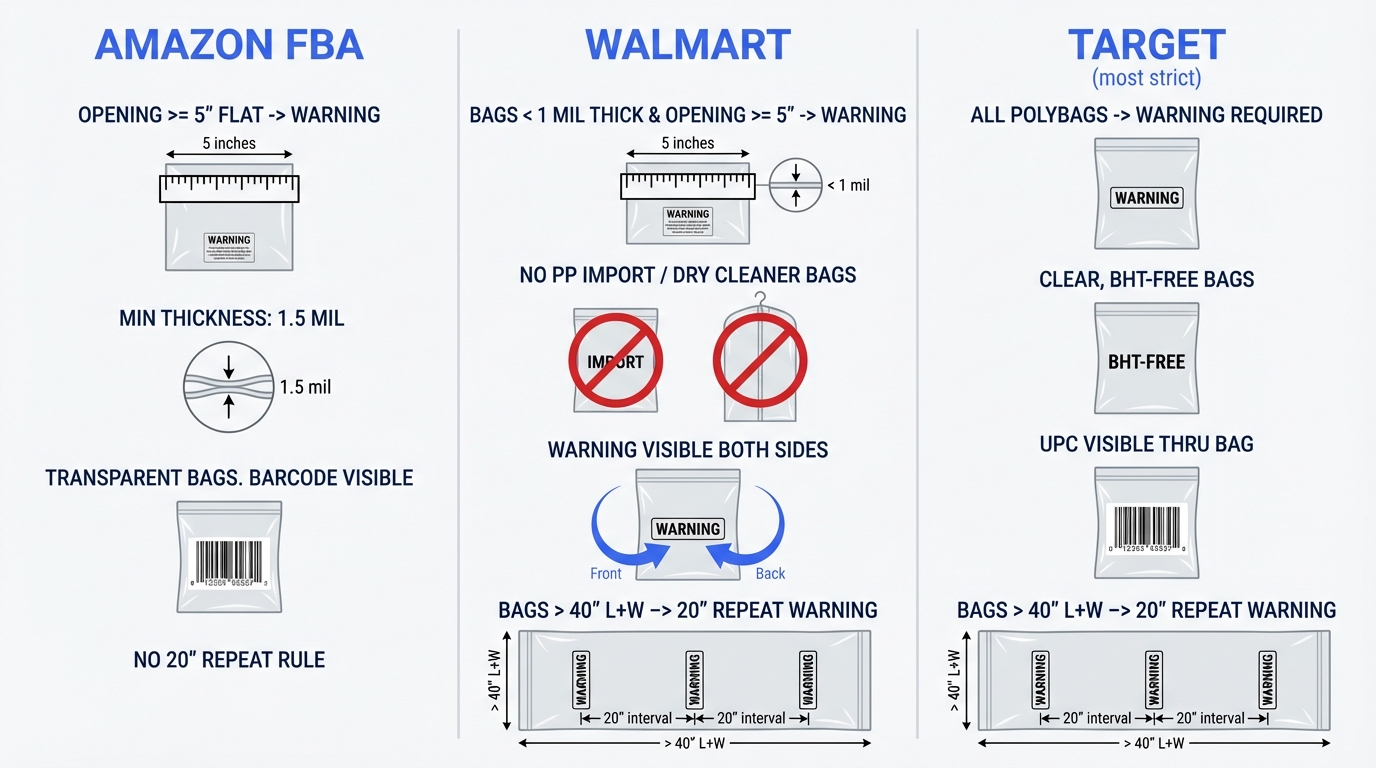
Below is a side-by-side comparison of polybag and suffocation warning requirements across Amazon, Walmart, and Target. Use this table to identify the strictest standard for each specification and build a single compliant bag design.
| Requirement | Amazon FBA | Walmart | Target |
|---|---|---|---|
| Warning trigger | Opening ≥ 5” flat | Bags < 1 mil thick with opening ≥ 5” | All polybags |
| Min. bag thickness | 1.5 mil | Not specified | Not specified |
| Bag material | Transparent poly | No PP import bags or dry cleaner bags | Clear, BHT-free |
| Warning text | CPSC-style (short or long form) | CPSC-style (equivalent language OK with approval) | CPSC-style (full form with “block nose and mouth”) |
| Barcode visibility | Scannable through bag or affixed externally | Hangtags visible through bag | UPC visible through bag |
| 20” repeat rule | Not required | Yes (bags > 40” L+W) | Yes (bags > 40” L+W) |
| Bilingual warning | Not required | Only if bag has other bilingual text | Not specified |
| Non-compliance penalty | Re-bagging at seller cost, chargebacks | Chargebacks, shipment rejection | Chargebacks, shipment rejection |
Every retailer is different
Struggling to keep up with each retailer’s packaging rules?
RetailerHub’s Compliance IQ lets you ask any packaging compliance question, such as “What bag thickness does Amazon require?” or “Does Target need a suffocation warning on poly mailers?” Then get instant, accurate answers.
U.S. State Suffocation Warning Laws
While there is no federal mandate, several U.S. states have enacted laws requiring suffocation warnings on plastic bags. These laws generally apply to thin plastic bags sold or distributed within the state, and they specify minimum warning text, font sizes, and sometimes bag thickness thresholds.
States with Suffocation Warning Laws
The following states have specific legislation requiring suffocation warnings on plastic bags. Requirements vary, but all mandate some form of printed warning about the suffocation hazard to children:
- California: Requires suffocation warnings on thin plastic bags; one of the earliest and most comprehensive state laws
- Massachusetts: 105 CMR 630.000 is one of the most detailed statutes, specifying exact font sizes by bag dimension, the basis for most industry font size charts
- New York: Requires warnings on plastic bags distributed to consumers
- Rhode Island: Requires suffocation warnings on plastic bags
- Virginia: Mandates suffocation warnings on bags meeting specific thickness criteria
In addition, some cities and municipalities have their own ordinances, including New York City and Chicago. These local requirements may apply even in states without a statewide law.
Important: State laws change frequently. This list reflects commonly cited states with suffocation warning legislation. Always verify current requirements with legal counsel or the relevant state consumer protection agency before finalizing your packaging.
Practical Implications for Suppliers
If you sell through retailers that distribute across multiple states, the safest approach is to apply suffocation warnings to all polybags regardless of the destination state. This eliminates the need to track state-by-state requirements and ensures compliance with the most restrictive jurisdictions. This is also the approach Target mandates for all its suppliers.
Common Mistakes & How to Avoid Them
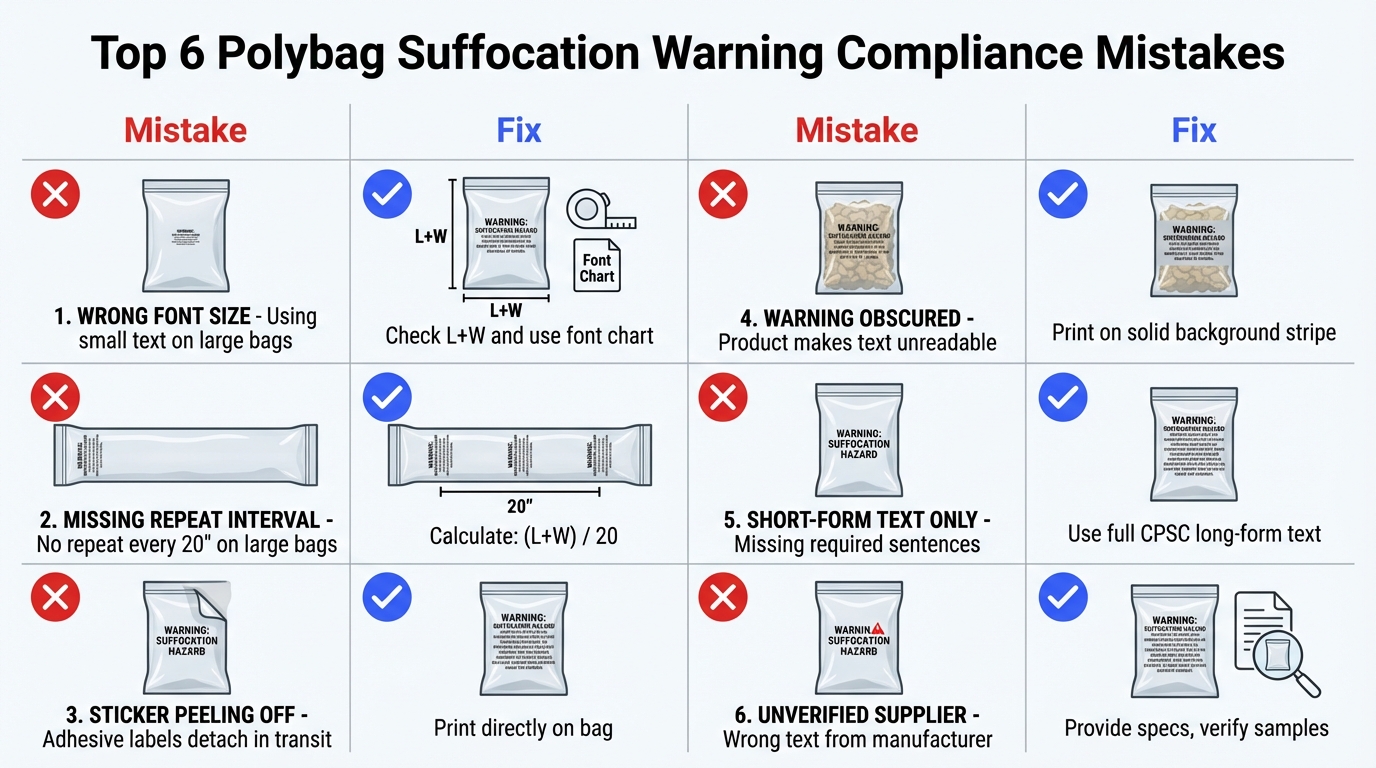
Based on common compliance failures reported by suppliers, here are the most frequent polybag warning mistakes and how to prevent them.
1. Wrong Font Size for Bag Dimensions
The most common error. Suppliers use a one-size-fits-all approach and print 10pt text on large bags that require 18pt or 24pt. Fix: Always calculate L+W and reference the font size chart before ordering bags.
2. Missing the 20-Inch Repeat Interval
Walmart and Target require the warning to be repeated every 20 inches on bags larger than 40” (L+W). A single warning on a large garment bag is non-compliant. Fix: Calculate how many warning placements you need: (L+W) ÷ 20, rounded up.
3. Sticker Warnings That Peel Off
Adhesive labels can peel off during shipping and handling, making the bag non-compliant on arrival at the DC. Fix: Print the warning directly on the bag whenever possible. If using stickers, use permanent adhesive rated for poly surfaces.
4. Warning Obscured by Product or Labels
On clear bags, the warning text can become unreadable when the product inside creates a busy background. Fix: Print the warning on a solid background stripe, or position it on a part of the bag that will remain clear (e.g., the seal area).
5. Using Short-Form Text When Long-Form Is Required
Some retailers (especially Target) require the full CPSC text including “block nose and mouth.” Fix: Default to the long-form warning text to satisfy all requirements.
6. Relying on Your Supplier Without Verification
Many brands assume their packaging supplier will print the correct warning. Overseas manufacturers may use incorrect text, wrong font sizes, or non-standard placement. Fix: Provide your supplier with exact specifications and verify a sample before production.
Avoid these mistakes automatically. RetailerHub’s Instant SOPs generate packaging checklists customized for each retailer, so your warehouse team never misses a polybag spec. See plans →
Polybag Compliance Checklist
Use this checklist before ordering bags or shipping products to ensure your polybags meet all requirements.
Before You Order Bags
- ☐Measure bag L+W to determine font size bracket
- ☐Choose long-form CPSC warning text (includes “block nose and mouth”)
- ☐Verify minimum bag thickness (1.5 mil for Amazon FBA)
- ☐Specify clear/transparent material (no BHT for Target)
- ☐Calculate number of warning placements needed (every 20” for bags > 40” L+W)
- ☐Ensure warning is printed (not stickered) or use permanent adhesive
Before You Ship
- ☐Warning text is legible and not obscured by product or labels
- ☐Barcode/UPC is visible through the bag (Amazon, Target requirement)
- ☐Bag is properly sealed with one selling unit per bag (Walmart eCommerce)
- ☐Warning visible from both sides of the bag (Walmart requirement for opaque bags)
- ☐Font size meets minimum for this bag’s L+W dimension bracket
Frequently Asked Questions
Is there a federal law requiring suffocation warnings on plastic bags?
No. There is no federal statute that mandates suffocation warnings on all plastic bags. The CPSC provides voluntary guidelines that form the basis of most state laws and retailer requirements. However, several states have enacted their own legislation, and major retailers enforce their own standards.
What is the minimum font size for a suffocation warning?
The minimum font size depends on the bag’s dimensions (length + width). For bags under 25”, the minimum is 10pt. For 25–39” bags, 14pt is the safest choice (Walmart requires 14pt from 25”; Amazon and Target from 30”). For 40–59” bags, it’s 18pt. For bags 60” or larger, the minimum is 24pt.
Does Amazon require suffocation warnings on all poly bags?
Amazon requires suffocation warnings on any polybag with an opening of 5 inches or more when measured flat. Bags must also be at least 1.5 mil thick. Non-compliant items may be re-bagged at the fulfillment center at the seller’s expense.
What happens if my polybag doesn’t have a suffocation warning?
Consequences vary by retailer: Amazon may re-bag your product at your expense, Walmart may reject the shipment or issue chargebacks, and Target may refuse non-compliant shipments. You may also face legal liability if your product is sold in a state with mandatory warning laws.
Can I use a sticker instead of printing the warning on the bag?
Most retailers accept either printed warnings or adhesive labels. However, stickers can peel off during transit, which would make the bag non-compliant. Printing directly on the bag is the recommended approach for reliability. If using stickers, use permanent adhesive rated for poly surfaces.
Do I need to repeat the warning on large bags?
Yes, for Walmart and Target. If the bag’s length plus width exceeds 40 inches, the suffocation warning must be repeated at 20-inch intervals. Amazon does not have this repeat requirement.
What is the difference between “mil” and “mm” for bag thickness?
A “mil” is one thousandth of an inch (0.001 inch or 0.0254 mm). It is the standard unit for measuring plastic bag thickness in the U.S. packaging industry. So 1.5 mil = 0.0015 inches = 0.0381 mm.
Does the warning need to be in multiple languages?
In most cases, English only is sufficient for U.S. retail. Walmart specifically states that a bilingual warning is only required if other text on the bag is bilingual. For products sold in Canada, French and English are typically required.
Can I use one bag design for Amazon, Walmart, and Target?
Yes. Use the strictest requirement from each retailer: 1.5 mil minimum thickness, long-form CPSC warning text, font size per the dimension chart, clear BHT-free material, and the 20-inch repeat interval for bags over 40”. This single design will satisfy all three retailers.
Where can I buy compliant polybags with suffocation warnings?
Pre-printed suffocation warning polybags are available from packaging suppliers like Uline, ClearBags, US Poly Pack, and EcoEnclose. Always verify that the pre-printed text and font size match your specific retailer requirements before ordering.
Never miss a packaging spec change
RetailerHub helps you instantly understand any retailer’s packaging requirements, generate warehouse-ready SOPs, and get alerted when specs change. Built by a former ShipBob Lead WMS Engineer with 10+ years in fulfillment.