
How to Get Your Product into Retail Stores: The Complete Guide
Last Updated: Mar 22, 2026
The no-BS guide to selling your product in major retail stores, from getting the buyer’s attention to shipping your first compliant PO. Covers what every other guide skips: EDI, routing guides, chargebacks, and the operational reality of retail.
In This Guide
The Call Every D2C Founder Dreams About
You got the email from the buyer. Your product is going into Target. Or Walmart. Or Costco. Congratulations. You’ve just crossed a threshold that most consumer brands never reach. That feeling of validation is real, and you’ve earned it.
Now comes the part nobody warned you about.
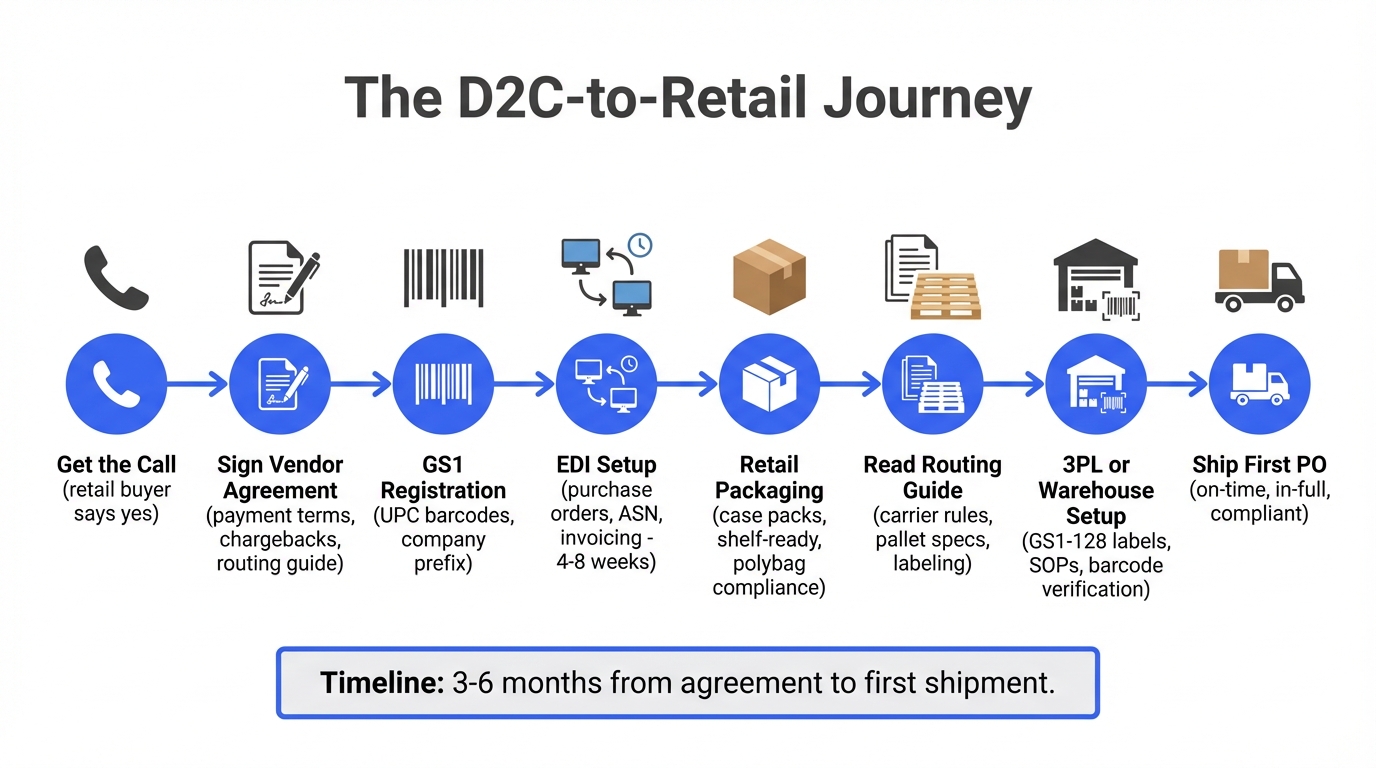
Getting your product into retail stores is not just about having a great product and a convincing pitch. The deal is the starting line, not the finish line. Between signing the vendor agreement and shipping your first compliant purchase order, there’s a maze of EDI setup, GS1 registration, routing guide compliance, labeling standards, and chargeback penalties that can eat your margins alive if you’re not prepared.
Most guides on how to sell your product to retailers stop at the pitch. They’ll tell you to attend trade shows and build a line sheet, and then leave you stranded at the most dangerous part of the journey. This guide covers the full picture: from assessing whether you’re actually retail-ready, to landing the meeting, to navigating vendor onboarding, to shipping your first order without triggering a wave of compliance chargebacks.
Whether you’re a D2C brand exploring your first retail partnership or a small manufacturer scaling into big-box distribution, this is the operational playbook that the Reddit threads wish existed.
Is Your Product Retail-Ready? The Honest Assessment
Before you pitch a single buyer, you need an honest look at whether your business can survive the economics and operational demands of retail. Plenty of products that sell well on Shopify or Amazon D2C aren’t viable at wholesale margins with net-60 payment terms.
Margin analysis
Retailers typically expect a wholesale price that is 50% or less of the retail price (a “keystone” markup). Some categories demand even higher margins. Grocery and consumables often require 25–35% gross margins for the retailer. If your cost of goods sold (COGS) doesn’t leave room for a 50%+ wholesale discount while still covering your operating expenses, retail may not be viable at your current cost structure.
Factor in promotional allowances (5–15% of wholesale), slotting fees ($5,000–$50,000+ per SKU at some retailers), and potential chargebacks (1–5% of revenue for first-year vendors). If your margins can’t absorb these costs, you’ll be writing checks to the retailer instead of cashing them.
Production capacity
A single regional test at a major retailer can mean 500–2,000 stores. A national rollout can mean 5,000+. Can your manufacturing operation scale from hundreds of units per month to tens of thousands without quality degradation or lead time blowouts? Retailers penalize short shipments and late deliveries, if you can’t fulfill a PO in full and on time, you’ll face chargebacks that wipe out the revenue from the orders you did ship correctly.
Cash flow reality
Most major retailers pay on net-30, net-60, or net-90 terms. That means you manufacture, ship, and deliver product today and get paid 60–90 days later. Meanwhile, you’re funding raw materials, production, warehousing, and freight out of pocket. For a D2C brand used to collecting payment at checkout, this cash flow gap is the #1 surprise. You need working capital (or a line of credit) to bridge the gap.
Insurance requirements
Every major retailer requires product liability insurance, typically with minimums of $1 million–$5 million per occurrence (Target requires $5 million) and $2 million–$5 million aggregate. The retailer must be named as an additional insured on your policy. If you don’t have this coverage, get quotes before you pitch. It’s a non-negotiable gate.
Quick retail-readiness check:
Gross margins support 50%+ wholesale discount after COGS
Production can scale to 10x current volume within 90 days
Working capital or credit line covers 90 days of inventory financing
Product liability insurance at $1M–$5M per occurrence (varies by retailer)
UPC barcodes from GS1 (not resellers)
Packaging can survive palletized shipping and retail shelf display
Understanding the Retail Landscape: Which Retailers Fit Your Brand
Not every retailer is the right fit for every product. The compliance burden, volume expectations, and margin requirements vary dramatically. Here’s how the major players compare for first-time vendors:
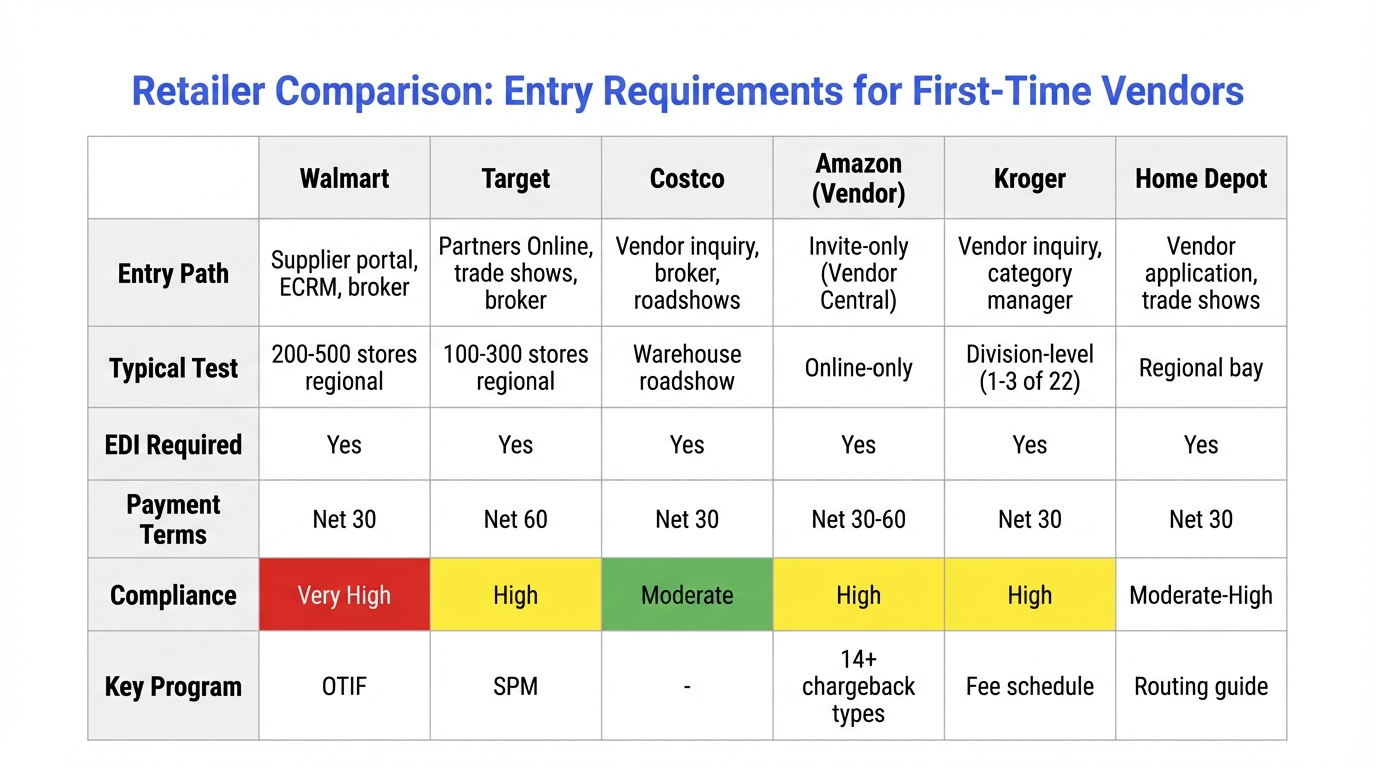
| Retailer | Entry Path | Typical Test | Compliance Level |
|---|---|---|---|
| Walmart | Supplier Application portal, ECRM, broker | 200–500 stores regional, or online-only | Very high (OTIF program, strict routing guide) |
| Target | Partners Online inquiry, trade shows, broker | 100–300 stores regional or online-only | High (SPM program, detailed deduction codes) |
| Costco | Vendor inquiry form, broker, roadshows | Warehouse roadshow (limited stores), regional buy | Moderate (fewer SKUs, simpler packaging rules) |
| Amazon (Vendor) | Invite-only (Vendor Central) | Online-only, no store rollout | High (14+ chargeback categories, strict prep rules) |
| Kroger | Vendor inquiry, category manager, broker | Division-level (1–3 divisions) | High (specific fee schedule per violation type) |
| Home Depot | Vendor application, trade shows | Regional bay, online-only | Moderate-high (EDI required, routing guide compliance) |
Start small. Many successful retail brands started with a regional test or an online-only launch before expanding to full distribution. A 200-store test lets you prove sell-through data, work out operational kinks, and build the track record buyers want to see before committing to a national rollout.
Consider starting with retailers whose compliance requirements match your current operational maturity. If you’ve never set up EDI or shipped pallets to a DC, jumping straight to Walmart’s OTIF program is a recipe for chargebacks.
How to Get in Front of Retail Buyers
Retail buyers are gatekeepers. They review hundreds of product pitches per week and say yes to a tiny fraction. Getting a meeting requires a combination of the right channel, the right timing, and the right pitch materials.
Vendor application portals
Most major retailers have an online vendor application process. Walmart has its Apply to be a Supplier page on their corporate site. Target accepts new supplier inquiries through their corporate supplier intake form. Costco accepts vendor inquiries through their corporate site. Amazon’s Vendor Central is invite-only, but Seller Central is open to anyone. These portals are high-volume and low-conversion, but they’re the official starting point and some brands do get traction through them.
Trade shows that actually work
Trade shows put you face-to-face with buyers who are actively looking for new products. The most productive shows for emerging brands include:
- ECRM: Pre-scheduled one-on-one meetings with category buyers. High cost ($5,000–$15,000+) but the most efficient format for emerging brands.
- ASD Market Week: Large general merchandise show in Las Vegas. Good for consumer goods, beauty, and accessories. Lower cost entry point.
- Natural Products Expo (West & East): The premier show for natural, organic, and specialty food brands. Mandatory for CPG brands targeting Whole Foods, Sprouts, or Kroger natural.
- Category-specific shows: Pet (Global Pet Expo), toy (Toy Fair), hardware (National Hardware Show), housewares (International Home + Housewares Show).
Brokers and rep firms
A broker (or manufacturer’s rep) has existing relationships with buyers and can get your product reviewed faster. They typically charge 3–10% of wholesale revenue. A good broker is worth it if you’re entering a new channel or a category where relationships matter (grocery, especially). Go direct if your product has strong D2C data and viral social proof. Buyers are increasingly scouting TikTok and Amazon bestsellers.
The retail pitch deck
Buyers want to see numbers, not just a pretty product. Your pitch should include:
- Sell-through data: Amazon sales rank, Shopify revenue, velocity per store if you’re already in any retail
- Marketing spend and plan: How you’ll drive traffic to the shelf (social media, influencers, in-store demos)
- Margin structure: Wholesale price, MSRP, retailer margin percentage
- Category growth data: Why this category is growing and where your product fits
- Social proof: Customer reviews, press mentions, social media following, user-generated content
The Vendor Agreement: What You’re Actually Signing
The vendor agreement (sometimes called a supplier agreement or trading partner agreement) is the legal contract that governs your entire relationship with the retailer. It covers everything from payment terms to compliance penalties to intellectual property rights. Most first-time vendors underestimate how much this document matters.
Payment terms
Standard payment terms range from net-30 (common with smaller retailers) to net-90 (some large retailers). Walmart typically pays net-30, Target pays around net-65, and some retailers stretch to net-90 or longer during promotional periods. These terms are usually non-negotiable for new vendors.
Chargeback clauses
The vendor agreement will include a section on compliance penalties, chargebacks that the retailer deducts from your payments when you fail to meet their requirements. These can range from $100 per incident for minor labeling errors to percentage-based penalties for late or short shipments. Our complete chargeback guide breaks down the penalties by retailer, but the key point is: read this section of your vendor agreement carefully. You’re agreeing to these penalties by signing.
Routing guide compliance
Your vendor agreement will reference the retailer’s routing guide: a document (often 50–200+ pages) that specifies exactly how, when, and where to ship. This covers carrier requirements, pallet specifications, labeling standards, delivery windows, and more. Violating the routing guide triggers chargebacks, and “I didn’t read it” is not a defense.
Other clauses to watch
- Cancellation and markdown allowances: The retailer may have the right to cancel orders, return unsold inventory, or require you to fund markdowns on slow-moving product.
- Exclusivity and channel conflict: Some agreements restrict where else you can sell the product or require price parity across channels.
- Insurance and indemnification: You’ll be required to indemnify the retailer against product liability claims and maintain specific insurance coverage.
- Promotional and co-op advertising fees: Many retailers require vendors to contribute to advertising programs, in-store displays, or seasonal promotions.
Confused by your vendor agreement?
RetailerHub’s Compliance IQ answers any retailer compliance question in seconds, from chargeback penalties to labeling specs to EDI requirements.
Vendor Onboarding: The First 90 Days
You’ve signed the agreement. Now comes the operational setup that every D2C brand underestimates. Here’s what you need to get in place before your first purchase order arrives.
EDI (Electronic Data Interchange)
EDI is the electronic system retailers use to send purchase orders (EDI 850), receive advance shipment notifications (EDI 856), and process invoices (EDI 810). If you’ve been running a D2C brand, you’ve probably never touched EDI. It’s the #1 surprise for brands entering retail. You’ll need an EDI provider (SPS Commerce, TrueCommerce, and Orderful are common options for emerging brands) and you’ll need to complete EDI testing with each retailer before you can receive POs.
Budget 4–8 weeks for EDI setup and testing. Don’t wait until your first PO is due to start this process.
GS1 Company Prefix and UPC registration
Every product in retail needs a unique UPC barcode, and those barcodes must come from GS1 (the global standards organization). You’ll need a GS1 Company Prefix (starting at $250 initial fee for up to 10 products, plus annual renewal fees, scaling up from there) and you’ll assign GTINs (Global Trade Item Numbers) to each SKU. Do not buy cheap barcodes from resellers. Major retailers verify GS1 registration and will reject non-authentic UPCs.
Retailer portals
Each retailer has a vendor portal where you’ll manage POs, view scorecards, submit product data, and monitor compliance. Walmart has Retail Link. Target has Partners Online. Amazon has Vendor Central. Getting access and learning to navigate these portals is a task in itself. Allocate time for it.
Shipping labels
Retail shipments require GS1-128 shipping labels with SSCC-18 barcodes on every carton and pallet. These are not the same as your D2C shipping labels. They contain encoded data (ship-to location, PO number, carton contents) that the retailer’s DC scans for automated receiving. Getting labels wrong is one of the most common chargeback triggers for new vendors.
For a deeper dive into compliance tools that streamline onboarding, see our guide to vendor compliance software.
Packaging and Labeling for Retail
Your D2C packaging, the branded mailer box your customers love unboxing, is not going to work for retail. Retail packaging has to survive a supply chain: palletized shipping, DC handling, shelf display, and consumer handling. It also has to meet specific retailer requirements.
UPC barcode requirements
Every retail unit needs a scannable UPC (UPC-A for the US, EAN-13 for international) on the consumer-facing packaging. The barcode must be properly sized (minimum 80% magnification), printed with adequate quiet zones, and achieve an ANSI Grade C or better scan quality. Barcodes that don’t scan at the register cause chargebacks.
Case pack structure
Retailers order in case packs (inner packs within a master carton). You’ll need to define your case pack configuration (e.g., 12 units per inner pack, 4 inner packs per master carton = 48 units per case) and register it in the retailer’s system. The case pack affects everything from shelf replenishment to pallet configuration. Get this wrong and you’ll get PO quantity errors and receiving rejections.
Retail-ready packaging (SRP)
Many retailers now require shelf-ready packaging (SRP), cases designed to be placed directly on the shelf without unpacking individual units. SRP reduces labor costs at the store level and gives your product a branded shelf presence. Costco, Walmart, and Target all have SRP programs.
Polybag and suffocation warnings
If your product is packaged in plastic bags or poly wrap, you’re legally required to include suffocation warning labels. The required text, font size, and bag thickness vary by jurisdiction and retailer. Amazon, Walmart, and Target all enforce polybag requirements. Non-compliant products are rejected at the DC or trigger chargebacks.
Shipping and Logistics: The Compliance Minefield
Shipping to retail DCs is nothing like shipping D2C orders. Every retailer has a routing guide that dictates carrier selection, delivery appointments, pallet specs, labeling, and documentation. Violating any of these rules triggers chargebacks. This is where first-time vendors lose the most money.
Routing guides explained
A routing guide is the retailer’s rulebook for inbound shipments. It specifies which carrier to use (often the retailer’s preferred carrier for collect shipments), how to palletize (GMA vs. CHEP pallets, max height, max weight, stacking patterns), when to ship (Must Arrive By Date windows), and what documentation to include (BOL, packing list, ASN).
Every retailer’s routing guide is different. What works for Walmart will get you chargebacks at Target. You need to read, understand, and operationalize each retailer’s guide separately.
ASN (Advance Shipment Notification)
The ASN (EDI 856) is an electronic notification that tells the retailer exactly what’s in your shipment before it arrives. It must be transmitted before the shipment reaches the DC, and the contents must match the physical shipment exactly. ASN errors are the #1 chargeback trigger for new vendors because manual ASN creation is error-prone.
MABD and on-time delivery
The Must Arrive By Date (MABD) is the deadline for your shipment to arrive at the retailer’s DC. Walmart’s OTIF (On-Time In-Full) program penalizes shipments that arrive late (currently requiring 98% on-time for collect shipments, 90% for prepaid) or with incorrect quantities (95% in-full threshold). Late shipments during promotional windows can result in the entire PO being cancelled.
The 3PL decision
Most D2C brands don’t have warehouse operations that can handle retail-compliant shipping. A third-party logistics provider (3PL) that specializes in retail fulfillment can handle palletizing, labeling, EDI integration, and routing guide compliance. The cost is typically $2–$5 per unit plus storage fees, but the chargeback savings often more than cover it.
If you’re handling fulfillment in-house, you’ll need documented standard operating procedures for every retail account. Our warehouse SOP guide has templates and retailer-specific examples.
Drowning in routing guide requirements?
RetailerHub’s Compliance IQ answers any routing guide question instantly, and Instant SOPs generate warehouse-ready checklists for each retailer account.
Avoiding the Chargeback Trap
Retail chargebacks are the hidden tax that destroys first-year vendor margins. They’re financial penalties that retailers deduct from your payments when you fail to meet compliance requirements: wrong labels, late shipments, ASN mismatches, incorrect pallets. New vendors are especially vulnerable because every mistake is a first-time mistake.
The chargebacks that hit first-time vendors hardest
- ASN errors: Missing, late, or inaccurate ASNs. The fix: automate ASN generation through your EDI provider.
- Labeling violations: Wrong barcode format, missing GS1-128 labels, incorrect SSCC. The fix: invest in barcode verification (not just scanning).
- Late shipments: Missing the MABD window. The fix: build 1–2 days of buffer into your ship schedule.
- Wrong pallet configuration: Wrong pallet type, overweight, wrong stacking pattern. The fix: read the routing guide, build it into your SOP.
- Short shipments: Shipping fewer units than ordered. The fix: verify PO quantities before picking.
How chargebacks eat your margin
Industry data suggests that first-year vendors lose 2–5% of gross revenue to chargebacks. On a $500,000 retail account, that’s $10,000–$25,000 in penalties. Combine that with slotting fees, promotional allowances, and net-60 terms, and your “profitable” retail deal can turn into a cash drain. The vendors who survive their first year are the ones who invest in compliance from day one.
Monitor your vendor scorecard in each retailer’s portal. Your scorecard tracks your compliance performance over time, and a declining score can lead to reduced PO volume or termination of the relationship.
Prevent chargebacks before they happen
RetailerHub’s Version Intel alerts you when a retailer changes their requirements, so you’re never blindsided by a new compliance rule.
Pricing Strategy: Wholesale Margins That Actually Work
The “keystone markup” (retailer buys at 50% of retail price) is the rule of thumb, but it’s not universal. Margin expectations vary by category, retailer, and product type.
| Category | Typical Retailer Margin | Notes |
|---|---|---|
| Grocery / CPG | 25–35% | Thin margins, high volume. Slotting fees common. |
| Health & Beauty | 40–50% | Higher margins, strong brand loyalty expected. |
| Electronics | 15–25% | Low margins, MAP pricing more common. |
| Home / Housewares | 45–55% | Higher margins, seasonal promotions expected. |
| Apparel | 50–60% | Highest margins but markdown risk. Seasonal returns. |
| Pet | 35–45% | Growing category with strong repeat purchase rates. |
The hidden costs of retail pricing
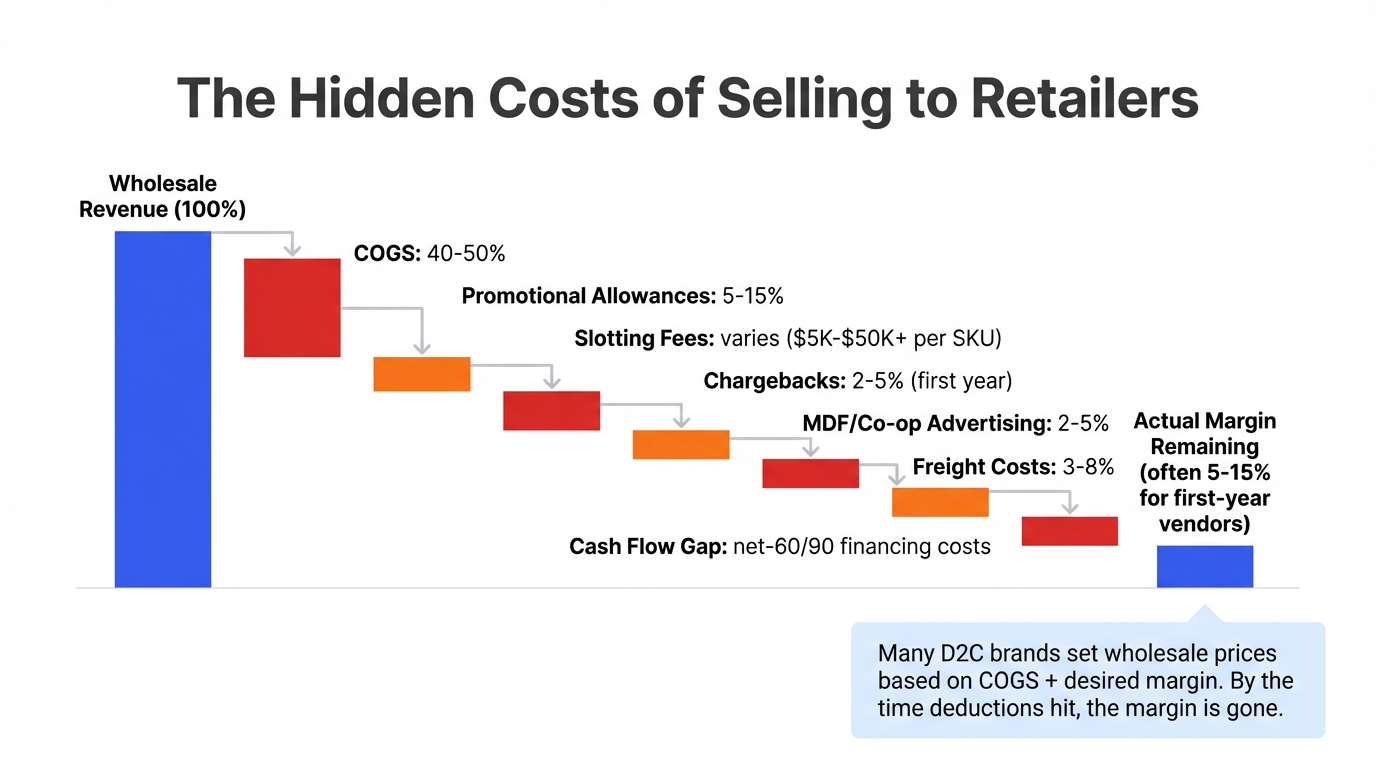
Your wholesale price is not your net revenue. You need to subtract:
- Slotting fees: One-time per-SKU fees to get shelf space. Common in grocery ($5,000–$50,000+ per SKU per retailer). Less common in general merchandise.
- Promotional allowances: 5–15% of wholesale for retailer-driven promotions, endcap displays, circular features.
- MDF (Market Development Funds): Co-op advertising contributions, often 2–5% of wholesale.
- Chargebacks: Budget 1–5% of wholesale for compliance penalties in year one.
- Freight: For prepaid shipments, you’re covering freight to the DC. For collect shipments, the retailer deducts freight charges.
Price your product so you’re profitable after all of these deductions, not before. Many D2C brands set their wholesale price based on COGS + desired margin and then get surprised when the deductions wipe out the margin. Work backwards from the deductions.
Scaling from D2C to Omnichannel
Once you’re in retail, you’re running an omnichannel business. That creates new complexities around inventory management, channel conflict, and pricing.
Inventory allocation
You can’t sell the same unit twice. Allocating inventory between D2C, Amazon, and retail requires a system (even if it’s a spreadsheet to start). Under-allocating to retail means short shipments and OTIF penalties. Under-allocating to D2C means lost high-margin sales. As you scale, an ERP or inventory management system becomes essential.
Channel conflict and pricing
If your product is $29.99 on your Shopify store and $34.99 at Target, buyers notice. If your Amazon price undercuts your retail partners, they notice even faster. Many retail agreements include price parity provisions or MAP (Minimum Advertised Price) policies. Establish a MAP policy before you enter retail, and enforce it across all channels including Amazon and your own site.
Building on the retail relationship
A successful first test leads to expansion, more stores, more SKUs, better placement. The key is sell-through data. Use the retailer’s portal to monitor weekly sales velocity. If sell-through is strong, come back to the buyer with expansion proposals backed by data. If it’s weak, diagnose why (pricing, placement, marketing support) and adjust before the retailer cuts your shelf space.
The First-Timer Checklist: Everything You Need Before Your First PO
Here’s the timeline for what to do once you’ve signed the vendor agreement.
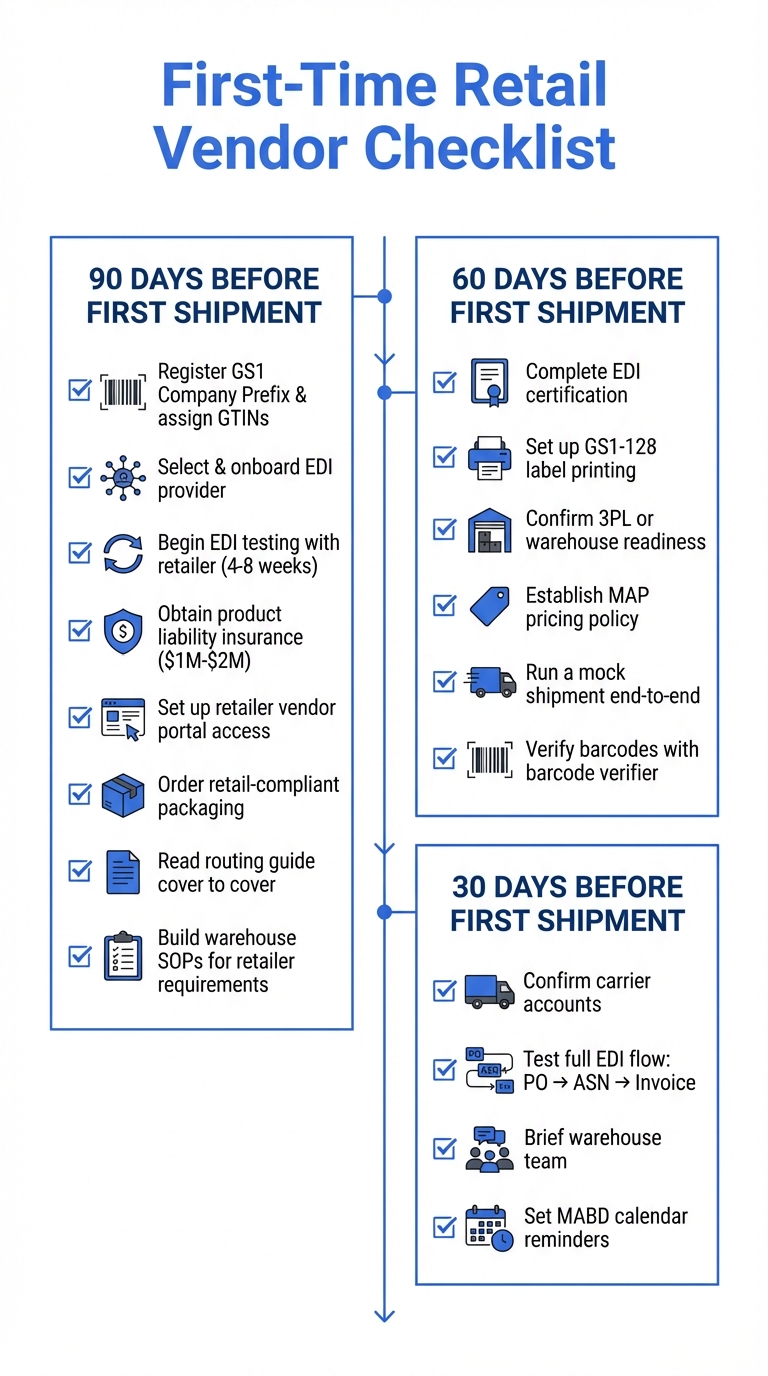
90 days before first shipment
Register for a GS1 Company Prefix and assign GTINs to all SKUs
Select and onboard an EDI provider (SPS Commerce, TrueCommerce, etc.)
Begin EDI testing with the retailer (this takes 4–8 weeks)
Obtain product liability insurance with retailer named as additional insured
Set up access to the retailer's vendor portal (Retail Link, Partners Online, etc.)
Order retail-compliant packaging (UPC labels, case pack cartons, pallet-ready)
60 days before first shipment
Read the retailer's routing guide cover to cover
Build warehouse SOPs for this retailer's specific requirements
Complete EDI testing and get certified for PO receipt, ASN, and invoicing
Set up GS1-128 label printing capability (thermal transfer printer + software)
Confirm 3PL readiness or internal warehouse capacity for retail fulfillment
Establish MAP pricing policy across all sales channels
30 days before first shipment
Run a mock shipment: pick, pack, label, palletize, and generate ASN exactly as you would for a real PO
Verify all barcodes scan correctly with a barcode verifier (not just a scanner)
Confirm carrier accounts are set up and the retailer's preferred carrier is configured
Test the full EDI flow end-to-end: PO → pick → ASN → ship → invoice
Brief your warehouse team on the specific requirements for this retailer
Set calendar reminders for MABD windows and PO confirmation deadlines
Frequently Asked Questions
From D2C to Retail-Ready in Days, Not Months
RetailerHub helps brands and 3PLs instantly answer any retailer compliance question, generate warehouse-ready SOPs, and get alerted when requirements change. Built by a former ShipBob Lead WMS Engineer with 10+ years in fulfillment.
Related Guides
Retail Chargebacks
Common types, retailer penalties, and proven prevention strategies.
EDI & ComplianceWhat is an ASN?
Complete guide to advance shipment notifications, EDI 856, and SSCC labels.
Labeling & BarcodesGS1-128 Shipping Labels
Everything about GS1-128 barcodes, SSCC-18, and retailer label requirements.