
Wholesale Pricing: How to Price Your Product for Retail
Last Updated: Mar 23, 2026
The complete guide to wholesale pricing for retail vendors, covering markup formulas, retailer margin expectations, hidden costs that destroy your margin, and pricing strategies that protect your bottom line.
In This Guide
Why Your D2C Pricing Won’t Work for Retail
You built a product, sold it online for $29.99, and your margins were healthy. Then a retail buyer called and asked for a wholesale price. You multiplied your cost by two and quoted $14.99. The buyer said yes. You celebrated.
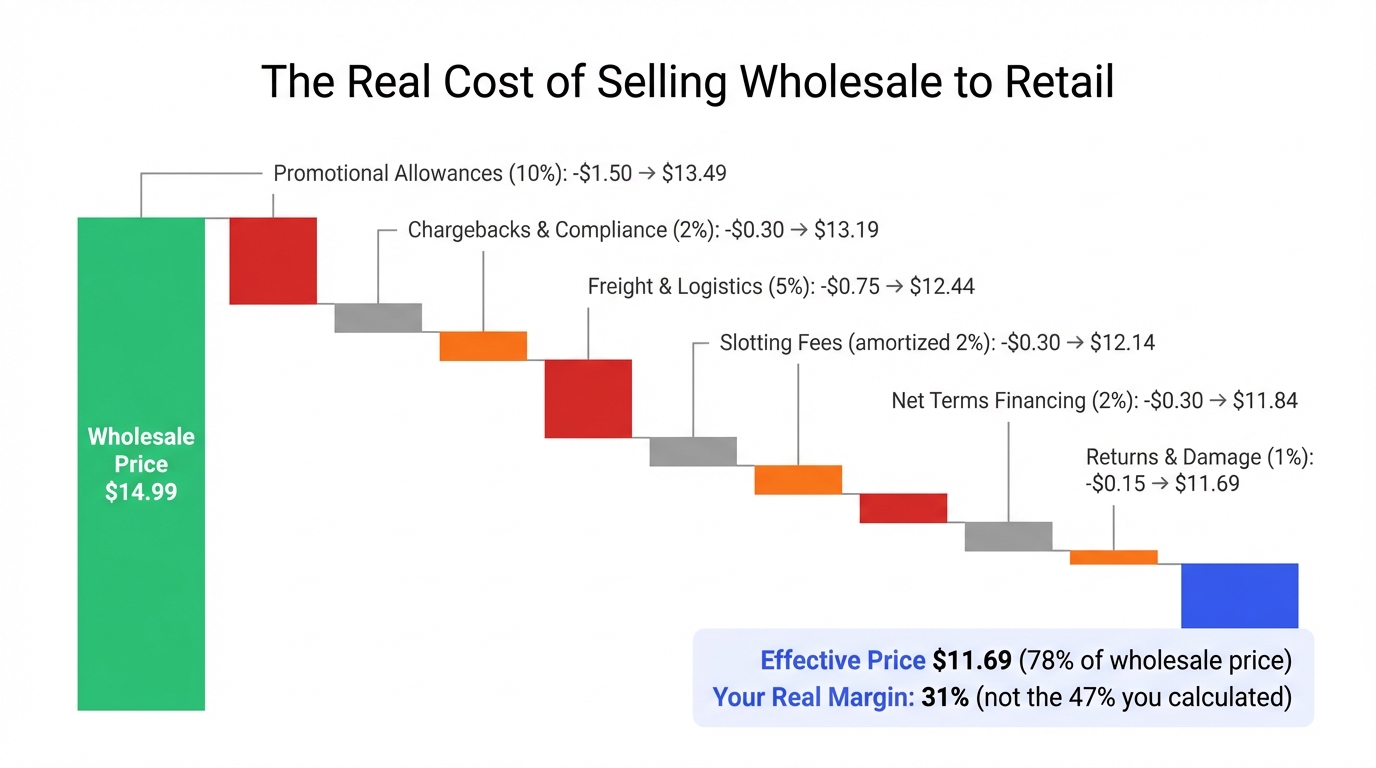
Then the reality of retail pricing arrived: promotional allowances took 10%. Net 90 payment terms meant you waited three months to get paid. Chargebacks for labeling errors cost 2% of revenue. Freight was your responsibility. And the slotting fee to get shelf space? $15,000 per SKU.
Your 50% wholesale margin was suddenly 15%, before accounting for the cost of capital tied up in unpaid invoices. This is the margin shock that hits every D2C brand entering retail for the first time, and it happens because generic wholesale pricing formulas don’t account for the real economics of selling to major retailers.
The Core Problem
Most wholesale pricing guides stop at the formula: Cost × 2 = Wholesale Price. That formula is a starting point, not an answer. This guide covers what happens after the formula, the hidden costs, retailer margin expectations, and negotiation dynamics that determine whether selling wholesale is profitable or a slow path to bankruptcy.
Wholesale Pricing Basics: The Fundamentals
Before diving into the complexities, let’s establish the core terminology. Wholesale price is what you charge the retailer. Retail price (or MSRP) is what the retailer charges the consumer. The difference between the two is the retailer’s gross margin.
| Term | Definition | Example |
|---|---|---|
| COGS | Cost of Goods Sold: materials, labor, packaging, freight to your warehouse | $8.00 |
| Wholesale Price | Price you charge the retailer per unit | $14.99 |
| Retail Price (MSRP) | Suggested retail price the consumer pays | $29.99 |
| Markup | Percentage added to cost: (Price − Cost) / Cost | 87% ($14.99 − $8) / $8 |
| Margin | Percentage of selling price that is profit: (Price − Cost) / Price | 47% ($14.99 − $8) / $14.99 |
Markup vs. Margin: The Distinction That Trips Everyone Up
Markup is calculated on cost. Margin is calculated on selling price. When a retail buyer says “I need 50% margin,” they mean 50% of the retail selling price is their gross profit. A 50% margin is not the same as a 50% markup: a 50% margin requires a 100% markup (doubling the wholesale price).
This distinction is critical because retailers always think in margins, while many vendors instinctively think in markups. If you quote a price based on a 50% markup when the buyer needs a 50% margin, your price is too high and the deal dies before it starts.
Keystone Pricing
Keystone pricing is the traditional retail pricing rule: the retail price is double the wholesale price. If your wholesale price is $15, the retailer sells at $30. This gives the retailer a 50% margin. Keystone has been the baseline in retail for decades, but many categories now demand higher margins (apparel, beauty) or accept lower ones (electronics, grocery). It’s a starting point for negotiations, not a guaranteed standard.
The Wholesale Pricing Formula for Retail
There are two approaches to calculating your wholesale price, and which you use depends on whether you’re starting from your costs or from the retail price.
Approach 1: Cost-Up (Start with COGS)
Wholesale Price = COGS ÷ (1 − Desired Margin %)
Example: $8.00 COGS ÷ (1 − 0.40) = $13.33 wholesale price (40% margin)
Your COGS must include everything: raw materials, manufacturing labor, packaging, quality testing, inbound freight to your warehouse, and any import duties or tariffs. Underestimating COGS is the most common pricing mistake. If your COGS is wrong, every number that follows is wrong too.
Approach 2: Retail-Back (Start with MSRP)
Wholesale Price = Retail Price × (1 − Retailer Margin %)
Example: $29.99 retail × (1 − 0.50) = $15.00 wholesale price (retailer gets 50% margin)
This is how most retail deals actually work. The buyer has a target retail price based on the category and competitive set. They apply their required margin percentage and tell you the wholesale price they’ll accept. Your job is to decide whether that price works for your business.
Wholesale Price Calculator: Worked Examples
| COGS | Target Margin | Wholesale Price | At Keystone (2×) | Retail Price |
|---|---|---|---|---|
| $5.00 | 40% | $8.33 | $16.66 | $16.99 |
| $8.00 | 45% | $14.55 | $29.10 | $29.99 |
| $12.00 | 50% | $24.00 | $48.00 | $49.99 |
| $20.00 | 55% | $44.44 | $88.88 | $89.99 |
Notice the gap between “Target Margin” and “At Keystone.” A 40% margin means you’re keeping more than keystone suggests, while a 55% margin means the retailer is taking a bigger cut. The formulas give you the floor, but the real wholesale price depends on what the retailer’s margin expectations are for your category.
Retailer Margin Expectations by Category
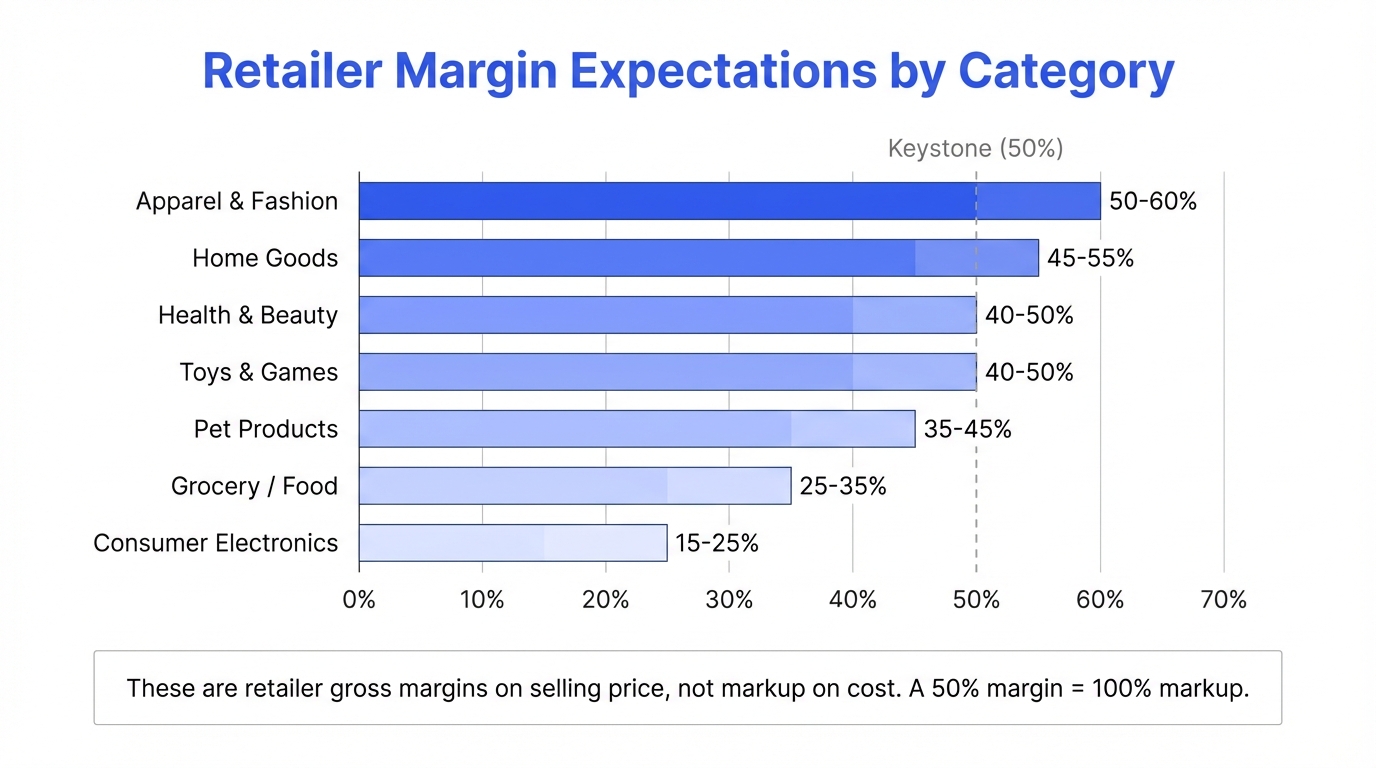
Retailers don’t all want the same margin. The margin a buyer expects depends on the product category, competitive dynamics, shelf space scarcity, and the retailer’s own business model. Here are typical gross margin ranges by category:
| Category | Typical Margin | Markup Equivalent | Notes |
|---|---|---|---|
| Grocery / Food | 25–35% | 33–54% | Thin margins, high volume. Perishables at the lower end. |
| Health & Beauty | 40–50% | 67–100% | Higher margins. Prestige brands negotiate lower retailer margins. |
| Apparel & Fashion | 50–60% | 100–150% | Highest margins. Accounts for markdown risk on unsold inventory. |
| Consumer Electronics | 15–25% | 18–33% | Low margins, high ASP. Retailers make money on accessories and warranties. |
| Home Goods | 45–55% | 82–122% | Wide range. Commoditized products at the lower end, decorative at higher. |
| Toys & Games | 40–50% | 67–100% | Seasonal demand creates markdown risk. Licensed products at lower margins. |
| Pet Products | 35–45% | 54–82% | Growing category. Premium/natural brands can negotiate toward the lower end. |
These are gross margin ranges, the retailer’s margin before their own operating costs (rent, labor, shrinkage, utilities). The retailer’s net margin after costs is typically much thinner, which is why buyers are aggressive on pricing. They’re not being greedy. They’re trying to cover their own cost structure.
One critical detail: when a buyer says “I need 50% margin,” they mean margin on the selling price, not markup on cost. A 50% margin means the wholesale price is half the retail price. This is the keystone model, and many categories still follow it.
Chargebacks eating your wholesale margin?
RetailerHub’s Compliance IQ answers any retailer compliance question instantly (labeling requirements, shipping windows, pallet configurations) so you avoid the chargebacks that shrink your effective wholesale price.
Wholesale vs. Retail Pricing: A Worked Example
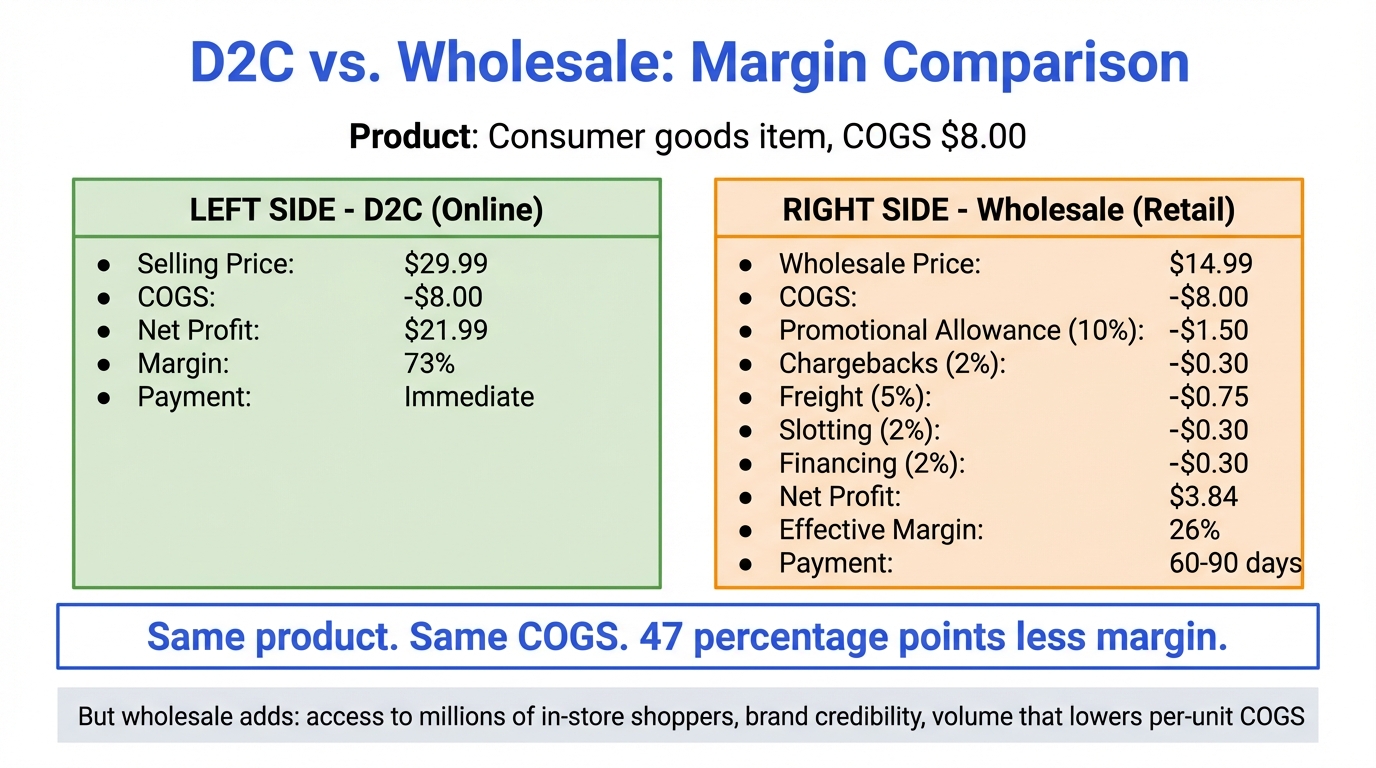
Let’s trace the real economics of a D2C brand selling a product at $29.99 online with a COGS of $8.00. They land a deal with a mid-size retailer.
| Line Item | D2C (Online) | Wholesale (Retail) |
|---|---|---|
| Selling Price | $29.99 | $14.99 |
| COGS | −$8.00 | −$8.00 |
| Promotional Allowance (10%) | – | −$1.50 |
| Chargebacks (2%) | – | −$0.30 |
| Freight (5%) | – | −$0.75 |
| Slotting Fee (amortized, 2%) | – | −$0.30 |
| Net Terms Financing (2%) | – | −$0.30 |
| Net Profit per Unit | $21.99 | $3.84 |
| Effective Margin | 73% | 26% |
The Math That Makes D2C Founders Gasp
The D2C margin was 73%. The wholesale margin before hidden costs was 47%. The effective wholesale margin after all costs is 26%. The product is still profitable, but only if you price with these costs built in from the start. Brands that set their wholesale price based on the formula alone discover these costs after the deal is signed, when it’s too late to renegotiate.
Wholesale Pricing Strategies for First-Time Retail Vendors
1. Build Retail Pricing into Your Cost Structure from Day One
If you know retail is in your future, design your product and cost structure to support wholesale margins from the start. This means engineering your COGS low enough that you can offer a wholesale price that gives the retailer their margin and leaves you with enough after hidden costs. Retrofitting a D2C product for retail margins usually means cutting costs, which can mean cutting quality.
2. Create Retail-Exclusive SKUs
Avoid channel conflict by creating different sizes, bundles, or variants for retail vs. your D2C store. A different pack size means the prices aren’t directly comparable. This protects your D2C margins and gives the retailer something exclusive to promote. Many successful brands sell a 12 oz size online and a 16 oz size in retail, or create a unique colorway for each retail partner.
3. Negotiate Tiered Pricing Based on Volume
Offer better pricing at higher volume commitments. This aligns incentives: the retailer gets a better price if they order more, and you get predictable volume that lowers your per-unit cost. A typical structure might be: base price at 1,000 units, 5% discount at 5,000 units, 10% discount at 10,000 units.
4. Start with Online Marketplace Channels
Selling through a retailer’s online marketplace (Target Plus, Walmart Marketplace) typically has lower compliance costs than in-store placement. No slotting fees, simpler logistics, and fewer chargebacks. Use marketplace sales data to demonstrate demand before pitching for in-store placement, where the economics are more demanding.
5. Set a MAP (Minimum Advertised Price) Policy
A Minimum Advertised Price (MAP) policy sets the lowest price any retailer can advertise for your product. MAP prevents a race to the bottom where retailers undercut each other and your D2C price. Note that MAP controls advertised prices, not actual selling prices. Retailers can sell below MAP in-store, but they can’t advertise below it. Enforcing MAP requires monitoring and willingness to cut off violators.
6. Use Promotional Periods Strategically
Retailers will ask you to participate in promotional events (Black Friday, seasonal sales, endcap features). Don’t say yes to everything. Each promotion costs you money in allowances and discounted pricing. Plan 2–3 strategic promotions per year that align with your highest-demand periods, and build those costs into your annual pricing model.
Net Payment Terms and Cash Flow
Payment terms define when the retailer pays you after receiving the goods. In D2C, you get paid immediately (or within days via Shopify/Stripe). In wholesale, the timeline stretches dramatically.
| Term | Meaning | Cash Flow Impact |
|---|---|---|
| Net 30 | Payment due 30 days after invoice | Manageable for most businesses. Common with smaller retailers. |
| Net 60 | Payment due 60 days after invoice | Requires working capital. Common with mid-size retailers. |
| Net 90 | Payment due 90 days after invoice | Significant cash strain. Common with some large retailers. Target typically pays net 60–90. |
| 2/10 Net 30 | 2% discount if paid within 10 days, otherwise net 30 | Early payment discount. Worth offering if cash flow matters more than margin. |
The Real Cash Flow Timeline
Consider this timeline for a product shipped to a retailer on net 90 terms: you order raw materials (week 1), manufacture the product (weeks 2–4), ship to the retailer (week 5), the retailer receives and processes (week 6), and then the 90-day clock starts. You might not see payment until week 19, nearly five months after you paid for materials.
This cash gap is what kills underfunded brands. You need enough working capital to cover 4–5 months of inventory, production, and overhead before the first check arrives.
Financing Options
Invoice factoring lets you sell your unpaid invoices to a factoring company at a discount (typically 2–5% of invoice value) and get cash within 24–48 hours. Purchase order financing funds the production of confirmed orders. A business line of credit provides flexible working capital. Each has costs that reduce your effective margin. Factor these into your wholesale pricing.
Pricing Negotiation with Retail Buyers
Retail buyers negotiate for a living. You’re likely doing it once. Here’s what to expect and how to prepare.
What Buyers Will Ask For
- ●Lower wholesale price. Always. Their first ask will be below your quoted price. Build in negotiating room.
- ●Promotional support: a percentage of sales or fixed dollar amount for marketing programs.
- ●Exclusivity windows: 30–90 day exclusive before you sell to their competitors.
- ●Longer payment terms: net 60 or 90 instead of net 30.
- ●Return rights: the ability to return unsold product. Resist this unless you’re highly confident in sell-through.
What’s Actually Negotiable
Margin expectations are mostly non-negotiable: the buyer has a target, and they won’t bend much. But promotional allowances, payment terms, minimum order quantities, and exclusivity windows all have room. You can trade concessions: offer a slightly better promotional allowance in exchange for net 30 instead of net 60. Or accept a lower MOQ in exchange for a full-price (no promotional) launch period.
When to Walk Away
Walk away if the deal doesn’t meet your floor price, the minimum wholesale price at which you can cover COGS, all hidden costs, and still make a meaningful margin. Calculate your floor price before the negotiation and don’t go below it. A retail placement that loses money doesn’t become profitable at higher volume. It just loses money faster.
Protect your wholesale margins from compliance costs
Chargebacks are one of the biggest hidden costs in wholesale. RetailerHub gives you instant answers to any retailer’s labeling, shipping, and packaging requirements, so you get it right the first time.
Wholesale vs. D2C: Should You Sell to Retailers at All?
After reading about all these costs, you might wonder if wholesale is even worth it. The answer depends on your business model, growth goals, and product economics.
| Factor | D2C (Online) | Wholesale (Retail) |
|---|---|---|
| Margin | Higher per unit (60–80%) | Lower per unit (20–40% effective) |
| Volume | Limited by marketing spend | Access to millions of shoppers in-store |
| Customer Acquisition | You pay for every customer (ads, SEO, social) | Retailer drives foot traffic; you pay through margin |
| Brand Credibility | Built over time through marketing | Instant credibility from being “on the shelf” |
| Cash Flow | Immediate payment | 60–90 day payment delay |
| Complexity | You control everything | EDI, compliance, chargebacks, routing guides |
| Scale Potential | Ceiling limited by CAC economics | Single PO can equal months of D2C revenue |
The best brands do both. They use D2C as a high-margin profit center and brand-building channel, while using wholesale for volume and credibility. The key is pricing each channel correctly so neither undermines the other.
For a complete roadmap on entering retail, including compliance, operations, and the full onboarding process, see our guide on how to get your product into retail stores.
Common Wholesale Pricing Mistakes
1. Using the "cost times two" rule without accounting for hidden costs
The keystone formula is a starting point, not a pricing strategy. If your wholesale price doesn’t account for promotional allowances, chargebacks, freight, and financing costs, your actual margin will be 15–20% lower than you expected.
2. Confusing markup with margin
A 50% markup on $10 gives you a $15 wholesale price. A 50% margin on a $30 retail price gives a $15 wholesale price. Same number, completely different math. Retail buyers think in margins. If you think in markups, you’ll miscommunicate on price and either lose the deal or under-price your product.
3. Pricing the same for every retailer
Different retailers have different margin requirements, promotional expectations, and compliance costs. A Walmart deal looks nothing like a Whole Foods deal. Tailor your pricing for each channel based on their specific cost structure, not a one-size-fits-all wholesale price.
4. Ignoring channel conflict with D2C pricing
If your product is $29.99 on your website and $29.99 at Target, you’re competing with your own retail partner. Retailers notice, and they don’t like it. Create retail-exclusive SKUs, implement MAP pricing, or differentiate by size/bundle to avoid undercutting your retail partners.
5. Accepting a deal that doesn’t meet your floor price
The excitement of landing a big retailer makes founders accept deals that don’t work financially. A money-losing deal at Walmart doesn’t become profitable at higher volume. It accelerates your cash burn. Know your floor price and don’t go below it.
6. Not budgeting for year-one chargeback costs
First-year chargeback rates are always higher than steady-state. New vendors are still learning each retailer’s specific compliance requirements: labeling, packaging, shipping windows, pallet configurations. Budget 1–5% for chargebacks in year one, then work to reduce it to under 1%.
Frequently Asked Questions About Wholesale Pricing
Protect your wholesale margins from day one
Brands and 3PLs use RetailerHub to instantly answer any retailer compliance question, generate warehouse-ready SOPs, and get alerted when requirements change. Built by a former ShipBob Lead WMS Engineer with 10+ years in fulfillment.
Related Guides
Retail Chargebacks
What they are, why they happen, and proven strategies to prevent them.
Getting StartedHow to Get Your Product into Retail Stores
The complete roadmap from pitch to shelf placement.
OnboardingRetail Vendor Onboarding
Navigating EDI setup, compliance requirements, and the vendor portal maze.