
What is an Advance Shipment Notification (ASN)?
Last Updated: Mar 20, 2026
The complete guide to advance shipment notifications, EDI 856 transactions, SSCC labels, and retailer compliance. Learn how ASNs work, why retailers require them, and how to avoid costly chargebacks.
This guide contains AI-generated content based on publicly available information and general industry knowledge. Always verify requirements directly with your retail trading partners.
In This Guide
What is an ASN in Shipping?
An Advance Shipment Notification (ASN) is an electronic document sent by a supplier to a retailer before a shipment arrives at the receiving dock. It tells the retailer exactly what is coming, how it is packed, when it will arrive, and how to identify each carton or pallet using SSCC barcodes.
In EDI (Electronic Data Interchange) terms, the ASN is transmitted as an EDI 856 transaction set, also known as a Ship Notice/Manifest. The terms "ASN," "advance ship notice," and "EDI 856" are often used interchangeably in the supply chain industry.
Most major retailers (including Walmart, Amazon, Target, Home Depot, and Kroger) require suppliers to send an ASN for every shipment. Failing to send one, or sending one late or with errors, typically results in chargebacks ranging from $200 to $2,000+ per shipment.
The retailer-specific requirements in this guide are based on publicly available retailer compliance information, including requirements published by Walmart, Target, and official EDI 856 implementation standards. This content is for general educational purposes. Always verify current requirements directly with your retail trading partners.
Key Facts
- ●Also known as: Advance Ship Notice, EDI 856, Ship Notice/Manifest, DESADV (in EDIFACT)
- ●Purpose: Notify the retailer what is being shipped before it arrives
- ●Timing: Must be sent before the shipment reaches the retailer’s DC
- ●Penalty for non-compliance: $200–$2,000+ per shipment depending on retailer
How the ASN Process Works
The advance shipment notification is one step in a larger EDI-based order fulfillment cycle. Here is how it fits into the end-to-end process, from purchase order to delivery:
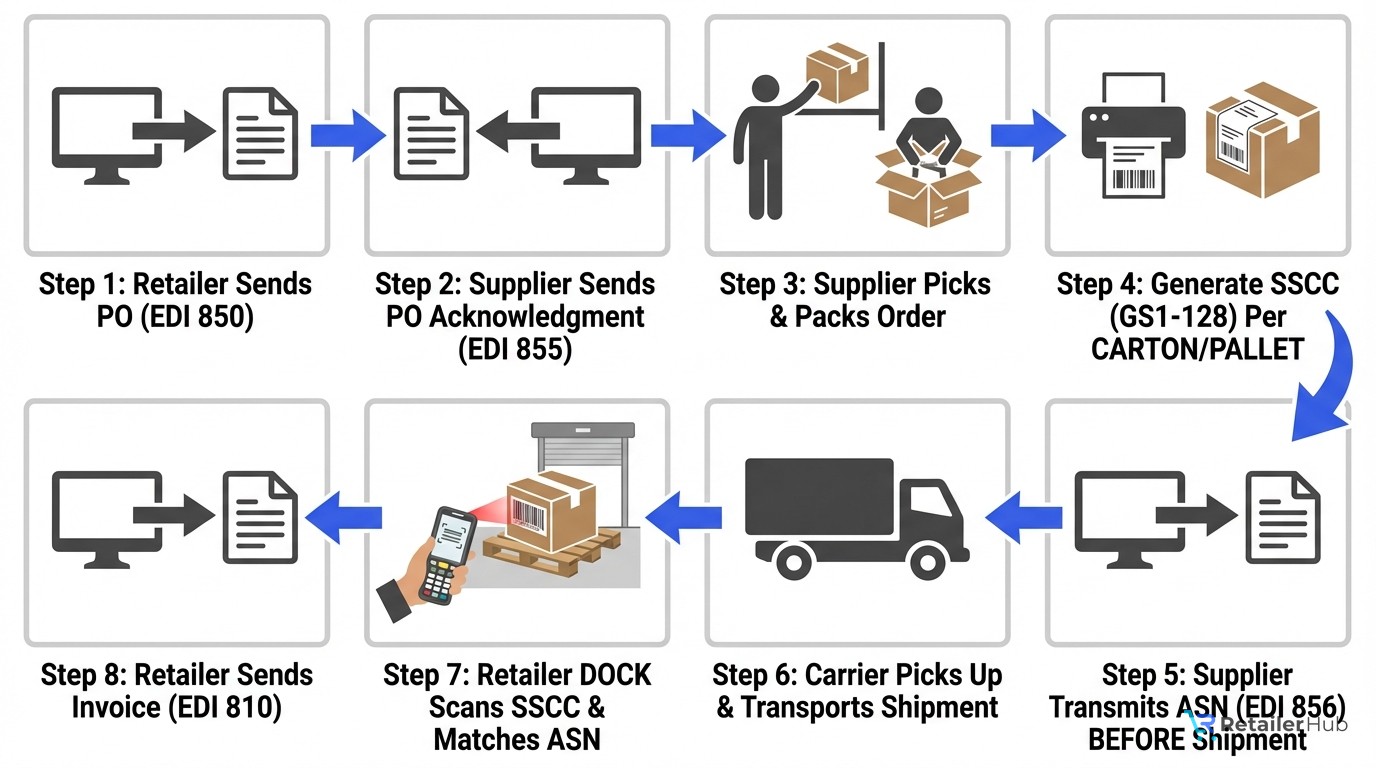
Purchase Order (EDI 850)
Retailer sends PO to supplier with item details, quantities, and delivery dates.
PO Acknowledgment (EDI 855)
Supplier confirms receipt, accepts the order, and notes any changes.
Pick & Pack
Warehouse picks items and packs them into cartons and pallets.
Generate SSCC Labels
Each carton and pallet gets a unique GS1-128 barcode label with SSCC number.
Transmit ASN (EDI 856)
Supplier sends the ASN electronically BEFORE the shipment leaves the facility.
Carrier Pickup
Carrier picks up the shipment and transports it to the retailer’s DC.
Receiving Dock Scan
Retailer scans SSCC barcodes and automatically matches against ASN data.
Invoice (EDI 810)
Supplier sends invoice after shipment to complete the cycle.
What Data is Included in an ASN?
An advance shipment notification contains detailed information at four levels: shipment, order, item, and label. Together, these fields give the retailer everything they need to plan receiving, verify contents, and reconcile against the purchase order.
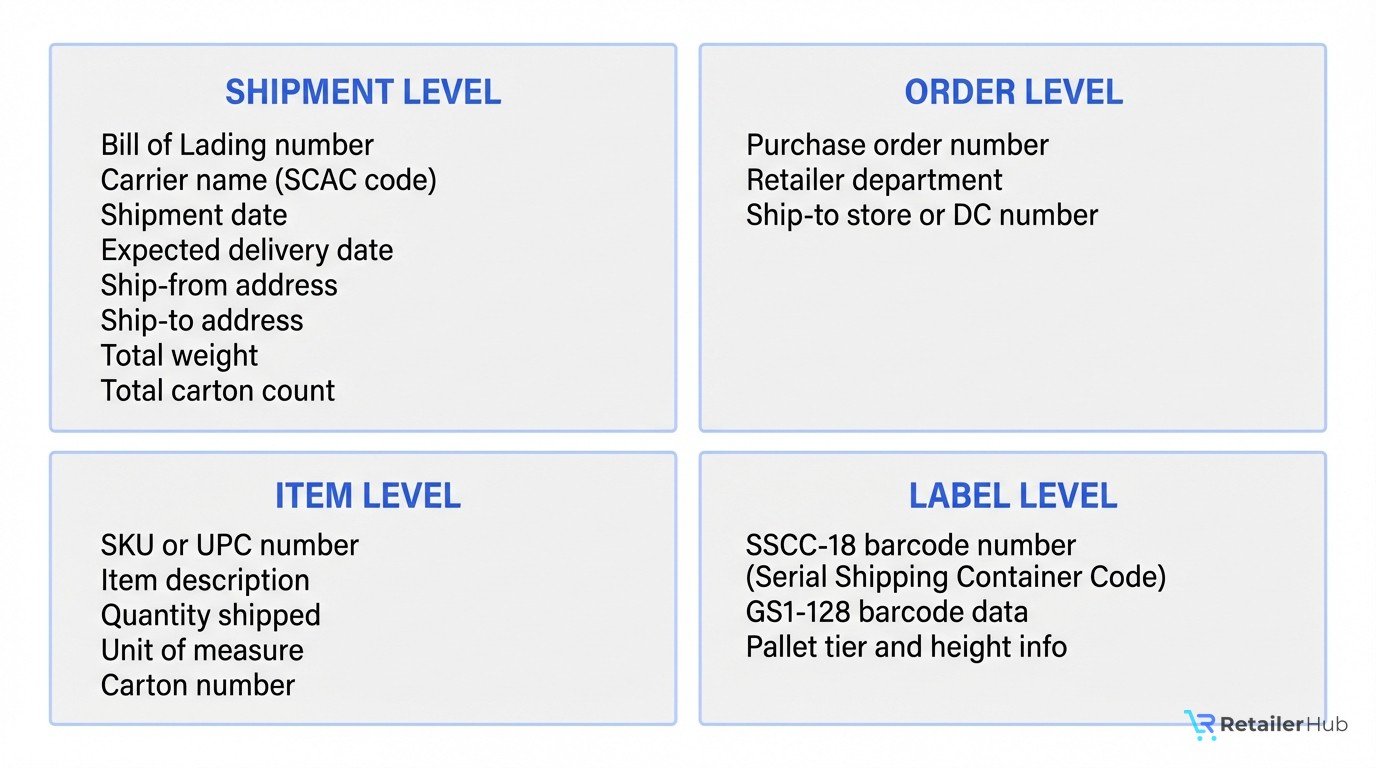
| Level | Field | Description |
|---|---|---|
| Shipment | Bill of Lading # | Unique identifier for the entire shipment |
| Shipment | SCAC Code | Standard Carrier Alpha Code identifying the freight carrier |
| Shipment | Ship Date | Date the shipment leaves the supplier’s facility |
| Shipment | ETA | Expected delivery date at the retailer’s DC |
| Shipment | Ship From / To | Origin and destination addresses |
| Shipment | Total Weight | Gross weight of the entire shipment |
| Order | PO Number | Retailer’s purchase order reference number |
| Order | Department | Retailer department or buyer code |
| Order | Ship-To DC | Destination distribution center or store number |
| Item | UPC / SKU | Universal Product Code or retailer-assigned SKU |
| Item | Quantity | Number of units shipped for each item |
| Item | Carton Number | Which carton this item is packed in |
| Label | SSCC-18 | 18-digit Serial Shipping Container Code for each carton/pallet |
| Label | GS1-128 | Barcode encoding the SSCC for scanning at the dock |
ASN vs EDI 856: What’s the Difference?
ASN is the concept: a notification about an incoming shipment. EDI 856 is the specific electronic format used to transmit that notification between trading partners using the ANSI X12 standard.
The EDI 856 is part of a larger document lifecycle. Understanding how these documents relate to each other is critical for supply chain compliance:
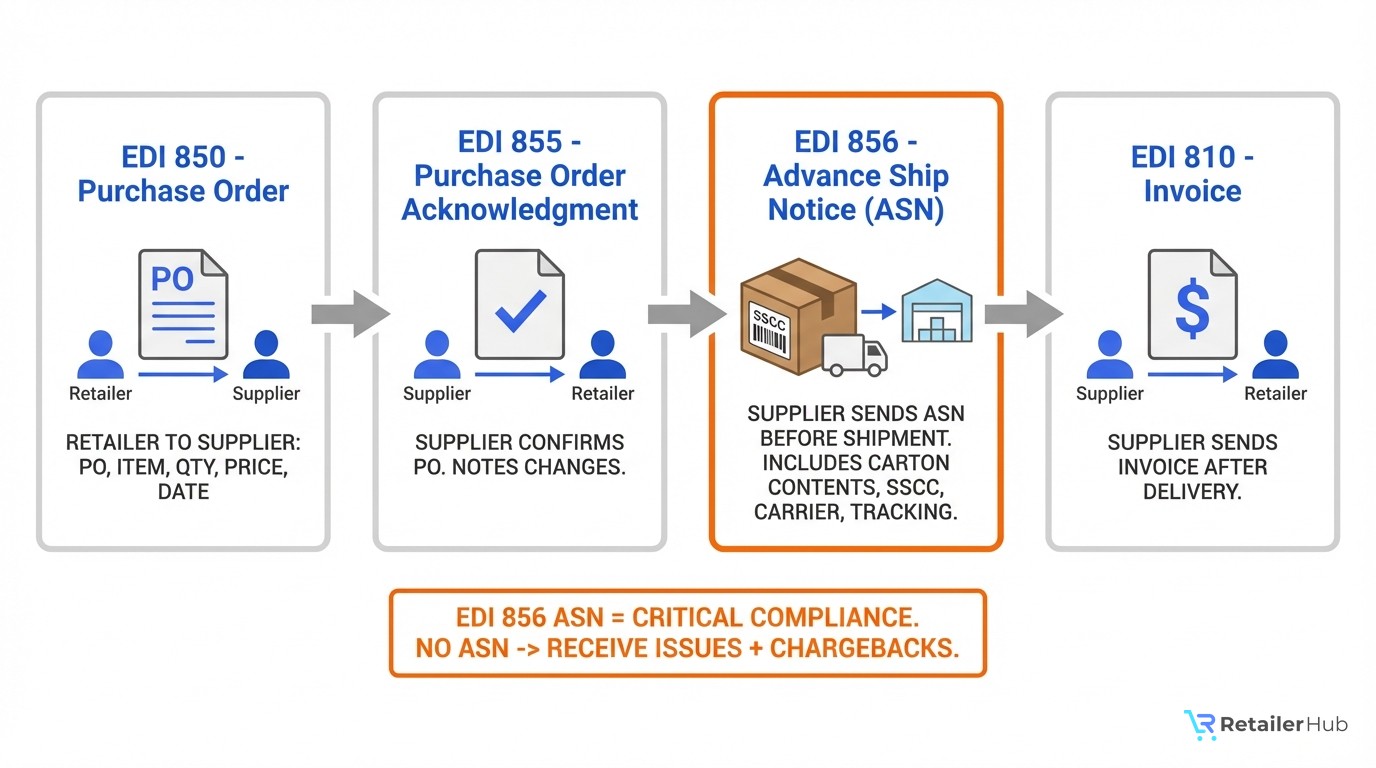
Retailer tells the supplier what to ship, how much, and when.
Retailer → Supplier
Supplier confirms they received the PO and can fulfill it.
Supplier → Retailer
Supplier notifies the retailer about the shipment contents, carrier, and SSCC data before arrival.
Supplier → Retailer
Supplier bills the retailer after shipment.
Supplier → Retailer
SSCC Labels and GS1-128 Barcodes
The SSCC (Serial Shipping Container Code) is the link between the physical carton or pallet and the electronic ASN data. Each shipping container gets a unique 18-digit SSCC number encoded in a GS1-128 barcode on its label.
When the shipment arrives at the retailer’s receiving dock, workers scan the SSCC barcode. The system automatically matches it against the ASN data, verifying the contents without opening the carton. This is why SSCC accuracy is non-negotiable: a mismatch means the carton cannot be received electronically.
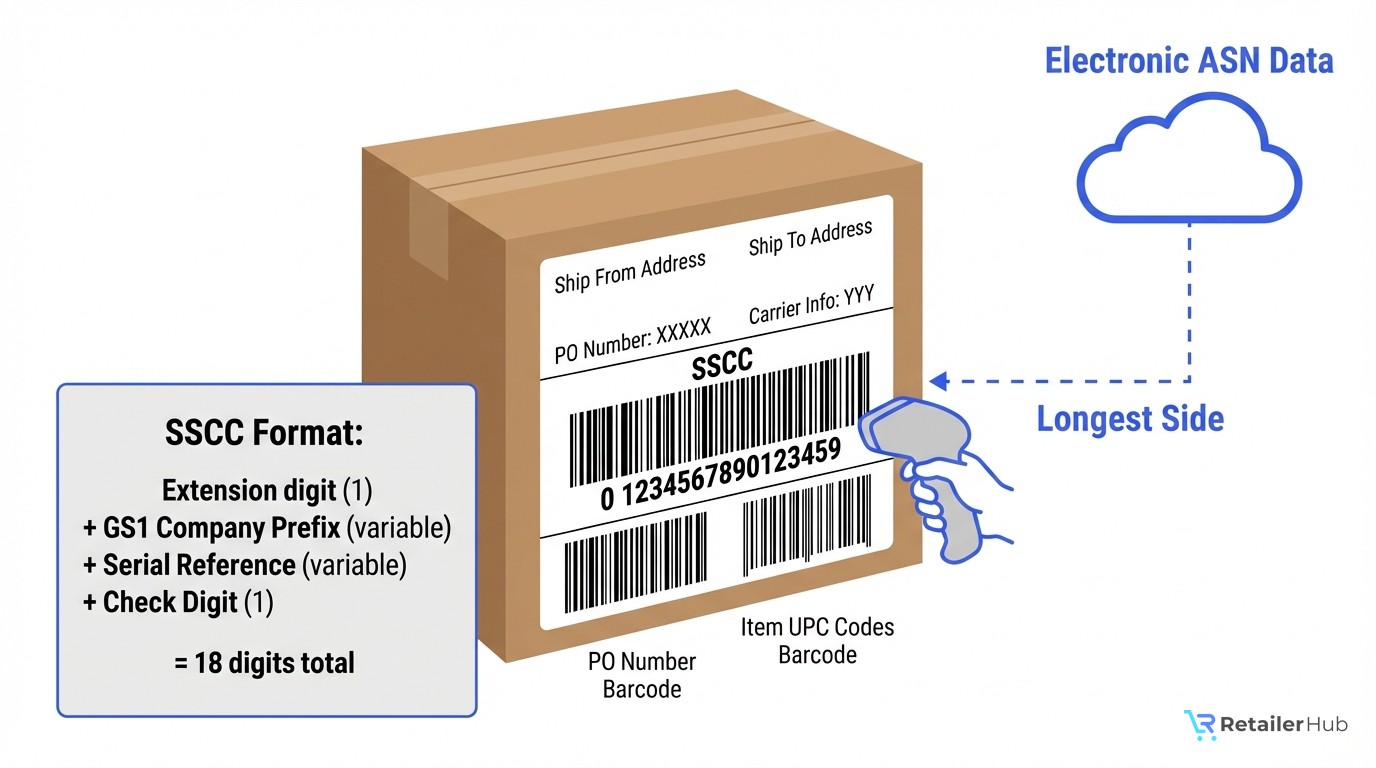
SSCC-18 Format
ASN Requirements by Retailer
Every retailer sets their own rules for when to send an ASN, what data to include, and what penalties apply for non-compliance. Here is a comparison of ASN requirements across major US retailers:
| Retailer | ASN Timing | Penalty | SSCC Required | Key Detail |
|---|---|---|---|---|
| Target | Before trailer arrives in yard | Deduction per PO/location | Yes (SSCC-18) | SSCC-18/GS1-128 label required on every master carton (min 4″×6″). Label placement: upper-right of largest flat surface. EDI 856 must be timely and error-free or deductions apply. |
| Home Depot | At trailer seal, batches every 30 min | Scorecard + financial offset | Yes (pallet-level) | One ASN per truck. Must include TMS Shipment ID. |
| Kroger | When truck leaves plant | $200/shipment flat fee | Yes (SSCC-18) | Ti x Hi recommended. Labels on bottom-left of pallet. |
| Amazon | Before arrival at fulfillment center | Chargeback for late/missing | Per label format | EDI 856 or Vendor Central. Must complete Vendor Central EDI integration. |
| Walmart | Before arrival; fix errors within 12 hrs | Shipment not received at DC | Yes (GTIN-14 / GS1-128) | Without a successful ASN, merchandise will not be received. Vendor pack cartons require GTIN-14 (ITF-14) barcode. Shipping labels must include DC#, PO type, dept, and Walmart item number. |
Last verified: March 2026 · Based on publicly available retailer compliance information
Note: Requirements change frequently. Always confirm current ASN requirements directly with each retailer’s vendor compliance team or EDI portal before shipping. Browse retailer-specific guidelines →
ASN Compliance and Chargebacks
ASN-related chargebacks are among the most common, and most preventable, compliance penalties in retail supply chains. Here are the five most frequent ASN errors, what they cost, and how to prevent them:
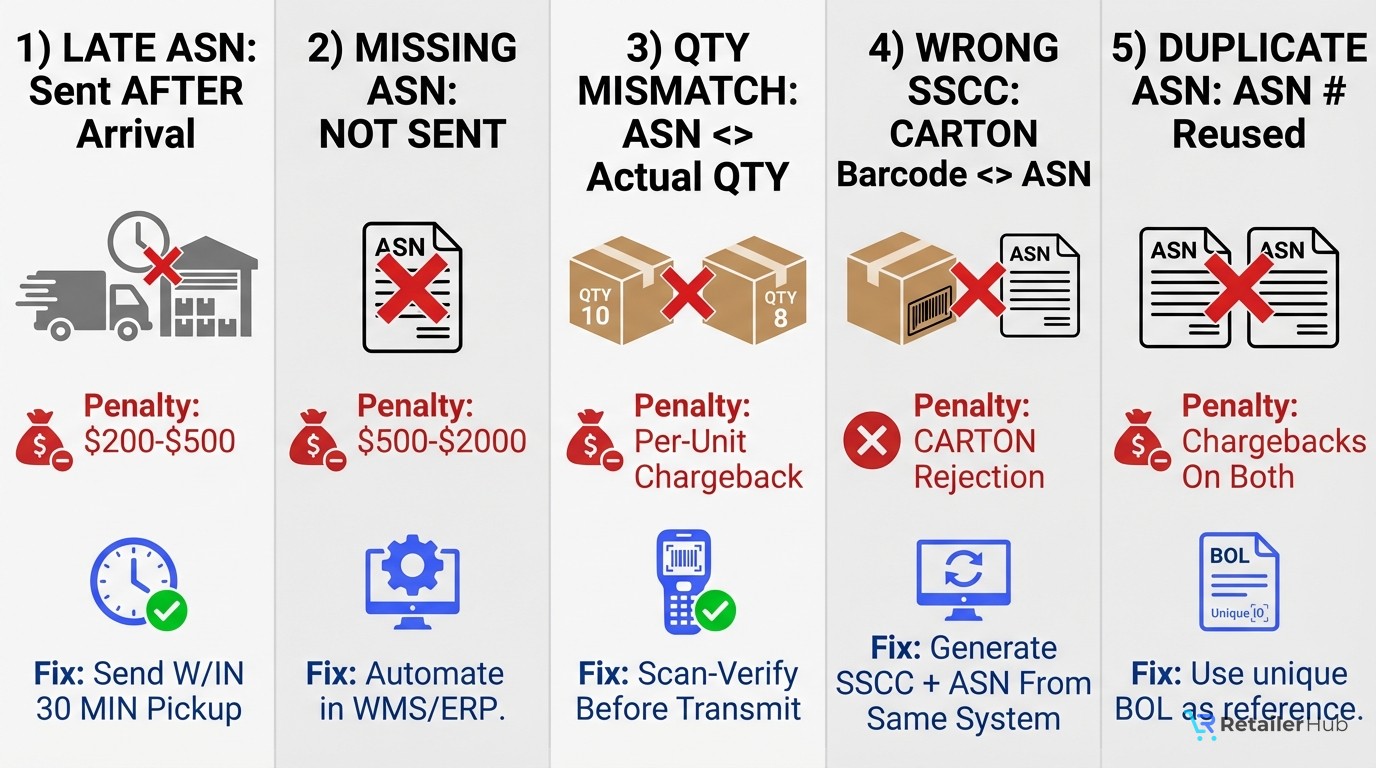
What Happens
ASN transmitted after the shipment has already arrived at the retailer’s distribution center.
Prevention
Send the ASN immediately after carrier pickup, ideally within 30 minutes. Automate transmission in your WMS.
What Happens
No ASN was sent at all. The retailer has no electronic record of what’s on the truck.
Prevention
Automate ASN generation in your WMS or ERP system so it’s impossible to ship without one.
What Happens
The ASN says 100 units but the carton only contains 90. The discrepancy triggers a shortage claim.
Prevention
Scan-verify every carton against the pick list before transmitting the ASN. Never estimate quantities.
What Happens
The SSCC barcode printed on the physical carton doesn’t match what’s in the ASN data.
Prevention
Generate SSCC labels and ASN data from the same system at the same time. Never manually key SSCC numbers.
What Happens
The same ASN reference number is reused for a different shipment, causing confusion at receiving.
Prevention
Use unique Bill of Lading or shipment ID as the ASN reference number. Never recycle identifiers.
Retailers update ASN requirements frequently. RetailerHub’s Version Intel automatically detects when a retailer changes their EDI or ASN specs, so your team is never caught off guard by a new requirement. See plans →
Stop guessing, start knowing
Not sure if your ASN meets retailer requirements?
RetailerHub’s Compliance IQ lets you ask any ASN compliance question and get instant, accurate answers. No more digging through routing guides to find the EDI 856 specs that differ between Walmart and Target.
ASN vs Bill of Lading vs Packing Slip
The ASN is often confused with other shipping documents. While they all travel with a shipment, each serves a different purpose. Here is how they compare:
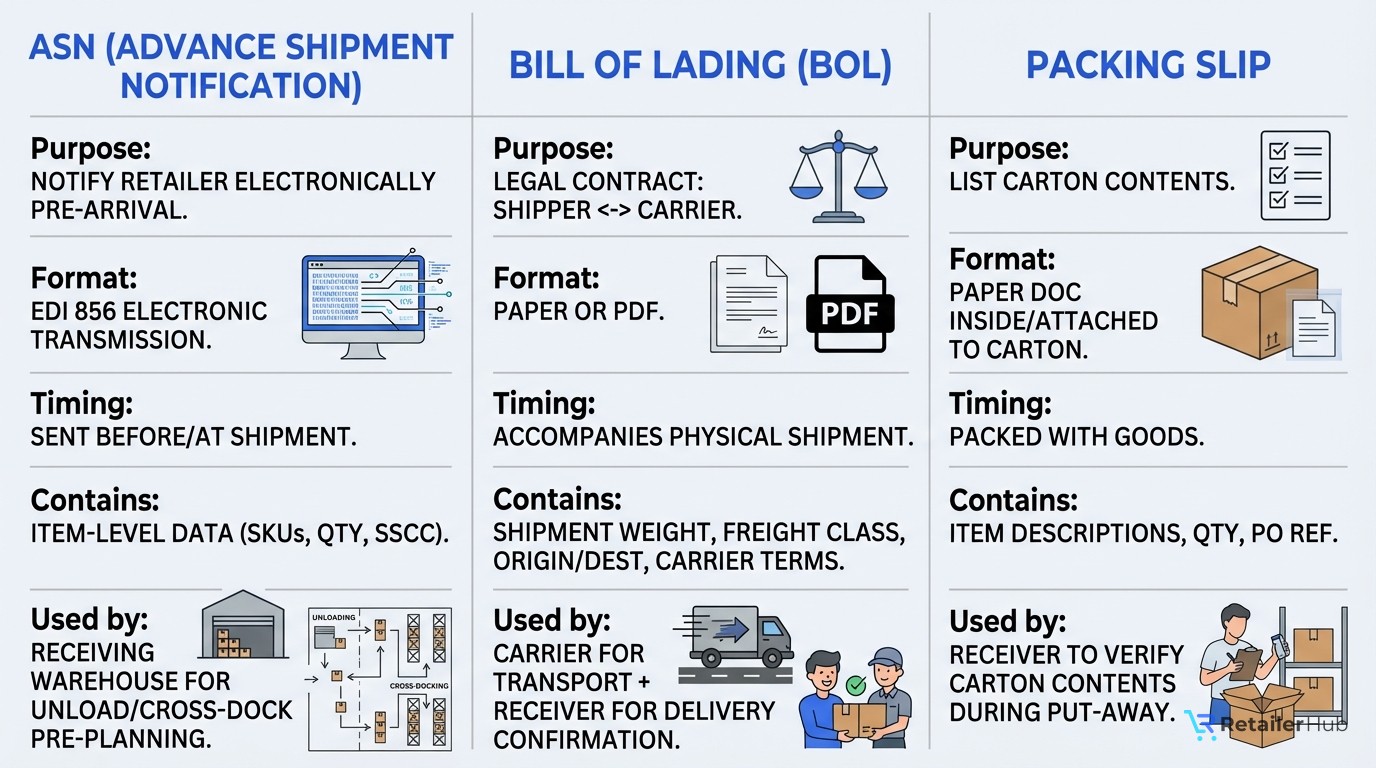
| Feature | ASN | Bill of Lading | Packing Slip |
|---|---|---|---|
| Purpose | Notify retailer electronically before arrival | Legal contract between shipper and carrier | List contents of each carton |
| Format | EDI 856 electronic transmission | Paper or PDF document | Paper inside or on the carton |
| Timing | Sent before or at shipment | Accompanies the physical shipment | Packed with the goods |
| Contains | SKUs, quantities, SSCC codes, PO refs | Weight, freight class, origin/destination, carrier terms | Item descriptions, quantities, PO reference |
| Used by | Receiving warehouse for pre-planning | Carrier for transport, receiver for delivery confirmation | Receiver to verify carton contents |
| Required by | Most major retailers (electronic) | All freight shipments (legal requirement) | Most retailers (physical document) |
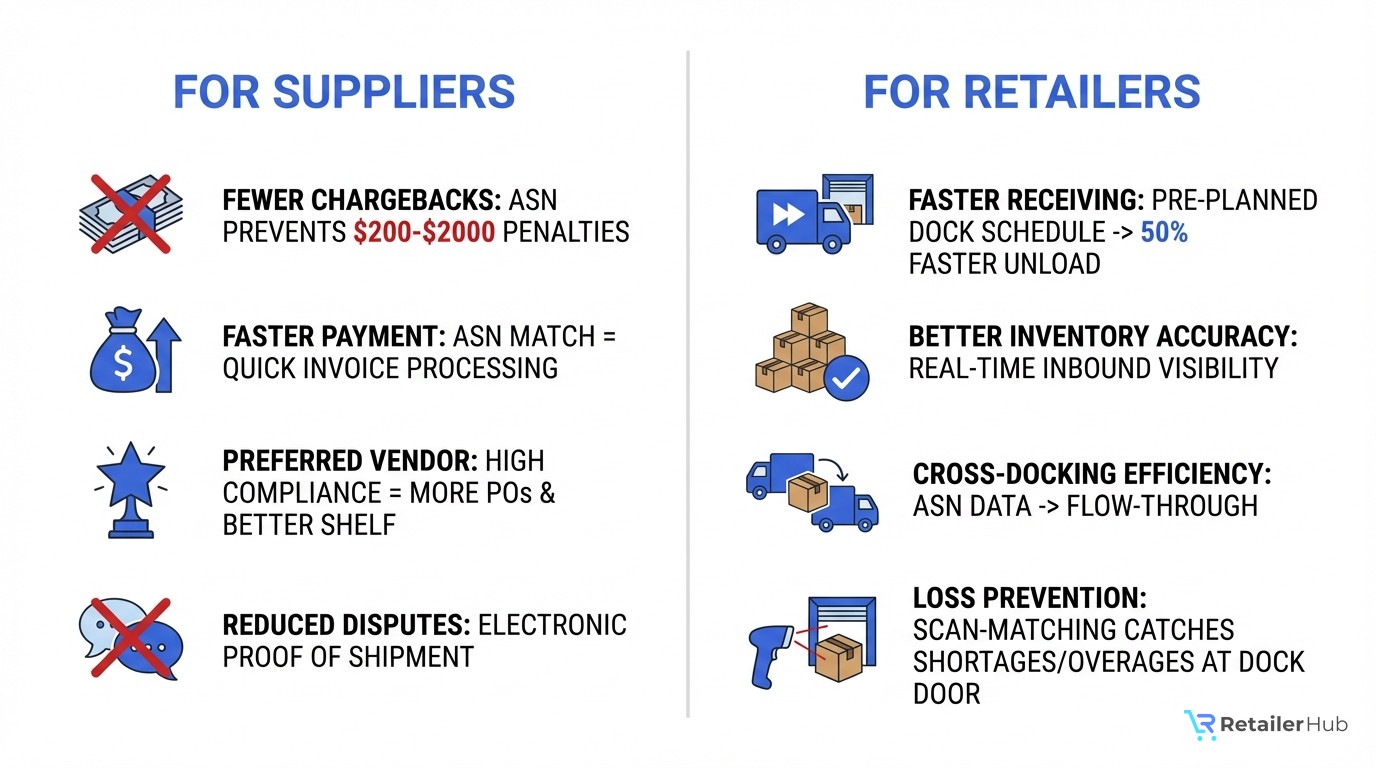
Benefits of Accurate ASNs
Getting ASNs right is not just about avoiding chargebacks. Accurate advance shipment notifications create measurable value for both suppliers and retailers across the supply chain:
Consider that Walmart will not receive merchandise without a successful ASN, and Target issues deductions against every PO/location where a timely, error-free ASN is not received before the trailer arrives in yard. For suppliers shipping to multiple retailers, even a 1% ASN error rate can translate to thousands of dollars in annual chargeback exposure.
Frequently Asked Questions
What does ASN stand for?
ASN stands for Advance Shipment Notification (also called Advance Ship Notice). It is an electronic document sent by a supplier to a retailer before a shipment arrives, detailing exactly what is being shipped, how it is packed, and when it will arrive.
What is an EDI 856?
EDI 856 is the specific ANSI X12 transaction set used to transmit an Advance Ship Notice electronically between trading partners. It is the standard format that most US retailers use for ASN data exchange. In international trade, the equivalent EDIFACT message is called DESADV.
What is the difference between an ASN and a bill of lading?
An ASN is an electronic notification sent to the retailer with item-level detail (SKUs, quantities, SSCC codes) before the shipment arrives. A bill of lading (BOL) is a legal contract between the shipper and carrier that documents the freight being transported. The ASN tells the retailer what to expect; the BOL tells the carrier what they are carrying.
How long before shipment should an ASN be sent?
The exact timing varies by retailer. Target requires ASNs before the trailer’s in-yard time at the DC. Home Depot requires them at trailer seal with batches every 30 minutes. Kroger requires them when the truck leaves the plant. The general rule is: send the ASN before the shipment arrives at the retailer’s distribution center.
What happens if you don’t send an ASN?
Missing an ASN typically results in chargebacks ranging from $200 to $2,000+ per shipment depending on the retailer. Beyond the financial penalty, shipments without ASNs cause receiving delays because the warehouse cannot pre-plan dock scheduling or use automated scan-matching.
What is an SSCC number?
SSCC stands for Serial Shipping Container Code. It is a unique 18-digit number assigned to each carton or pallet, encoded in a GS1-128 barcode label. The SSCC is what links the physical shipping container to the electronic ASN data, allowing automated receiving via barcode scanning.
Do all retailers require ASNs?
Most major retailers require ASNs for all shipments to their distribution centers. However, requirements vary. Some smaller retailers or specialty stores may not require EDI 856 transactions. Always check the specific retailer’s vendor compliance guide or routing guide for their ASN requirements.
Can I send an ASN without EDI?
Some retailers, like Amazon, accept ASN data through web portals such as Vendor Central in addition to EDI 856. Others offer similar web-based interfaces where suppliers can manually enter shipment data. However, EDI 856 remains the most common and preferred method for ASN transmission in the retail industry.
Managing ASN requirements across dozens of retailers?
RetailerHub helps you instantly answer any retailer compliance question, generate warehouse-ready SOPs, and get alerted when requirements change. Built by a former ShipBob Lead WMS Engineer with 10+ years in fulfillment.
Related Guides
GS1-128 Shipping Labels
Everything about GS1-128 barcodes, SSCC-18, and retailer label requirements.
EDI & IntegrationWhat is EDI?
Transaction sets, setup costs, and how to get started with EDI for retail.
Shipping & LogisticsRouting Guide Explained
How routing guides work, carrier requirements, and avoiding transportation chargebacks.