
How to Sell to Walmart: A Vendor’s Complete Guide
Last Updated: Mar 23, 2026
Everything brands need to know about becoming a Walmart vendor—from the supplier application to Retail Link, EDI setup, OTIF requirements, chargebacks, and Walmart Marketplace. Built for D2C brands and first-time retail vendors.
This guide contains AI-generated content based on publicly available information and general industry knowledge. Always verify requirements directly with Walmart.
In This Guide
What It’s Really Like to Sell to Walmart
Selling to Walmart is the ultimate growth milestone for consumer brands. Walmart operates over 4,700 stores in the United States alone, generates roughly $681 billion in annual revenue globally, and serves approximately 280 million customers and members each week. There is no bigger stage for a consumer product.
But Walmart is not just big—it is operationally demanding. Their EDLP (Every Day Low Price) model means razor-thin margins. Their supply chain runs on precision: OTIF (On-Time In-Full) scoring, mandatory EDI, and a chargeback program that can wipe out a quarter’s profit in a single shipment gone wrong. First-time vendors who come from D2C or Amazon often underestimate the operational leap required.
This guide covers the full journey—from getting your product in front of a Walmart buyer to surviving your first OTIF scorecard. Whether you’re targeting physical shelves or Walmart Marketplace, you’ll find the compliance details that other guides skip.
Walmart at a Glance
- ●U.S. stores: ~4,700 locations (Supercenters, Neighborhood Markets, Sam’s Club)
- ●Revenue: ~$681 billion globally (FY2025)
- ●Vendor programs: In-store vendor (1P), Walmart Marketplace (3P), Sam’s Club supplier
- ●Vendor portal: Retail Link (analytics & operations)
- ●Known for: EDLP strategy, OTIF obsession, massive scale, private label (Great Value, Equate)
The Walmart-specific data in this guide is based on publicly available retailer compliance information. This content is for general educational purposes—always verify current requirements directly with your Walmart buyer or through Retail Link.
Walmart’s Vendor Programs: In-Store vs. Marketplace vs. Sam’s Club
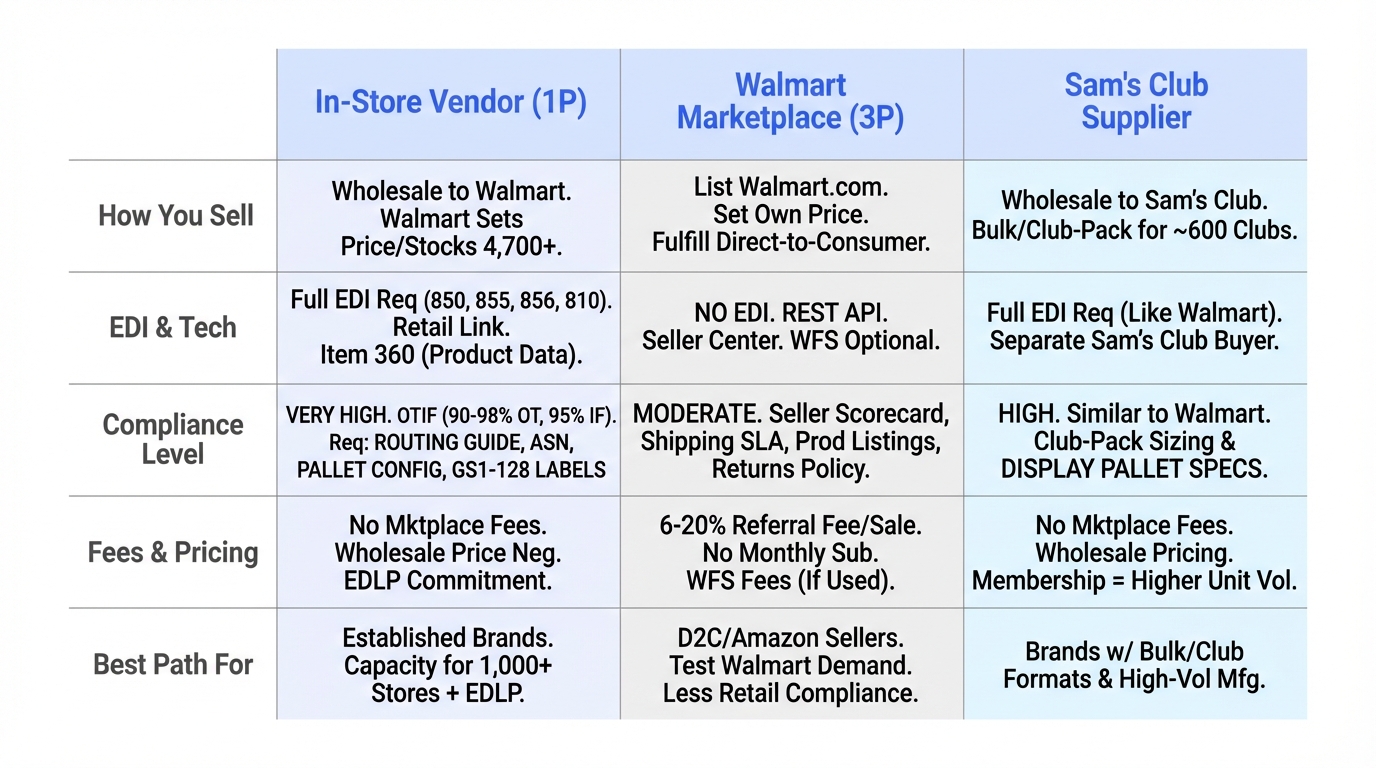
Before applying, understand which program fits your brand. Walmart has three distinct paths for vendors, each with different fulfillment models, compliance requirements, and margin structures.
| Criteria | In-Store Vendor (1P) | Walmart Marketplace (3P) | Sam’s Club |
|---|---|---|---|
| How it works | You ship to Walmart DCs; Walmart handles store replenishment | You ship directly to consumers or use Walmart Fulfillment Services (WFS) | You ship to Sam’s Club DCs; separate buyer team and compliance |
| Product visibility | In-store shelves + Walmart.com | Walmart.com only | Sam’s Club stores + SamsClub.com |
| Application | Retail supplier portal on corporate.walmart.com | Open application at marketplace.walmart.com | Separate supplier application through Sam’s Club procurement |
| EDI required | Yes — full EDI suite (850, 855, 856, 810, etc.) | No — API-based integration | Yes — same EDI requirements as Walmart stores |
| Compliance burden | Very high — OTIF, routing guide, ASN, pallet config, labeling | Lower — shipping SLA, product listing standards, seller scorecard | High — similar to Walmart stores, plus club-pack sizing |
| Fees | No marketplace fees; wholesale pricing negotiation | Referral fee 6–20% by category; WFS fees if used | No marketplace fees; wholesale pricing negotiation |
| Best for | Brands ready for massive scale and full retail compliance | D2C brands testing Walmart demand without retail complexity | Brands with bulk/club-size formats and high volume capacity |
Walmart’s Private Label Brands
Walmart operates a massive private label portfolio, including Great Value (grocery), Equate (health & beauty), Mainstays (home), and Parent’s Choice (baby). These brands command significant shelf space and are priced to reinforce Walmart’s EDLP promise.
Before pitching, research whether Walmart has a private label in your category. You’ll need to demonstrate that your product drives incremental sales—not just swap revenue from their own brand. Differentiation through innovation, premium positioning, or an underserved niche is key to winning shelf space alongside Great Value.
How to Apply: Becoming a Walmart Supplier
Walmart’s supplier application process is centralized through their corporate website. The process is competitive—Walmart receives thousands of applications and only accepts a small percentage.
Step 1: Submit the Retail Supplier Application
Visit the Suppliers section on corporate.walmart.com and complete the retail supplier application. You’ll provide company details, product information, pricing, and production capacity. Walmart’s merchandising team reviews submissions and routes qualifying ones to the appropriate category buyer.
Step 2: What Walmart Looks For
Walmart buyers evaluate suppliers on five primary criteria:
- ●Price competitiveness: Can you deliver EDLP? Walmart’s entire brand promise depends on having the lowest everyday price. Your cost structure must support this without compromising quality.
- ●Scale readiness: Walmart doesn’t test with 50 stores. A regional rollout might mean 500–1,000+ locations. Can your supply chain handle that volume consistently?
- ●Proven demand: Sell-through data from other retailers, Amazon, or your D2C channel. Walmart wants evidence, not projections.
- ●Product differentiation: What makes your product worth the shelf space? Innovation, unique positioning, or an underserved category gap.
- ●Margin structure: Can you maintain viable margins at Walmart’s price points? See our wholesale pricing guide for margin benchmarks.
Step 3: Open Call & Trade Shows
Walmart hosts an annual Open Call event in Bentonville, Arkansas, where entrepreneurs pitch their products directly to Walmart buyers. Open Call is specifically designed for U.S.-made products and small businesses, and it’s one of the fastest paths to getting a buyer’s attention.
Outside of Open Call, Walmart buyers attend industry trade shows like ECRM sessions, NACS, Natural Products Expo, and category-specific expos. Having your product in front of a buyer at a trade show, combined with a formal application, can accelerate the review process.
Step 4: Broker or Rep Firms
Many successful Walmart vendors use brokers who specialize in Walmart. Companies like Acosta, Advantage Solutions, and smaller Bentonville-based firms have established buyer relationships and understand the internal merchandising process. Broker commissions typically run 3–7% of sales. For a first-time vendor without existing buyer relationships, the investment often pays for itself in faster onboarding and fewer early mistakes.
The Walmart Vendor Agreement: Key Terms to Understand
Once Walmart decides to bring your product in, you’ll negotiate and sign a vendor agreement. Walmart’s contracts are notoriously detailed and heavily favor the retailer. Here are the terms first-time vendors need to understand before signing.
| Term | What It Means | Watch Out For |
|---|---|---|
| Payment terms | When Walmart pays you after delivery (typically net 30) | Walmart offers early payment programs with a discount; standard net 30 is the baseline |
| EDLP commitment | Your pricing must support Walmart’s everyday low price strategy | Walmart monitors competitor pricing; you may be asked to match or beat |
| Deductions & allowances | Financial penalties for compliance violations + negotiated marketing/placement fees | Deductions come directly off your payment; see the chargebacks section |
| Markdown allowances | You may share the cost of markdowns on slow-moving inventory | Can significantly reduce effective margins on seasonal or underperforming SKUs |
| OTIF penalties | Financial penalties for failing to meet OTIF delivery standards | Walmart charges fines per case for OTIF failures; see the OTIF section |
| Insurance requirements | Product liability and general liability coverage | Minimums vary by category; Walmart must be named as additional insured |
Unlike smaller retailers, Walmart’s leverage means most terms are non-negotiable for small to mid-size suppliers. The key is understanding the full cost structure—deductions, allowances, OTIF penalties, and early payment discounts—before you set your wholesale price. Read our retail chargebacks guide to understand the financial impact of compliance failures.
Vendor Onboarding at Walmart
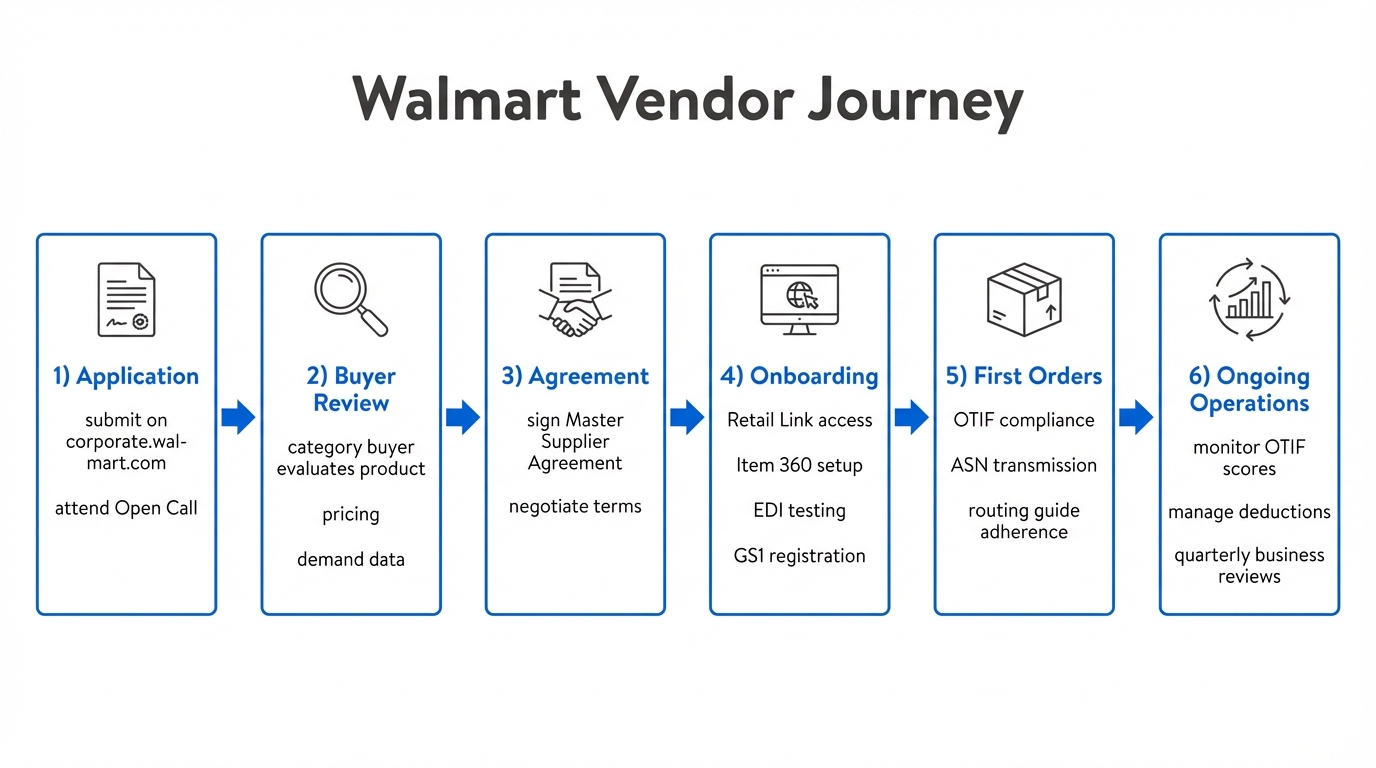
Walmart onboarding is one of the most complex in retail. There are multiple systems, portals, and data requirements to set up before you can receive your first purchase order. Plan for 60–120 days from agreement signing to first shipment.
Retail Link
Retail Link is Walmart’s proprietary vendor portal and the nerve center of your Walmart relationship. Every vendor needs Retail Link access to view sales data, manage orders, track inventory, and monitor performance metrics. Key applications within Retail Link include:
| Application | What It Does |
|---|---|
| Retail Link | Central hub for sales data, inventory, and performance analytics |
| Item 360 | Item setup and maintenance (product data, images, descriptions, case packs) |
| SQEP (Supplier Quality Excellence Program) | Enterprise-wide quality and compliance management for all suppliers |
| Scintilla (formerly Luminate) | Advanced analytics platform replacing parts of Retail Link (sales, inventory, shopper insights) |
| APDP (Accounts Payable Dispute Portal) | Deduction management and dispute filing |
| Supplier One | Modern supplier management platform being phased in for onboarding and compliance |
EDI Setup
Walmart requires Electronic Data Interchange (EDI) for all first-party vendor transactions. This is non-negotiable—you cannot process Walmart orders via email or a web portal. EDI automates purchase orders, invoices, and shipment notifications.
Walmart requires several EDI transaction sets including:
- ●EDI 850 — Purchase Order (incoming from Walmart)
- ●EDI 855 — Purchase Order Acknowledgment
- ●EDI 856 — Advance Shipment Notification (ASN)
- ●EDI 810 — Invoice
- ●EDI 860 — Purchase Order Change Request
- ●EDI 997 — Functional Acknowledgment
- ●EDI 824 — Application Advice (error notification for rejected documents)
Popular EDI providers for Walmart vendors include SPS Commerce, TrueCommerce, and Cleo. Expect to spend $300–$600/month for a full EDI setup. Walmart requires a testing phase against their X12 VICS standards before you go live. If Walmart rejects an EDI document (via an 824 Application Advice), you must correct and resubmit within 12 hours.
Item Setup (Item 360)
Before your product enters Walmart’s system, you must complete item setup in Item 360 with detailed product attributes including:
- ●UPC/EAN barcode registered with GS1 (GS1 Company Prefix required)
- ●Product images: High-resolution images meeting Walmart’s content standards
- ●Product descriptions: Detailed attributes including dimensions, weight, and category-specific data
- ●Case pack information: Units per case, case dimensions, pallet configuration (Ti x Hi)
- ●Compliance certifications: Category-specific (CPSIA for children’s products, FDA for food, etc.)
Overwhelmed by Walmart’s onboarding?
RetailerHub’s Compliance IQ answers any Walmart compliance question instantly. Ask about EDI setup, labeling requirements, or OTIF targets—get answers in seconds instead of digging through documentation.
Walmart’s OTIF Program: The Metric That Defines Your Vendor Relationship
OTIF (On-Time In-Full) is Walmart’s most important vendor performance metric. It measures whether you deliver the right product, in the right quantity, at the right time. Poor OTIF scores lead to financial penalties and can ultimately cost you the relationship.
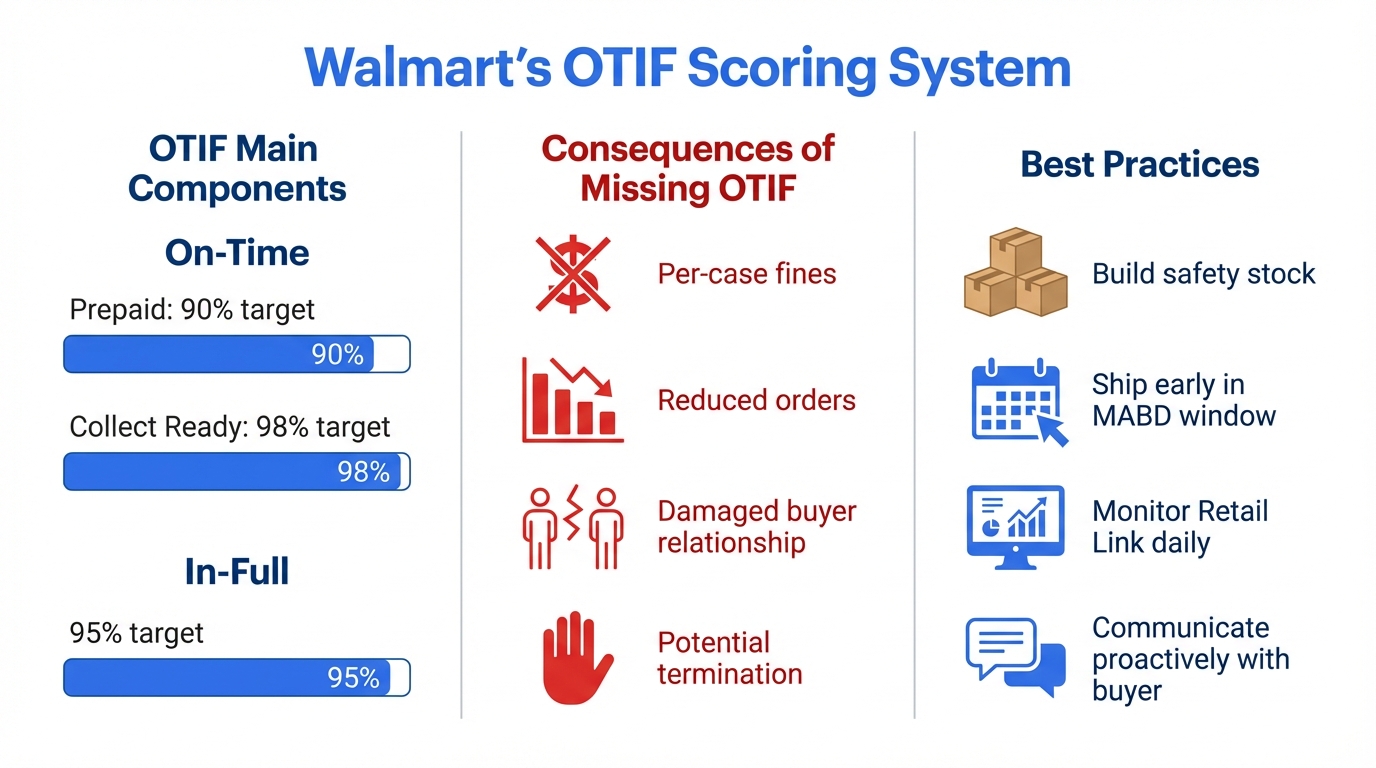
Walmart splits OTIF into two components, and the on-time target differs based on your delivery model:
| Component | What It Measures | Target |
|---|---|---|
| On-Time (Prepaid) | Shipment is delivered to the DC within the must-arrive-by-date (MABD) window | 90% |
| On-Time (Collect Ready) | Shipment is ready for carrier pickup by the assigned pickup date | 98% |
| In-Full | The full quantity ordered on the PO is shipped—no partial fills | 95% |
OTIF Penalties
Walmart charges financial penalties for OTIF failures. The penalty structure applies per case for each failed metric:
- ●On-Time failure: A per-case fine is applied to the non-compliant portion of the order
- ●In-Full failure: A per-case fine is applied to the quantity shortfall
- ●Measurement window: OTIF is scored on a rolling basis, giving vendors a continuous view of performance
OTIF scores are visible in Retail Link and are a frequent topic in quarterly business reviews with your Walmart buyer. Consistently missing OTIF targets signals to Walmart that you’re an unreliable supplier, which can lead to reduced orders, shelf space cuts, or termination. For a deeper dive into OTIF across retailers, see our routing guide explainer.
How to Hit OTIF Targets
OTIF Best Practices
- ●Build safety stock: Always carry buffer inventory to cover demand spikes and production delays
- ●Ship early in the window: Don’t wait until the last day of the MABD window to ship
- ●Monitor Retail Link daily: Catch PO changes and demand signals early
- ●Communicate proactively: If you know you’ll miss a shipment, notify your buyer before the MABD passes
- ●Use a 3PL with Walmart experience: Experienced 3PLs know the appointment systems and carrier requirements
Walmart’s Compliance Requirements
Walmart’s compliance program is one of the most demanding in retail. Every detail matters—from how you label a pallet to which carrier picks it up. Violations trigger deductions that come straight off your payment.
Routing Guide & Shipping
Walmart’s routing guide governs how you ship to their distribution centers. The system works through Walmart’s transportation management:
- ●Collect shipments: Walmart arranges and pays for transportation from your facility to their DC. You must have the shipment ready for the assigned carrier at the scheduled pickup time.
- ●Prepaid shipments: You arrange and pay for transportation. Must still meet MABD and use approved carriers.
- ●Appointment scheduling: All DC deliveries require a scheduled appointment through Walmart’s system
- ●TONU (Truck Order Not Used): If Walmart dispatches a carrier and your shipment isn’t ready, you get charged a TONU fee
ASN & Labeling Requirements
Walmart requires an EDI 856 ASN for every shipment. The ASN must be transmitted before the shipment arrives at the DC. Late or inaccurate ASNs are a leading cause of Walmart deductions.
Your shipping labels must follow Walmart’s GS1-128/SSCC-18 label format. Key labeling requirements include:
- ●GS1-128 barcode with SSCC-18 on every pallet and carton
- ●Ship-from and ship-to addresses, PO number, and carrier information
- ●Labels must match ASN data exactly—any mismatch triggers deductions
- ●4×6 inch minimum label size, placed on two adjacent sides of each pallet
Packaging & Pallet Requirements
Walmart has strict packaging requirements for DC shipments:
- ●Pallet specs: Standard GMA pallets (48″×40″), max height up to 96 inches including pallet (varies by DC and product type)
- ●Pallet configuration (Ti x Hi): Must match exactly what was set up in the item file. Deviations trigger chargebacks.
- ●Stretch wrap: All pallets must be stretch-wrapped for stability during transit
- ●Polybag suffocation warnings required on all poly-wrapped items
- ●Retail-ready packaging (PDQ/shelf-ready) where applicable
Stay ahead of Walmart’s compliance changes
RetailerHub’s Version Intel tracks changes to Walmart’s vendor guidelines and alerts you when requirements update. Never get caught by a routing guide revision again.
Walmart’s Chargeback & Deduction Program
Walmart’s deduction program is one of the most feared aspects of being a vendor. Deductions are financial penalties automatically deducted from your payments for compliance violations. They can be substantial—some vendors report losing 5–10% of revenue to deductions in their first year.
| Category | What Triggers It | Impact |
|---|---|---|
| OTIF Fines | Late shipments or partial fills below the 90–98%/95% thresholds | Per-case fines on non-compliant portion |
| Transportation | Wrong carrier, TONU (shipment not ready), routing violations | TONU fees; freight cost charged back for routing violations |
| ASN & EDI | Late ASN, missing ASN, data mismatches between ASN and physical shipment | Per-shipment penalties; can compound across multiple POs |
| Invoice Discrepancies | Price, quantity, or term mismatches between invoice and PO | $50–$75 admin fee per PO plus the discrepancy amount |
| Packaging & Labeling | Wrong pallet config, missing labels, incorrect Ti x Hi | Per-case handling fees; labor recharges if Walmart re-works shipment |
| Shortages & Overages | Shipment contains more or fewer units than the ASN/PO states | Cost of overage rejected; shortage deducted from payment |
How to Dispute Walmart Deductions
Not all deductions are valid. Walmart provides a dispute process through the APDP (Accounts Payable Dispute Portal) and Supplier One:
- ●Review deductions weekly: Log into APDP and review all new deductions. Categorize by type.
- ●Gather documentation: BOL copies, carrier receipts, ASN transmission logs, photos, packing slips, and the Supplier Discrepancy Form.
- ●File within the dispute window: Walmart has time limits on dispute filings—missed deadlines mean the deduction stands. Expect 6–8 weeks for dispute resolution.
- ●Consider a deduction management service: Companies like SupplyPike specialize in Walmart deduction recovery.
Top Deduction Triggers for New Vendors
- ●OTIF failures: Not hitting the on-time (90–98%) / in-full (95%) targets in the first few months
- ●ASN errors: EDI 856 not matching physical shipment contents or late transmission
- ●TONU charges: Walmart dispatches a truck and your shipment isn’t ready for pickup
- ●Pallet config errors: Ti x Hi doesn’t match what’s in the item file
- ●Invoice mismatches: Price on your EDI 810 doesn’t match the PO price
For a comprehensive look at chargeback prevention strategies across all retailers, see our retail chargebacks guide.
Selling on Walmart Marketplace
Walmart Marketplace is Walmart’s third-party seller platform, open to approved U.S. businesses. Unlike the in-store vendor program (which requires Walmart to buy your product wholesale), Marketplace lets you sell directly to Walmart.com customers while keeping control of pricing and inventory.
How Walmart Marketplace Works
- ●Open application: Unlike Target Plus (invitation-only), any legitimate U.S. business can apply at marketplace.walmart.com.
- ●Referral fees: Walmart charges 6–20% per sale depending on category (most fall in 6–15%)—competitive with Amazon’s fees.
- ●No monthly subscription: Unlike Amazon’s $39.99/month professional seller fee, Walmart Marketplace has no monthly charge.
- ●Walmart Fulfillment Services (WFS): Similar to Amazon FBA—you ship inventory to Walmart warehouses and they handle fulfillment. WFS items get the “Fulfilled by Walmart” badge.
- ●API-based integration: No EDI required—Marketplace uses REST APIs for inventory, orders, and catalog management.
Walmart Marketplace vs. Amazon: Key Differences
| Factor | Walmart Marketplace | Amazon (3P Seller) |
|---|---|---|
| Monthly fee | None | $39.99/month (Professional) |
| Referral fees | 6–15% by category | 8–45% by category |
| Fulfillment option | WFS (optional) or seller-fulfilled | FBA (optional) or seller-fulfilled |
| Competition | 200,000+ sellers (growing rapidly) | ~2 million+ active sellers |
| Advertising | Walmart Connect (sponsored products, display) | Amazon Advertising (PPC, DSP, video) |
When Marketplace Makes Sense
Walmart Marketplace is a strong entry point for brands that want to test Walmart demand without the full operational complexity of in-store vendor compliance. It’s particularly appealing for:
- ●D2C brands already proficient at e-commerce fulfillment
- ●Amazon sellers wanting to diversify their marketplace presence
- ●Brands wanting to build Walmart sales data before pitching for in-store placement
- ●Companies that can’t yet meet the production volume for 4,700+ stores
Lessons from Real Walmart Vendors
Online vendor communities and industry forums are full of first-hand accounts from brands that have sold to Walmart. Here are the key themes that come up repeatedly:
“EDLP means your margins will be thinner than you think”
Walmart’s EDLP model means your wholesale price must be aggressive from day one. Add in OTIF penalties, deductions, markdown allowances, and promotional funds, and your effective margin can be 10–20% lower than your wholesale price suggests. Model the full cost stack before committing.
“OTIF changed everything”
When Walmart introduced aggressive OTIF targets, many vendors were caught off guard. The fines are real and they accumulate fast. Vendors who invested in demand planning, safety stock, and 3PLs with Walmart experience adapted. Those who didn’t saw their margins evaporate.
“Bentonville matters more than you expect”
Walmart’s headquarters in Bentonville, Arkansas, is the center of gravity for vendor relationships. Many successful suppliers maintain a presence there—whether it’s a full office, a broker, or regular visits. Face-to-face time with buyers and merchant teams builds the relationships that survive tough conversations about OTIF scores and shelf space.
“Deduction management is a full-time job”
Many Walmart vendors hire dedicated staff or use third-party services just to manage deductions. Between OTIF fines, transportation chargebacks, invoice discrepancies, and shortage claims, the volume of deductions can be overwhelming. The vendors who recover the most money are the ones who dispute systematically and document everything.
Walmart Vendor Success Checklist
Use this checklist to track your progress from application to first shipment. Each phase builds on the previous one—don’t skip ahead.
1 Pre-Application
- ☐ Confirm your product supports EDLP pricing with viable margins
- ☐ Verify production capacity for 1,000+ store distribution
- ☐ Secure product liability insurance (Walmart as additional insured)
- ☐ Prepare sell-through data from D2C, Amazon, or other retailers
- ☐ Research whether Walmart has a competing private label product
2 Application
- ☐ Complete retail supplier application on corporate.walmart.com
- ☐ Apply for Walmart Open Call (if U.S.-made product)
- ☐ Prepare pitch with pricing model, demand data, and differentiation story
- ☐ Evaluate whether a Bentonville-based broker makes sense
3 Onboarding
- ☐ Set up Retail Link access
- ☐ Register GS1 Company Prefix and assign UPCs
- ☐ Complete item setup in Item 360 (product data, images, case packs)
- ☐ Select and contract an EDI provider
- ☐ Complete EDI testing and move to production
- ☐ Set up labeling equipment for GS1-128/SSCC-18 labels
- ☐ Review Walmart’s routing guide and transportation requirements
4 First Order
- ☐ Confirm correct carrier assignment per routing guide
- ☐ Verify pallet configuration matches item file (Ti x Hi)
- ☐ Transmit EDI 856 ASN before shipment arrives at DC
- ☐ Verify GS1-128 labels on all cartons and pallets
- ☐ Double-check invoice (EDI 810) matches PO pricing exactly
5 Ongoing Operations
- ☐ Monitor OTIF scores weekly in Retail Link
- ☐ Review and dispute deductions in APDP
- ☐ Track routing guide updates and compliance requirements
- ☐ Use Scintilla analytics for demand planning and replenishment
- ☐ Prepare for quarterly business reviews with your buyer
Frequently Asked Questions About Selling to Walmart
Sell to Walmart with confidence
Brands and 3PLs use RetailerHub to instantly answer Walmart compliance questions, generate warehouse-ready SOPs, and get alerted when vendor guidelines change. Built by a former ShipBob Lead WMS Engineer with 10+ years in fulfillment.
Related Guides
Retail Vendor Onboarding
Step-by-step guide to everything after a retail buyer says yes.
Vendor ComplianceRetail Chargebacks
Common types, retailer penalties, and proven prevention strategies.
Retail StrategyHow to Get into Retail Stores
The full playbook for D2C brands entering retail for the first time.