
Vendor Compliance Software: What It Is, Why You Need It & How to Choose
Last Updated: Mar 22, 2026
A practical guide to vendor compliance management software for brands, suppliers, and 3PLs selling into major retailers, covering what to look for, how these platforms reduce chargebacks, and what makes retail compliance different from generic vendor management.
This guide contains AI-generated content based on publicly available information and general industry knowledge. Always verify requirements directly with your retail trading partners.
In This Guide
What Is Vendor Compliance Software?
Vendor compliance software is a platform that helps suppliers, brands, and third-party logistics providers (3PLs) understand and follow the requirements that retailers impose on their trading partners. These requirements cover everything from shipping and labeling to packaging, EDI, and on-time delivery, and every retailer defines them differently.
When most people search for “vendor compliance software,” results are dominated by generic vendor risk management tools, platforms built for IT procurement, SOC 2 audits, and third-party security assessments. Those tools solve a real problem, but it’s not this problem. If you’re a consumer goods brand shipping to Walmart, Amazon, Target, Kroger, or Home Depot, your compliance challenge isn’t SOC 2. It’s making sure every shipment has the right GS1-128 labels, the correct ASN, the right pallet configuration, and arrives within the retailer’s delivery window, or you pay chargebacks.
Retail-focused vendor compliance software bridges this gap. Instead of managing security questionnaires, it manages the operational compliance rules that determine whether your shipments get accepted or penalized at the dock door.
The retailer-specific compliance data in this guide is based on publicly available retailer compliance information. This content is for general educational purposes. Always verify current requirements directly with your retail trading partners.
Why Retail Vendor Compliance Is So Difficult
Selling to one retailer is manageable. Selling to five or more (each with their own routing guide, labeling specs, packaging standards, and penalty structure) is where compliance teams break down. Here’s why:
Every retailer has different rules
Walmart requires OTIF scores above 98% for collect shipments. Amazon has 14+ chargeback categories in Vendor Central. Target uses a deduction system with TR-prefixed codes. Kroger charges $500 flat fees for labeling errors. Home Depot fines $10 per tracking number for parcel routing violations. You can't apply one retailer's rules to another. Each has its own routing guide, labeling spec, and penalty structure.
Requirements change without warning
Retailers update their compliance guides regularly, sometimes quarterly, sometimes mid-season. A pallet spec that was correct last month may trigger a chargeback today. Most retailers don't proactively notify vendors of every change. You're expected to check.
The information is scattered across PDFs and portals
Walmart publishes its requirements across the Transportation Guide, Supply Chain Standards, Supplier Packaging & Labeling Compliance Manual, and DSV-specific documents. Amazon splits requirements between the North American Vendor Manual, Labeling Requirements guide, and FBA Shipping guide. Getting a simple answer often means searching across multiple documents.
Compliance knowledge lives in people's heads
The person who knows Target's VRS system or Kroger's appointment scheduling process holds institutional knowledge that isn't documented internally. When they leave, take PTO, or are unavailable, the team is flying blind. Software captures and centralizes this knowledge.
The penalties are disproportionate to the errors
A missing GS1-128 label on one carton can cost $500 at Kroger. A UPC violation can cost $1,000–$5,000 per item per division. An unauthorized carrier at Home Depot is $10 per tracking number, which adds up fast on large shipments. Small mistakes create large financial consequences.
The result? Compliance teams spend hours digging through PDFs, emailing buyers for clarification, and hoping nothing changed since the last time they checked. When something slips through, the retailer doesn’t send a warning. They send a chargeback.
What Major Retailers Actually Require
To understand why vendor compliance software matters, look at what the top five U.S. retailers require from their suppliers. Each has its own system, its own terminology, and its own penalties.
| Requirement | Walmart | Amazon | Target | Kroger | Home Depot |
|---|---|---|---|---|---|
| Routing system | TSCP 2.0 | Vendor Central / EDI 753 | VRS / ShipIQ | Vendor Standard Routing Instructions | Global Routing Guide |
| Labeling standard | ITF-14 barcodes, SQEP compliance | SSCC/AMZNCC license plates, carton content labels | Code 128 (PLN), SSCC-18 / UCC-128 | GS1 case GTIN, human-readable info | UCC/GS1-128 pallets, ITF-14 cartons |
| Packaging test | ISTA 3A/3B/6 | Rigid six-sided box, 2" cushion min | ISTA 3A/3B for furniture | Automated case handling compatible | ISTA 2 series |
| Delivery metric | OTIF (98% on-time, 95% in-full) | PO On-Time, Confirmation Rate | SPM on-time ship & fill rate | Appointment scheduling compliance | Fill Rate & On Time (scorecard) |
| Penalty term | Non-compliance cost recovery | Chargebacks / inbound defect fees | Deductions (TR-prefix codes) | Liquidated damages | Financial offsets / fines |
| Dispute portal | Supplier One / Transportation Portal | Vendor Central Chargeback Support | Synergy | Through Kroger representative | Through supplier representative |
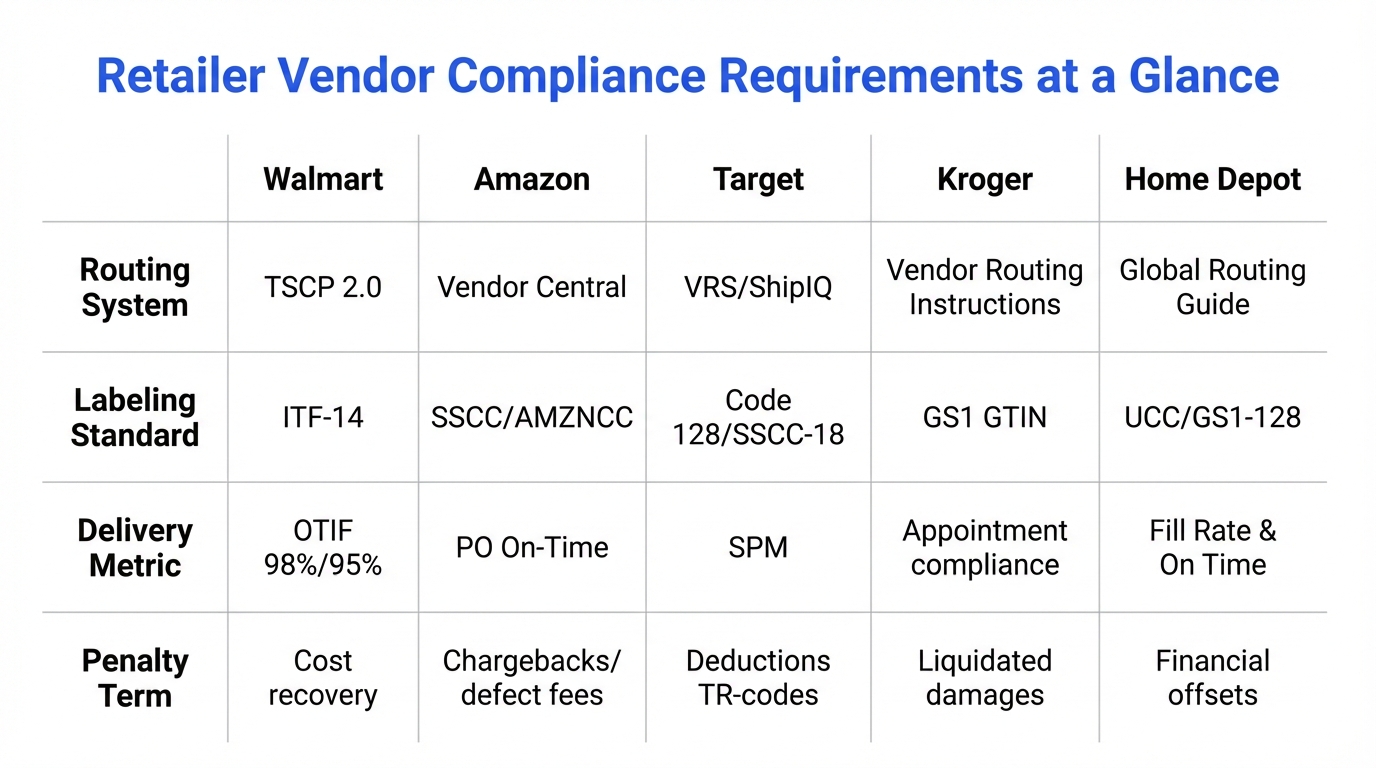
Notice how every column is different. The carrier rules, labeling specs, penalty structures, and portals are all retailer-specific. A compliance team managing five retail accounts is effectively managing five separate compliance programs. This is the core problem that vendor compliance management software solves.
What Non-Compliance Actually Costs
Chargebacks aren’t abstract. Here are real penalty structures from major retailers, drawn from publicly available compliance guides and vendor agreements.
| Retailer | Violation | Penalty |
|---|---|---|
| Walmart | DSV wrong carrier method | $5/package or rate difference |
| Walmart | Truck Order Not Used (TONU) | Carrier-assessed fee |
| Amazon | Missing carton content label | $5 per carton |
| Amazon | Repeated defects | Shipment blocking |
| Target | Unauthorized ground carrier | Full freight cost |
| Target | Unapproved backorders | Per-shipment deduction |
| Kroger | ASN not provided | $200/shipment |
| Kroger | Case labeling error | $500/shipment |
| Kroger | UPC violation | $500–$5,000/item/division |
| Home Depot | Wrong carrier (FedEx instead of UPS) | $10/tracking number |
| Home Depot | Third-party account misuse | $150/tracking number |
For a mid-size CPG brand shipping to multiple retailers, chargebacks can quietly drain 2–5% of gross revenue. That’s the cost of not having a system, and it’s the ROI case for vendor compliance software.
Need to check a retailer requirement right now?
RetailerHub’s Compliance IQ lets you ask any retailer compliance question, such as “What pallets does Kroger accept?” or “What’s Target’s label size for master cartons?” Then get instant, cited answers.
What to Look for in Vendor Compliance Software
Not every “vendor compliance” tool is built for retail. Generic vendor management systems focus on onboarding, risk scoring, and contract management. If you’re a supplier shipping physical goods to retail DCs, here are the capabilities that actually matter:
Retailer-specific compliance intelligence
The platform should know the actual requirements for each retailer you sell to, not generic best practices. When you ask "What pallet does Target want?", it should give you Target's specific answer, not a general answer about pallets.
Why it matters: Generic answers cause chargebacks. Retailer-specific answers prevent them.
Requirement change detection
Retailers update their compliance guides without individually notifying every vendor. The platform should monitor for changes and alert you when requirements shift, before your next shipment, not after a chargeback.
Why it matters: The most expensive chargebacks come from requirements that changed after your team last checked.
Warehouse-ready SOP generation
Compliance knowledge needs to reach the dock floor, not just the compliance manager's inbox. Look for tools that generate printable standard operating procedures tailored to each retail account, covering labeling, packaging, pallet build, and carrier selection.
Why it matters: The person loading the truck is the one who needs the information. SOPs bridge that gap.
Cross-retailer search
When your team needs to answer a question, such as "Which of our retailers require ISTA 3A testing?" or "Who accepts 48×40 pallets?", they shouldn't have to open five different PDFs. A compliance platform should let you search across all retailers at once.
Why it matters: Saves hours of manual research per week, especially during new product launches.
Onboarding and training support
New hires on the compliance or warehouse team need to get up to speed on each retailer's rules quickly. A platform with searchable, always-current compliance data cuts onboarding time from weeks to days.
Why it matters: Reduces the institutional knowledge risk when team members leave or rotate.
Coverage of your actual retail accounts
Some platforms cover 10 retailers. Others cover 200+. Make sure the tool covers the specific retailers you sell to, including any specialty or regional chains (not just the big five).
Why it matters: A tool that covers Walmart but not your regional grocery chain still leaves compliance gaps.
Generic Vendor Management vs. Retail Compliance Software
The term “vendor compliance software” covers two very different product categories. Understanding the distinction helps you avoid investing in the wrong type.
| Dimension | Generic Vendor Management | Retail Compliance Software |
|---|---|---|
| Primary user | IT procurement, legal, risk teams | Supply chain, logistics, compliance teams |
| Core problem | Vendor security & regulatory risk | Retailer shipping & labeling compliance |
| Compliance type | SOC 2, GDPR, HIPAA, ISO 27001 | Routing guides, ASN, OTIF, chargebacks |
| Typical features | Risk scoring, questionnaires, contract mgmt | Requirement lookup, SOP generation, change alerts |
| Penalty for failure | Audit findings, contract breach | Financial chargebacks deducted from payments |
| Update frequency | Annual (regulatory cycles) | Quarterly or ad hoc (retailer-driven) |
| Example vendors | Vanta, OneTrust, Ncontracts | RetailerHub |
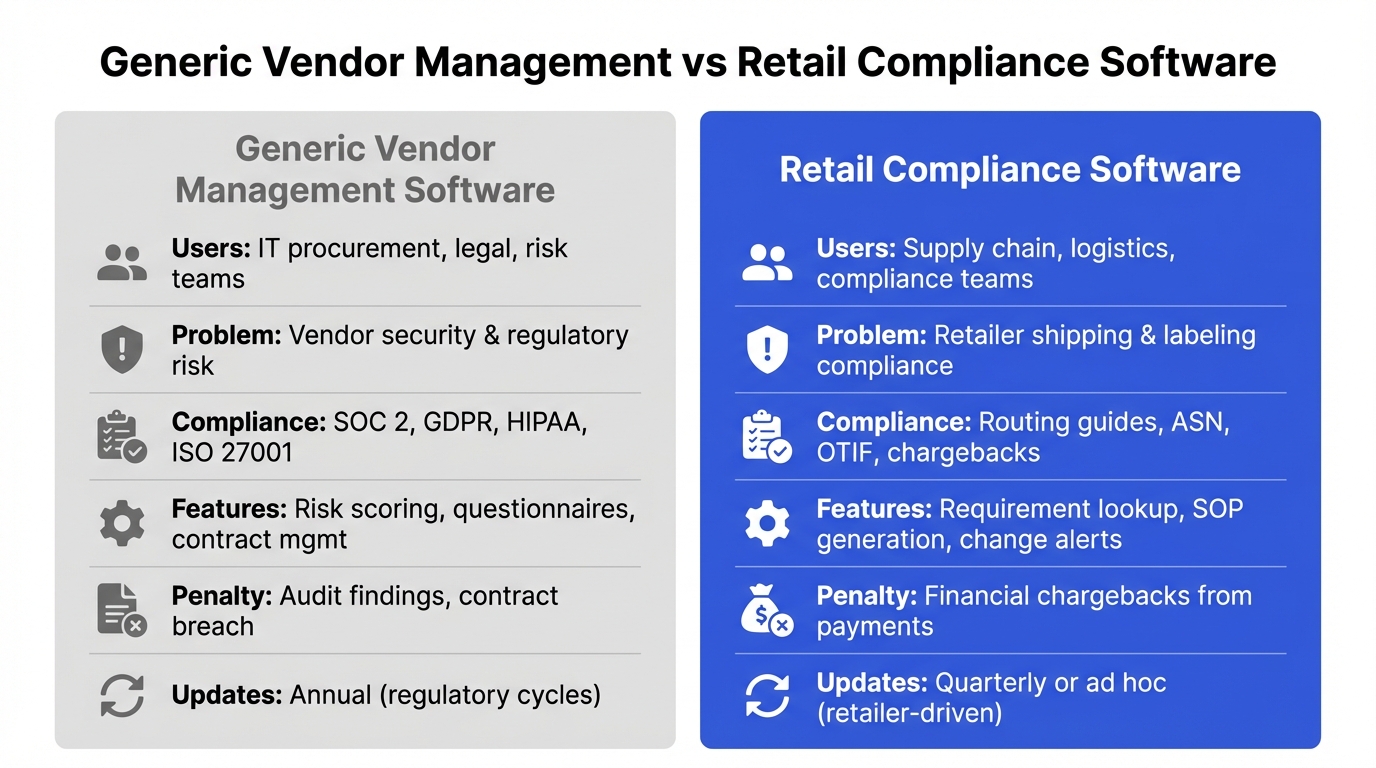
Both categories are legitimate. They just serve different buyers. If your compliance problem is “which vendors have current SOC 2 reports,” you need the generic type. If your problem is “what pallet does Kroger want at their Tolleson DC,” you need a retail-specific tool.
How to Evaluate Vendor Compliance Software
Before committing to a platform, run it through these practical tests. The goal is to separate marketing claims from actual capability.
Ask a retailer-specific question
During the demo, ask something specific: "What's Kroger's penalty for a missing ASN?" If the platform can't answer retailer-specific operational questions, it's a generic vendor management tool, not a retail compliance platform.
Red flag: The answer requires you to upload the routing guide yourself.
Check the retailer coverage list
Ask for the full list of retailers covered. Verify it includes your accounts, not just the top 5, but any regional or specialty retailers you ship to.
Red flag: The vendor says they'll "add your retailers" after you sign up.
Ask how they handle requirement changes
When a retailer updates their routing guide, how quickly does the platform reflect the change? Is it automatic, or does it depend on their team manually updating content?
Red flag: Content is updated "periodically" with no defined SLA.
Try the output on your warehouse team
If the platform generates SOPs or checklists, show one to a dock supervisor. Can they use it without additional context? If the output requires interpretation by a compliance specialist, it hasn't solved the last-mile problem.
Red flag: SOPs are generic templates that require manual customization.
Calculate the total cost of ownership
Some platforms charge per user, per retailer, or per query. Model the cost against your actual usage, because a per-query model can get expensive for teams that need to look things up frequently.
Red flag: Pricing isn't transparent until you're deep into the sales process.
Building a Vendor Compliance Program (With or Without Software)
Software is a tool, not a strategy. Whether you use a platform or manage compliance manually, you need these foundational elements in place:
Inventory your retail accounts and their requirements
List every retailer you ship to. For each, identify the routing guide version, labeling requirements, packaging specs, and penalty structure. This is your compliance baseline.
Assign compliance ownership
Someone needs to own each retail account's compliance. In smaller teams, one person may cover all accounts. In larger orgs, assign by retailer or by compliance domain (transportation, labeling, packaging).
Create retailer-specific SOPs for your warehouse
Translate each retailer's requirements into step-by-step procedures your warehouse team can follow. Include label placement, pallet build patterns, carrier selection, and ASN transmission timing.
Build a change monitoring process
Decide how you'll detect requirement changes. Options: manually check each retailer portal quarterly, subscribe to retailer communications, or use a platform that monitors changes automatically.
Track chargebacks by type and root cause
Log every chargeback with the retailer, category, amount, and root cause. Review monthly to identify patterns. If 60% of your chargebacks are ASN-related, that's where to focus process improvement.
Set up a pre-shipment audit process
Before a shipment leaves your dock, verify: correct carrier, correct labels, ASN transmitted, PO quantities match, packing list included, pallet specs met. A 5-minute check costs far less than a chargeback.
Most vendors start manual and add software as they scale beyond two or three retail accounts. The inflection point is usually when the compliance team starts missing updates or when chargeback costs exceed the cost of a platform.
See how RetailerHub handles vendor compliance
Compliance IQ for instant answers. Version Intel for change alerts. Instant SOPs for warehouse-ready checklists.
The ROI of Vendor Compliance Software
The business case for compliance software is straightforward: it costs less than the chargebacks it prevents. Here’s how to build the ROI model.
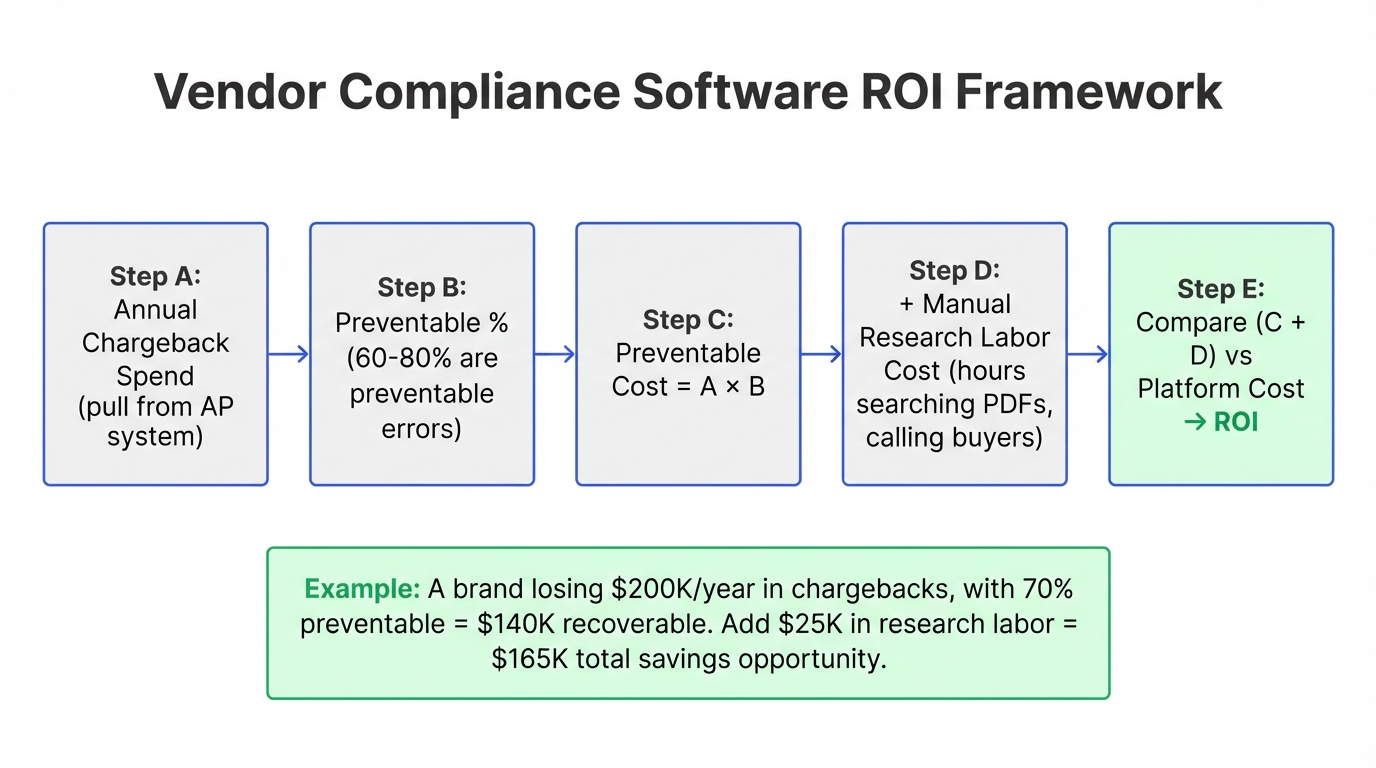
Simple ROI Framework
Calculate your annual chargeback spend across all retailers. Pull this from your AP system or vendor portals.
Estimate how many chargebacks were caused by preventable compliance errors (wrong label, missed requirement change, incorrect carrier). Industry data suggests 60–80% of chargebacks are preventable.
Multiply A × B to get your preventable chargeback cost. This is the ceiling for software ROI.
Add the labor cost of manual compliance research: hours spent searching PDFs, calling buyers, and updating internal docs.
Compare (C + D) against the annual cost of the platform. If the platform costs less than the chargebacks and labor it eliminates, the ROI is positive.
Beyond direct chargeback savings, compliance software reduces the time your team spends on manual research. If a compliance analyst spends 10 hours per week looking up retailer requirements, that’s $25,000+ per year in labor costs that a platform can largely eliminate.
The hardest cost to quantify is the one that matters most: the chargebacks you never received because the software caught the issue before shipment. Prevention is invisible, but your P&L will reflect it.
Vendor Compliance Checklist
Whether you use software or a spreadsheet, every shipment to a major retailer should pass through these compliance checkpoints. Use this as a starting template and customize it for each retail account.
Routing guide version verified as current
Confirm you're working from the latest version of the retailer's routing guide.
Carrier and shipping method match retailer assignment
Use the retailer-assigned carrier and service level. No substitutions without approval.
GS1-128 / SSCC labels printed and verified
Barcode verifier confirms ANSI Grade C or better. SSCC matches ASN.
ASN transmitted before shipment departs
EDI 856 sent with correct carton contents, quantities, and SSCC references.
PO confirmed and quantities match
Verify PO status and match pick quantities to PO line items exactly.
Packing list included in shipment
Lists all carton contents, quantities, and matches the PO.
Pallet specs meet retailer requirements
Correct pallet type, size, weight limit, stacking pattern, and stretch wrap per retailer spec.
Delivery appointment scheduled within window
Appointment confirmed within the retailer's required delivery window.
Packaging meets retailer testing requirements
ISTA certification current, carton strength verified, polybag warnings applied if needed.
All documentation ready (BOL, customs, certificates)
Complete paperwork ready before carrier pickup. Nothing missing at the dock door.
RetailerHub’s Instant SOPs automatically generates retailer-specific checklists like this one, tailored to each account’s current requirements. When a retailer updates their guidelines, the SOPs update too.
Frequently Asked Questions
Stop guessing. Start shipping with confidence.
RetailerHub gives brands and 3PLs instant answers to any retailer compliance question, auto-generated warehouse SOPs, and alerts when requirements change. Built by a former ShipBob Lead WMS Engineer with 10+ years in fulfillment.
Related Guides
Retail Chargebacks Guide
Common types, retailer penalties, and prevention strategies to protect your margins.
Vendor PerformanceVendor Scorecard Guide
Metrics, templates, and how major retailers grade supplier performance.
OperationsWarehouse SOP Template
Build SOPs for receiving, shipping, and quality control at your warehouse.