
Warehouse SOPs: Standard Operating Procedures Template & Best Practices
Last Updated: Mar 21, 2026
A complete guide to warehouse standard operating procedures, covering receiving, picking, shipping, inventory management, and safety SOPs with templates, real-world examples, and retailer-specific requirements from Walmart, Amazon, and Kroger.
This guide contains AI-generated content based on publicly available information and general industry knowledge. Always verify requirements directly with your retail trading partners.
In This Guide
What Is a Warehouse SOP?
A warehouse standard operating procedure (SOP) is a repeatable playbook for a single warehouse process (unloading an inbound trailer, building a retail-compliant pallet, or verifying a pick before it ships) written so that any trained associate can execute it correctly on the first attempt. From dock-door receiving through final carrier loading, SOPs ensure consistent output regardless of who is on shift.
Without SOPs, warehouse operations rely on tribal knowledge, unwritten rules that live in the heads of experienced workers. When those workers call in sick, take vacation, or leave the company, the knowledge walks out the door. SOPs capture that knowledge in a format that can be trained, audited, and improved.
For vendors shipping to major retailers like Walmart, Amazon, and Kroger, warehouse SOPs are especially critical. Each retailer has specific requirements for labeling, palletizing, ASN transmission, appointment scheduling, and documentation. A single missed step can trigger a compliance chargeback that costs hundreds or thousands of dollars.
The retailer-specific data in this guide is based on publicly available retailer compliance information, including requirements published by Walmart, Amazon, and Kroger. This content is for general educational purposes. Always verify current requirements directly with your retail trading partners.
Why Warehouse SOPs Matter
Warehouse SOPs aren’t just documentation for documentation’s sake. They directly impact your bottom line, compliance rate, and ability to scale. Here’s why every warehouse operation needs them.
Reduce compliance chargebacks
Retailers like Walmart, Amazon, and Kroger issue chargebacks for labeling errors, ASN mismatches, and packaging violations. SOPs ensure every shipment meets retailer-specific requirements.
Speed up new hire training
A new warehouse associate can follow a documented SOP on day one. Without SOPs, training depends entirely on shadowing experienced workers, which doesn't scale.
Reduce picking and packing errors
Standardized procedures with verification steps catch mistakes before they leave the warehouse. Each error that reaches a retailer's DC costs significantly more to resolve.
Enable consistent quality across shifts
Day shift and night shift should produce the same quality of work. SOPs eliminate the "we do it differently" problem that causes inconsistent output.
Support continuous improvement
You can't improve what you haven't documented. SOPs provide a baseline that can be measured, audited, and refined over time.
Meet audit and certification requirements
Customer audits, ISO certifications, and retailer qualification processes all require documented procedures. SOPs are table stakes for working with major retailers.
The cost of not having SOPs
Without documented SOPs, error rates for picking and packing typically run 1–3%. With well-implemented SOPs and regular training, best-in-class warehouses achieve error rates below 0.1%. For a warehouse processing 1,000 orders per day, that’s the difference between 10–30 errors and fewer than one.
Warehouse SOP Template: What to Include
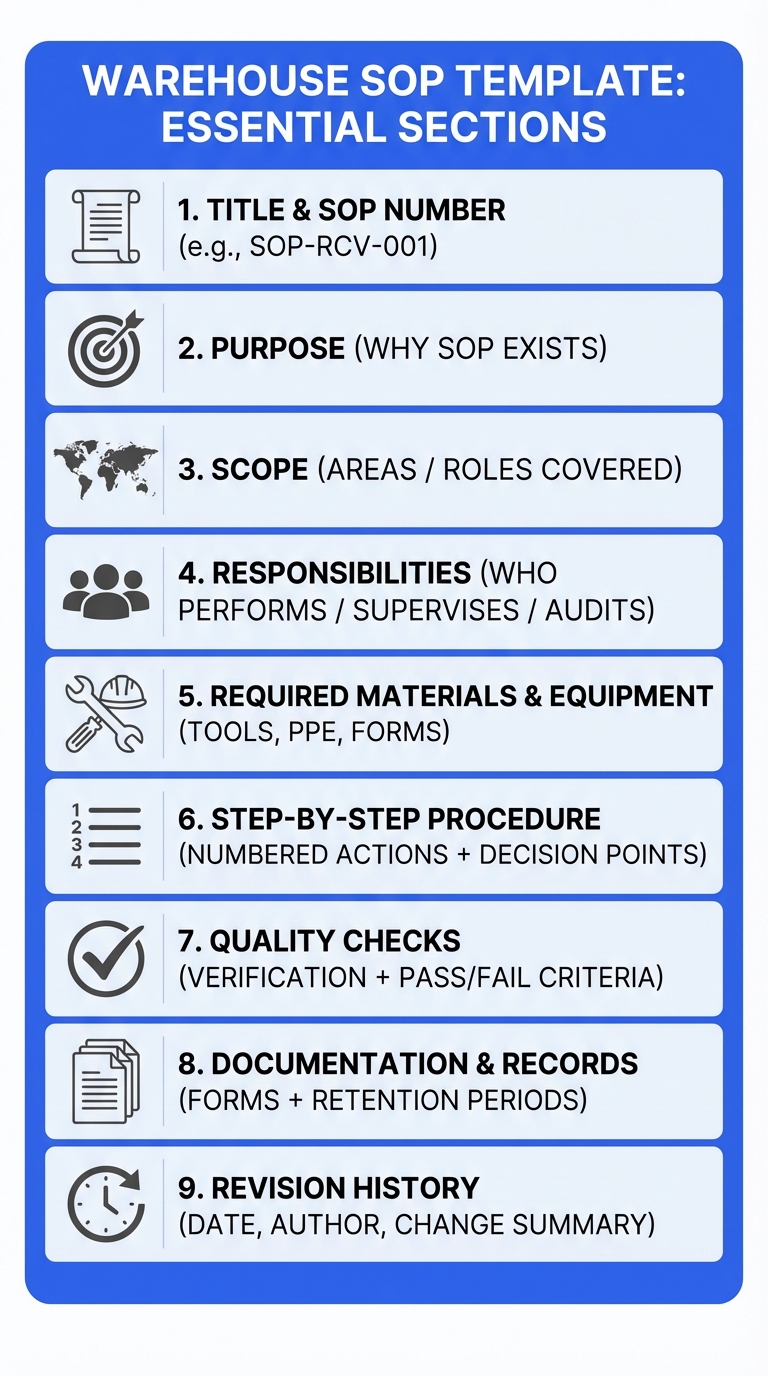
A good warehouse SOP template follows a consistent structure that makes procedures easy to find, read, and follow. Whether you’re writing a receiving SOP, a picking SOP, or a safety SOP, use this template as your starting point.
Standard SOP Template Structure
Title & SOP Number
A clear, descriptive title and a unique identifier (e.g., SOP-RCV-001). The number makes it easy to reference in training materials and audit logs.
Purpose
One or two sentences explaining why this SOP exists and what it aims to achieve.
Scope
Which areas, roles, or processes this SOP covers, and what it doesn't cover.
Responsibilities
Who is responsible for performing, supervising, and auditing this procedure.
Required Materials & Equipment
Tools, PPE, forms, scanners, or supplies needed before starting.
Step-by-Step Procedure
Numbered steps in chronological order. Each step should be a single action. Include decision points ("If X, then Y").
Quality Checks
Verification steps at key points in the process. What to check, acceptable vs. non-acceptable criteria, and what to do if a check fails.
Documentation & Records
What forms or logs to fill out, where to file them, and how long to retain them.
Revision History
Date, author, and summary of each change. This is critical for audit trails and knowing which version your team is working from.
SOP writing best practices
- •Use active voice and imperative mood: "Scan the barcode", not "The barcode should be scanned."
- •One action per step: Don't combine "scan the barcode and place the item in the bin." Make them two steps.
- •Include photos or diagrams for physical tasks like label placement, pallet stacking, or equipment operation.
- •Write for the least experienced person who will perform the task. Don't assume knowledge that hasn't been trained.
- •Test the SOP by having someone unfamiliar with the process follow it. If they get confused, the SOP needs revision.
- •Keep it under 2 pages per procedure. If it's longer, split it into sub-procedures.
Many teams start with a Word document or Google Doc, but SOPs quickly become stale when they live in shared drives. The biggest challenge isn’t writing the SOP. It’s keeping it current when requirements change. RetailerHub’s Instant SOPs feature auto-generates warehouse-ready standard operating procedures based on each retailer’s current requirements, so your team always works from up-to-date instructions.
Skip the template. Get the file.
Build your own warehouse SOP in about two minutes
Answer five short questions and watch the document write itself. Edit anything. Download it as a PDF.
Warehouse Receiving SOP: Step-by-Step Procedures
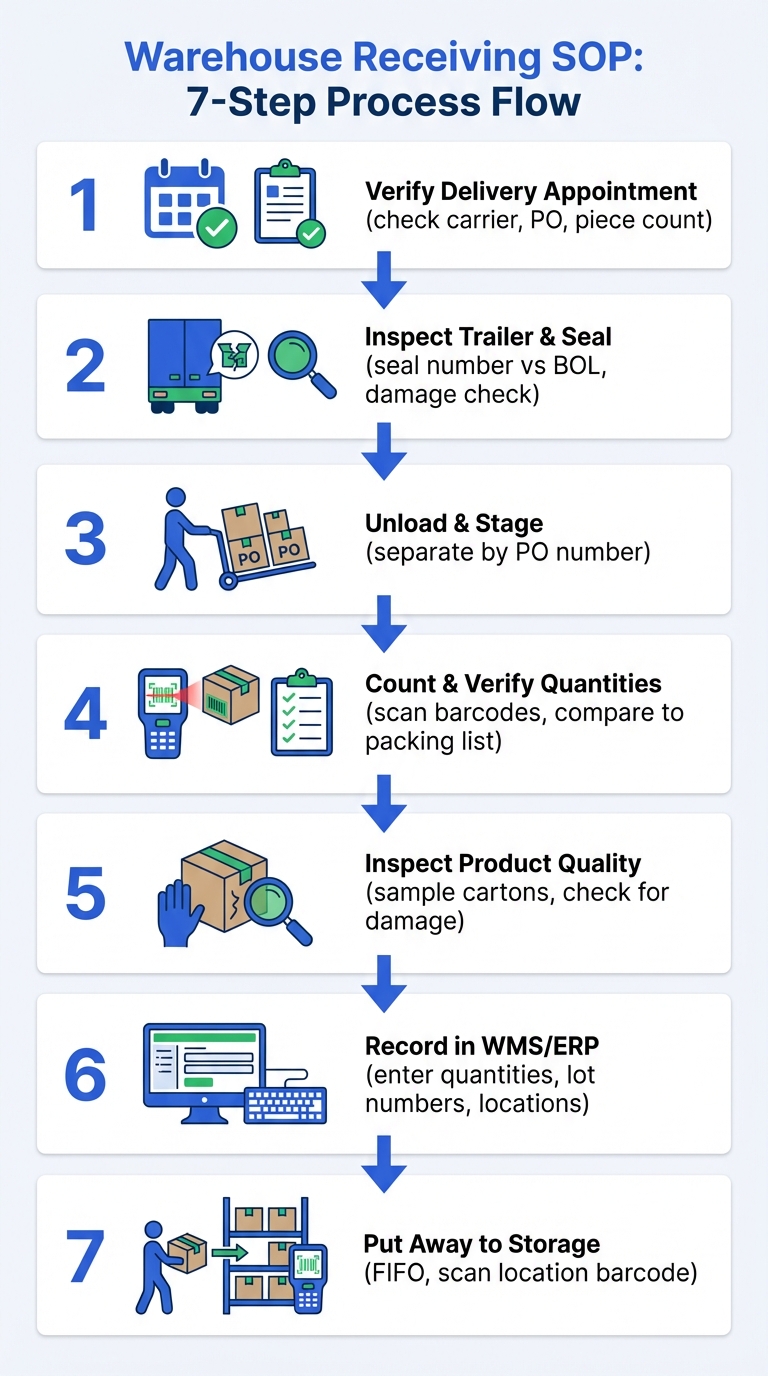
The warehouse receiving process is where errors enter your supply chain. A thorough receiving SOP ensures that inbound shipments are inspected, counted, documented, and put away correctly. Here’s a comprehensive receiving procedure template.
Verify the delivery appointment
Before the truck arrives, confirm the delivery is expected. Check the appointment schedule for the carrier, PO numbers, and expected piece count.
- ✓Carrier name matches appointment
- ✓PO numbers are active and expected today
- ✓Expected quantity is within tolerance
Inspect the trailer and seal
Check the trailer seal number against the bill of lading. Inspect the trailer for damage, odors, pests, or temperature issues (for perishables). If the seal is broken or missing, photograph and document before opening.
- ✓Seal number matches BOL
- ✓No visible damage to trailer exterior
- ✓Temperature recorder check (if applicable)
Unload and stage
Unload pallets or cartons onto the receiving dock staging area. Keep products separated by PO number. Do not mix inbound product with existing inventory or outbound staging.
- ✓Product segregated by PO
- ✓No damage from unloading
- ✓Staging area clear before unloading
Count and verify quantities
Count cartons or units against the packing list and PO. Use barcode scanners to verify item numbers. Document any overages, shortages, or damaged items immediately.
- ✓Carton count matches packing list
- ✓Item numbers match PO
- ✓Damaged items documented and photographed
Inspect product quality
Open a sample of cartons to inspect product condition, labeling, and packaging. Check for damage, incorrect items, missing labels, or expiration date issues.
- ✓Product matches description on PO
- ✓Packaging intact and undamaged
- ✓Expiration dates within acceptable range
Record receipt in WMS/ERP
Enter the received quantities, lot numbers, and locations into your warehouse management system. If quantities differ from the PO, create a discrepancy report and notify purchasing.
- ✓Receipt recorded with correct quantities
- ✓Lot numbers and expiration dates captured
- ✓Discrepancy report filed (if applicable)
Put away to designated locations
Move received product to the assigned storage locations. Scan the location barcode and product barcode to confirm the put-away in the WMS. Follow FIFO rules, so new product goes behind existing stock.
- ✓Product in correct location
- ✓WMS confirms put-away
- ✓FIFO sequence maintained
Receiving SOP checklist
Delivery appointment confirmed
Carrier, PO, and piece count match the schedule.
Trailer seal verified against BOL
Seal number matches. Photograph if broken.
Quantities counted and verified
Match packing list and PO. Document discrepancies.
Product quality inspected
Sample cartons opened. No damage, correct items, valid dates.
Receipt entered in WMS
Correct quantities, lot numbers, and locations recorded.
Product put away to correct locations
FIFO maintained. WMS confirms put-away.
Discrepancy report filed (if needed)
Overages, shortages, or damage reported to purchasing.
Receiving paperwork filed
BOL, packing list, and inspection notes retained per policy.
Retailer-Specific Warehouse SOPs: Walmart, Amazon & Kroger
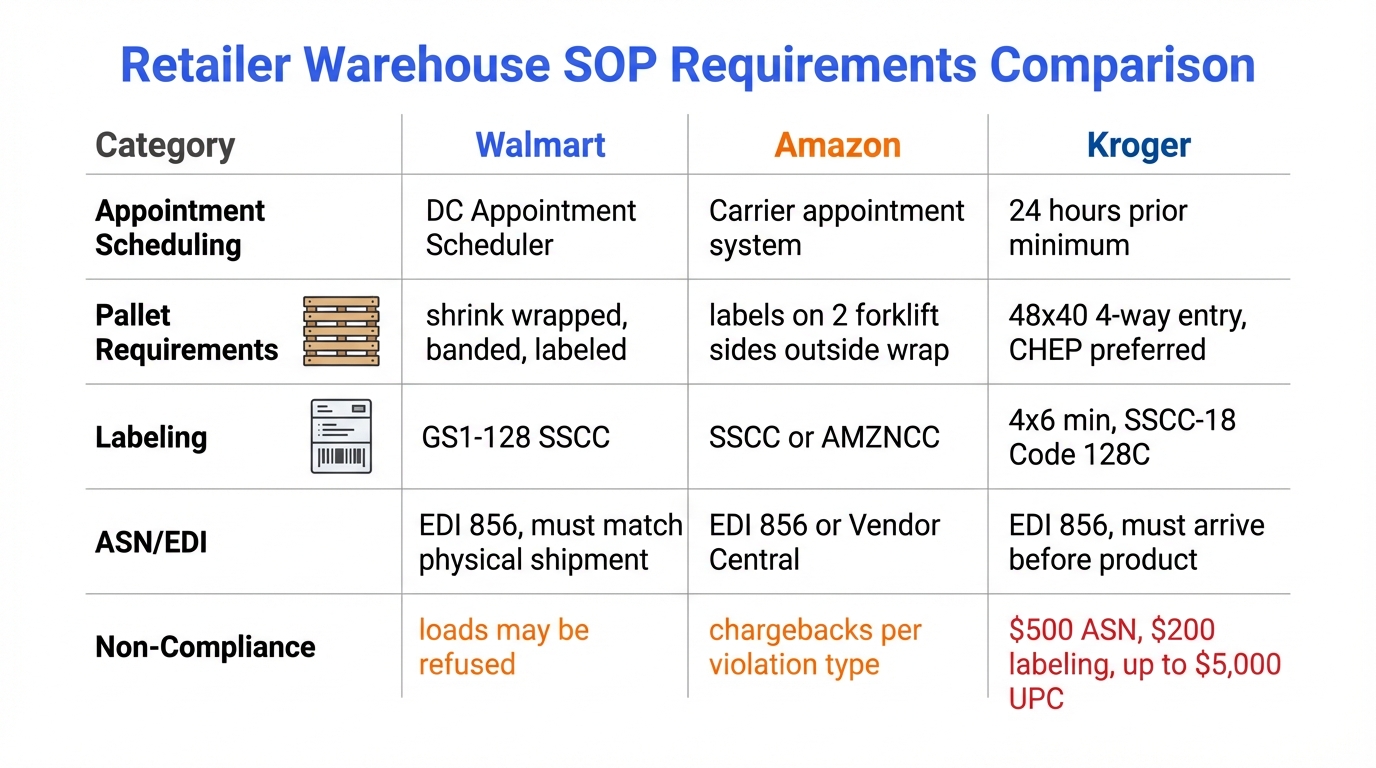
Generic SOPs are a starting point, but vendors shipping to major retailers need procedures that address each retailer’s specific requirements. Here’s what your warehouse SOPs must account for when shipping to the top three.
Walmart
Walmart’s Supply Chain Standards require vendors to follow specific procedures at every stage of the outbound shipping process. Key SOP requirements include:
| Process Area | Walmart Requirement |
|---|---|
| Appointment scheduling | All inbound DC deliveries require a scheduled appointment via DC Appointment Scheduler with accurate SCAC, PO numbers, and case counts |
| Palletization | Multiple POs per pallet allowed with tier sheet separation and MPP (Multi PO Pallet) placard; all pallets must be shrink wrapped and banded with proper labeling |
| ASN / EDI | ASN (EDI 856) must match physical shipment; respond to ASN errors promptly to avoid receipt rejections |
| Shipment confirmation | Collect: confirm by 4:00 PM CST day after order; Prepaid: confirm 72 hours prior to DNSB |
| Non-compliance | Non-compliant loads (labeling, temperature, documentation) may be refused at the DC |
Amazon
Amazon’s fulfillment network has some of the most detailed vendor shipment requirements in retail. Your warehouse SOPs for Amazon shipments must cover:
| Process Area | Amazon Requirement |
|---|---|
| Appointments | No loads accepted without an appointment; schedule via Amazon’s carrier appointment system |
| Carton specs | Min 6"×4"×1", max 36" length (25" width/height); weight 1–50 lbs (40 lbs for jewelry); max 5 POs per carton |
| Labeling | Item labels (UPC/EAN/ASIN), carton labels (SSCC or AMZNCC), pallet labels on two forklift sides outside stretch wrap with PO numbers |
| ASN | EDI 856 (EDI vendors) or Vendor Central submission; ASN must be submitted before goods arrive at the fulfillment center |
| Pre-ship checklist | Verify PO quantities, case pack accuracy, label placement (away from corners/seams), and pallet label visibility |
Kroger
Kroger’s vendor requirements include specific labeling, palletization, and scheduling procedures, backed by a transparent non-compliance fee schedule.
| Process Area | Kroger Requirement |
|---|---|
| Appointments | Schedule minimum 24 hours prior via Kroger’s appointment scheduling system; include PO numbers, case counts, weight, pallet counts, and load type |
| Pallet specs | 48×40 four-way entry pallets required; CHEP block pallets preferred; must meet quality, safety, and sanitation standards |
| Labeling | Min 4"×6" pressure-sensitive labels; SSCC-18 barcode (Code 128C, min 0.8" height); includes vendor name, item number, lot, quantity, MFG/EXP dates |
| EDI / ASN | EDI 856 ASN must be sent when truck leaves the plant; ASN must arrive at Kroger before the product does |
| Non-compliance fees | $200/shipment for ASN errors, $500/shipment for labeling issues, $500–$5,000/item/division for UPC violations |
Each retailer publishes their own compliance guide with requirements that change regularly. The challenge for vendors shipping to multiple retailers is maintaining separate SOPs for each account. RetailerHub’s Compliance IQ lets your team ask questions like “What pallets does Kroger accept?” or “What’s Amazon’s max carton weight?” and get instant, accurate answers: no digging through 100-page PDFs required.
Stop writing SOPs by hand
Need warehouse SOPs for a specific retailer?
RetailerHub’s Instant SOPs auto-generate warehouse-ready standard operating procedures based on each retailer’s current compliance requirements. Your dock team gets a printed checklist for every account. Always up to date, no manual maintenance.
Warehouse Picking & Packing SOP
Picking and packing are the highest-volume activities in most warehouses and the most common source of errors. A well-structured warehouse picking SOP reduces mispicks, speeds throughput, and ensures retailer-specific packaging requirements are met.
Picking methods
| Method | How It Works | Best For |
|---|---|---|
| Single-order picking | One picker fulfills one order at a time, walking the warehouse to collect all items. | Low-volume operations, high-value items, orders with few line items. |
| Batch picking | One picker collects items for multiple orders simultaneously, then sorts them at a packing station. | Medium-volume operations with overlapping SKUs across orders. |
| Zone picking | Each picker is assigned a zone. Orders are passed zone to zone until complete. | Large warehouses with high volume and many SKUs. |
| Wave picking | Orders are grouped into waves by carrier, delivery window, or priority. All orders in a wave are picked simultaneously. | Retail compliance operations with tight delivery windows and carrier scheduling. |
Packing SOP steps
Verify pick accuracy
Scan each item against the pick list. Confirm SKU, quantity, and lot number. Reject any items that don't match.
Select correct packaging
Use retailer-specified carton sizes if applicable. Amazon requires cartons between 6"×4"×1" and 36" max length (25" width/height). Avoid oversized packaging that wastes dunnage and increases shipping costs.
Apply inner packaging and dunnage
Use approved cushioning materials to prevent damage. Items should not shift inside the carton during transit.
Apply carton labels
Affix the correct carton content label (GS1-128 SSCC, AMZNCC, or retailer-specific). Labels go on the designated face, away from corners, seams, and tape.
Seal and weigh
Tape the carton securely. Weigh the packed carton and compare to the expected weight. A significant variance indicates a pick error.
Stage for shipping
Move packed cartons to the shipping staging area, organized by retailer, carrier, and delivery appointment.
Warehouse Shipping SOP
The warehouse shipping SOP covers everything that happens between a packed order and the carrier pulling away from the dock. This is your last quality gate before a shipment reaches the retailer’s distribution center, and your last chance to catch errors before they become chargebacks.
Build and verify pallets
Stack cartons on the correct pallet type (48×40 GMA for most retailers, CHEP preferred for Kroger). Ensure single-PO pallets where required. Apply stretch wrap and banding per retailer specs.
Apply pallet labels
Affix pallet labels on two forklift-accessible sides, outside the stretch wrap. Include PO numbers, BOL number, pallet count, and SSCC-18 barcode where required.
Generate and transmit ASN
Create the EDI 856 ASN with accurate carton contents, quantities, and SSCC references. Transmit before the shipment departs. For Kroger, the ASN must arrive before the product does.
Prepare shipping documentation
Print the bill of lading (BOL) with carrier, PO numbers, piece count, weight, and destination. Include packing lists in or on the shipment. Prepare customs documentation for import shipments.
Schedule the delivery appointment
Book the appointment using the retailer's scheduling system (DC Appointment Scheduler for Walmart, Carrier Portal for Amazon, Kroger Transportation Center for Kroger). Include accurate load details.
Load and seal the trailer
Load pallets per the load plan. Apply a new seal and record the seal number on the BOL. Photograph the loaded trailer and sealed door for dispute documentation.
Confirm the shipment
Mark the shipment as shipped in your WMS/ERP. For Walmart collect shipments, confirm by 4:00 PM CST the day after the order. For Walmart prepaid, confirm 72 hours prior to DNSB.
Pre-shipment compliance audit
Before any shipment leaves your dock, run through a compliance audit specific to the destination retailer. Verify the correct carrier, label format (GS1-128 vs. AMZNCC vs. retailer-specific), pallet specs, and documentation requirements. A 5-minute audit at the dock door costs far less than a chargeback.
Inventory Management SOP
Accurate inventory is the foundation of every other warehouse SOP. If your inventory counts are wrong, your picks will be wrong, your ASNs will be wrong, and your retailer compliance will suffer. Here are the key procedures to maintain inventory accuracy.
Cycle counting
Count a subset of inventory locations each day on a rotating schedule. Focus on high-velocity SKUs and locations with recent discrepancies. Cycle counts catch errors before they compound into ASN mismatches or short shipments.
Frequency: Daily, with each location counted at least once per quarter
FIFO enforcement
First-In, First-Out ensures older inventory ships before newer inventory. Critical for perishables and products with expiration dates. Your receiving SOP should place new stock behind existing stock, and your picking SOP should pull from the front.
Frequency: Every receipt and every pick
Location management
Every item must have a defined home location in the WMS. When you move product (for replenishment, consolidation, or re-slotting), scan the "from" and "to" locations to keep the WMS accurate. Phantom inventory, meaning items the WMS thinks are somewhere they're not, is the #1 cause of mispicks.
Frequency: Continuous, and every product movement must be scanned
Damaged and expired product handling
Isolate damaged or expired product in a quarantine area immediately. Update the WMS to reflect the quarantine status so the product isn't picked for orders. Document the reason and disposition (return to vendor, destroy, donate).
Frequency: As encountered, processed within 24 hours
Annual physical inventory
A full wall-to-wall count of every item in the warehouse. Operations typically shut down during the count. Reconcile all variances and adjust the WMS. Use the results to identify systemic accuracy issues.
Frequency: Annually (or semi-annually for high-value inventory)
Inventory accuracy directly impacts ASN accuracy. Retailers like Walmart and Amazon match the ASN against the physical shipment at receiving. If your inventory counts are off, your ASN will declare the wrong quantities, triggering a chargeback even if you shipped the right product.
Warehouse Safety SOP
Warehouse safety SOPs protect your team and your business. OSHA requires documented safety procedures for warehouses, and non-compliance can result in fines of $16,550 per violation (up to $165,514 for willful violations). Beyond regulatory compliance, safety SOPs reduce worker injuries, insurance costs, and downtime.
Essential safety procedures
Forklift operation
Only trained, certified operators may use forklifts. Daily pre-shift inspection required. Speed limits in aisles and near pedestrian areas. Horns at intersections. No riders on forks.
Personal protective equipment (PPE)
Steel-toed shoes required in all warehouse areas. Hi-vis vests in loading dock and forklift zones. Gloves for handling chemicals or sharp materials. Hard hats in areas with overhead racking.
Hazardous material handling
Follow SDS (Safety Data Sheet) procedures for all hazmat. Proper labeling, storage, and spill containment required. Annual hazmat training for all associates who handle these materials.
Loading dock safety
Wheel chocks on all trailers during loading/unloading. Dock locks engaged before entering trailers. Dock plates inspected before use. No pedestrian traffic on active docks.
Housekeeping and aisle maintenance
Aisles must be clear of debris, spills, and obstructions at all times. Clean-as-you-go policy. Spills cleaned immediately with appropriate materials. End-of-shift walkthrough by team lead.
Racking inspection
Monthly visual inspection of all pallet racking for damage, leaning, missing safety clips, or overloaded beams. Tag damaged uprights immediately and remove from service until repaired. Annual third-party racking audit recommended.
Battery charging and propane handling
Designated charging area with ventilation, eye wash station, and spill kit. No smoking within 25 feet. Propane tank exchanges only in outdoor or well-ventilated areas. Only trained associates may change tanks.
Emergency procedures
Posted evacuation routes at every exit. Fire extinguisher locations marked and inspected monthly. First aid kits stocked and accessible. Annual fire drill and emergency response training.
Safety SOPs should be reviewed quarterly and updated whenever there’s an incident, a near-miss, or a change in equipment or layout. Post safety SOPs at the relevant workstation, not buried in a binder that nobody opens.
How to Implement Warehouse SOPs
Writing SOPs is only half the battle. The other half is getting your team to actually follow them. Here’s a proven implementation process.
Start with your highest-risk processes
Don't try to write 50 SOPs at once. Start with the processes that cause the most errors, chargebacks, or safety incidents. For most retail vendors, that's receiving, labeling, and shipping.
Shadow-walk the process before you write
Don't write SOPs from a desk. Shadow an associate performing the task, take notes at each step, and record the decision points they navigate instinctively. Then draft the SOP from your observations and have the associate review it for accuracy. SOPs written in a conference room always miss the workarounds that keep the dock running.
Train with a buddy system, then enforce
Pair each associate with an SOP buddy who has already been trained on the procedure. The buddy walks them through it live, answers questions, and signs off when they can execute it solo. Allow a 2-week adoption period before holding associates accountable to the new procedure.
Post SOPs at the workstation
A laminated one-page version of the SOP should be posted where the work happens: at the receiving dock, the packing station, the shipping lane. If associates have to walk to a computer to look up the procedure, they won't.
Run compliance spot-checks tied to chargebacks
Pick one SOP per week and have a supervisor silently observe 3-5 associates performing it. Score each observation against the SOP steps and log the results. Correlate SOP compliance scores with your chargeback data. If labeling chargebacks spike, audit the labeling SOP adherence first.
Update when things change
SOPs must be living documents. When a retailer changes their requirements, when you add new equipment, or when an audit reveals a gap, update the SOP immediately. Stale SOPs are worse than no SOPs, because they give a false sense of compliance.
Automate your SOP creation
Keeping SOPs updated across multiple retailer accounts?
RetailerHub’s Version Intel detects when a retailer changes their compliance requirements and alerts your team. Combined with Instant SOPs, your warehouse procedures stay current without manual maintenance.
Warehouse SOP Examples by Department
Here are practical warehouse SOP examples organized by department. Each example shows the level of detail your SOPs should include.
Inbound Receiving for Retail Vendors
Receiving Department
1.Check appointment schedule for expected deliveries. Verify carrier name, PO numbers, and expected piece count.
2.Inspect trailer seal against BOL. If seal is broken or missing, photograph before opening and notify receiving manager.
3.Unload pallets to receiving staging area. Keep products separated by PO number.
4.Scan each carton barcode. Count pieces and compare to packing list.
5.Open sample cartons (1 per 10 or per PO). Inspect for damage, correct product, and valid expiration dates.
6.Enter received quantities in WMS. Flag discrepancies for purchasing review.
7.Move product to assigned put-away locations. Scan location barcode to confirm.
8.File BOL, packing list, and inspection notes in daily receiving folder.
GS1-128 Label Application for Walmart Shipments
Shipping Department
1.Print GS1-128 SSCC labels from WMS/label printer. Verify print quality, because the barcode must be scannable.
2.Verify SSCC number on label matches the ASN record for this carton.
3.Apply label left of center on the longest side of the carton. Bottom of barcode must be at least 1.25" from the bottom and 0.75" from the right edge.
4.Do not apply label over seams, tape, or corrugation flaps.
5.Scan the printed label with a barcode verifier. Confirm ANSI Grade B or better for print-and-apply labels (Grade C for direct print on corrugated).
6.If label fails verification, reprint and reapply. Do not ship with an unverified label.
7.Log the SSCC and carton contents in the shipment record.
Daily Cycle Count
Inventory Control
1.Print cycle count list from WMS for today's scheduled locations.
2.Go to the first location. Do not look at the expected quantity.
3.Count all items in the location. Count twice if the quantity is large.
4.Enter the counted quantity in the WMS or on the cycle count sheet.
5.If the count matches the WMS, move to the next location.
6.If the count does not match, recount. If the discrepancy persists, flag for investigation.
7.After completing all locations, submit the count. Review discrepancies with the inventory manager.
8.Investigate root causes for any discrepancies over 2% variance.
Frequently Asked Questions
Generate retailer-specific SOPs in seconds
Brands and 3PLs use RetailerHub to auto-generate warehouse-ready SOPs, answer any retailer compliance question instantly, and get alerted when requirements change. Built by a former ShipBob Lead WMS Engineer with 10+ years in fulfillment.
Related Guides
What is an ASN?
Complete guide to advance shipment notifications, EDI 856, and SSCC labels.
ComplianceRetail Chargebacks Guide
Common chargeback types, retailer penalties, and prevention strategies.
Labeling & BarcodesGS1-128 Shipping Labels
Everything about GS1-128 barcodes, SSCC-18, and retailer label requirements.